
A Long Way To Go
Forget gay marriage. In India, the constitutional debate is stuck at the lowest rung.
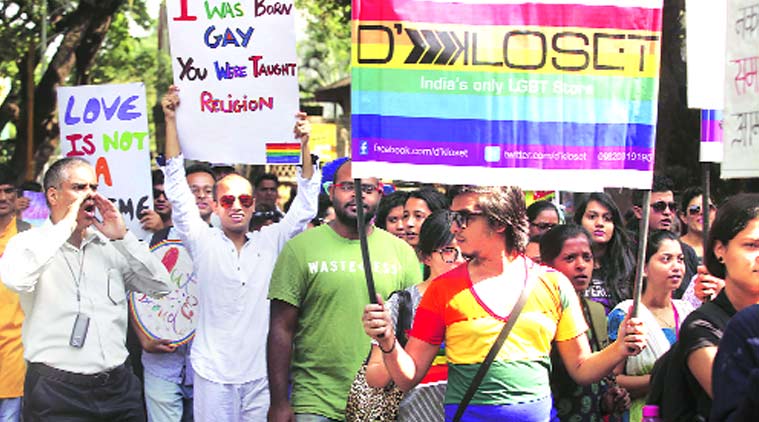 The US decision takes us forward, but India still has a huge distance to go to prevent cruelty to its LGBTQ population.
Had Barack Obama not been elected president and appointed Justices S. Sotomayor and E. Kagan to join Bill Clinton appointees R.B. Ginsburg and S. Breyer, the court’s gay marriage decision might have gone the other way. Within America, Ronald Reagan appointee Justice A. Kennedy’s majority (5-4) decision has won support. This is not to suggest that all Americans have accepted the judgment. Governor Scott Walker (Wisconsin) wants a legislative reversal by defining marriage as between a man and a woman. Within the court, the dissenting Republican appointees dubbed the decision a constitutional usurpation of the rights of the people and Congress. This only goes to show that the composition of the bench matters. In India, had the Naz case been assigned to judges other than Justices G.S. Singhvi and S.J. Mukhopadhaya (as, for example, Justices A. Kabir and S.S. Nijjar), the decision could have gone the other way. Such is the fragility of chance-based justice. Surely, our case should have gone to a larger bench. It is precisely this that makes the Indian SC’s justice fragile.
The issues in the Indian and the US cases were different. In Naz, the SC recriminalised homosexuality. But the US decision assumed that lesbian and gay relations are valid and constitutionally protected. The issue was whether same-sex marriage was constitutional. The US decision is grounded on five assumptions: one, the importance of protecting personal choices central to individual dignity; two, recognising the right to choose a partner to marry and have a family and children; three, the equal right to marry between consenting adults under the 14th amendment (equality clause); four, grounding the right to marry as part of liberty; and five, treating this as a matter of constitutional jurisprudence, independent of legislative solutions. This boils down to two principles: liberty, choice and individual autonomy, which justify same-sex intimate relations; and equal treatment for all marriages. While realising that ancient texts may have regarded marriage as being between men and women, Justice Kennedy treats marriage as an evolving institution and shows that same-sex intimacy is now medically seen as “both a normal expression of human sexuality and immutable”. If we start with the latter premise, the rest of the judgment falls into place nicely. Having crossed the threshold of legitimising same-sex intimacy, the next step to protect all marriages (including, perforce, same-sex marriages) follows logically. This is why the judgment is prolix on the question of marriage and equal treatment.

To obviate the charge of judicial intrusion into the legislative field, the majority judgment treats the issues before it as constitutional ones, declaring that in the wake of so many referenda, debates, grassroots campaigns, studies, papers, books and writings, it was not necessary to wait for legislation. This is to refute the charge of judicial activism — somewhat grandiloquently made by Justice A. Scalia and acerbically by Justices J. Roberts, S. Alito and C. Thomas. The judgment is certainly judicially activist within the constitutional framework, but not outrageously extravagant so as to “vilify Americans who are unwilling to assent to the new orthodoxy” (Alito).
In India, the constitutional debate is stuck at the lowest rung. Justice Singhvi’s judgment relies on English history from 1290, but ignores the decriminalisation of homosexuality in 1967. He accepts privacy as being part of the right to liberty but cannot accept protecting the choices of consenting adults. He assumes that the use of Section 377 has been minimal, with only 200 cases in over 150 years, ignoring that LGBTQs are harassed everyday — including by the police.
Ultimately, the Indian argument is founded on the assumption that sexual activity amongst persons of the same sex is immoral, unnatural and against the public interest. But constitutionally, the concept of public interest is wider than echoing people’s prejudice. It must take people as they are and treat their chosen relationships as protectable private interests. Otherwise, constitutional protections are pointless.
The US decision takes us forward, but India still has a huge distance to go to prevent cruelty to its LGBTQ population.
The writer is a senior advocate at the Supreme Court.
 Share


