6 min readNov 12, 2022 09:26 AM IST
First published on: Nov 12, 2022 at 04:15 AM IST
“Like old clocks, our judicial institutions need to be oiled, wound up and set to true time” (Lord Harry Woolf: Lord Chief Justice of England and Wales, June 2000-October 2005)
The reach of India’s highest court is all-pervasive. The Supreme Court sits in final judgment over decisions not only of the high courts in the states (there are 18 high courts for 28 states and eight Union Territories), but also over a hundred tribunals, central and state, functioning throughout India. And the law declared by the Supreme Court, its pronouncements on the constitutional validity of enacted law, including constitutional amendments, is binding on all other courts and authorities in the country (Article 141). There is virtually no area of legislative or executive activity which is beyond the highest court’s scrutiny.

Empowering itself with the trappings of modern technology, India’s Supreme Court has been striving to perform its arduous task. But what of the future? First, and foremost, the judiciary as an institution needs to preserve its independence, and to do this it must strive to maintain the confidence of the public in the established courts. The independence of judges is best safeguarded by the judges themselves — through institutions and organisations that the law empowers them to set up, to preserve the image of an incorruptible higher judiciary that would command the respect of all right-thinking people.
In the United States, under the Judicial Councils Act, 1980, this task has been gladly undertaken by the judges. But regrettably, so far, there is no law in India to guide our judges — only “guidelines”. There is a felt need for a law. The 1980 US Act confers powers on bodies comprised of judges to take such action against a federal judge “as is appropriate, short of removal.” Under this law, some time ago, a committee of fellow judges had investigated complaints against a federal district judge, John McBryde; the Judicial Council reprimanded him and suspended him from hearing new cases for a year. McBryde challenged the decision. He argued that the 1980 law violated the judicial independence which the US Constitution had guaranteed to life-tenured federal judges; he said that it also interfered with the mechanism of Congressional impeachment that the US Constitution had established for removing judges. A one-year suspension from hearing new cases, he argued, was nothing but a “temporary impeachment”. But a US Court of Appeals rejected all these pleas, and a petition for certiorari against its decision was denied by the US Supreme Court: It accepted the argument of the US Solicitor-General that judicial independence, protected by Article III of the US Constitution, was meant “to insulate judges from interference from other branches of government — not from oversight by other judges”. An American judge once famously said about the judiciary that “some things will sometimes go wrong”. In India, in the past and in recent times, some things have gone wrong. And citizens need the reassurance of a system of judicial accountability — a remedial mechanism which will protect the higher judiciary from some of its own members who have gone astray. Such reassurance can only be provided by enacting a law on the lines of the American model.
Other aspects of judicial reform are not lacking for want of ideas. We have been overwhelmed with innumerable reports of Law Commissions, more than 200 of them, on all aspects of judicial governance. And a bench of three justices of the Supreme Court, in a judgment delivered in August 2005, had drawn up a fine blueprint on case-management, on how to make recent amendments in our procedural laws work on the ground, and how to get more cases moving along: For instance, on three different tracks — fast track, normal track and slow track. In the Salem Advocate Bar Association case, the justices had requested the high courts to implement the detailed blueprint – most of them have not; they could not direct the high courts to do so because under our constitutional scheme the latter are autonomous constitutional bodies not subject to administrative directions of the Supreme Court. It is in the high courts that there are now left the largest number of roadblocks and delays; in their administrative functioning the high courts are answerable to no one but themselves.
This often enables the Supreme Court to plead helplessness, hardly a good augury for integrated court-management. It is time that the Supreme Court be entrusted with direct responsibility for the functioning of the high courts: Only then can the highest court be an effective apex court, only then can the Supreme Court be made answerable, as it should be, for judicial governance for the entire country.
And judicial governance means that all judges who are constitutionally entrusted with the responsibility of protecting the rights of citizens must also be seen to be persons of rectitude. They must make annual financial disclosure statements, not privately to their respective chief justices, but publicly. It is done by justices of the Supreme Court in the world’s oldest democracy, the US, and it is appropriate that all such disclosure statements of its judges be made and then also published in the world’s most populous democracy, India.
Judges must set an example for ministers, central and state, for members of Parliament and of state legislatures, and for all high officials of government, to follow. As stated in the Annie Besant translation of the Third Discourse in the Bhagavad Gita: “Whatsoever a great man doeth, that other men also do; the standard he setteth up, by that the people go”.
The writer is a constitutional jurist and senior advocate to the Supreme Court

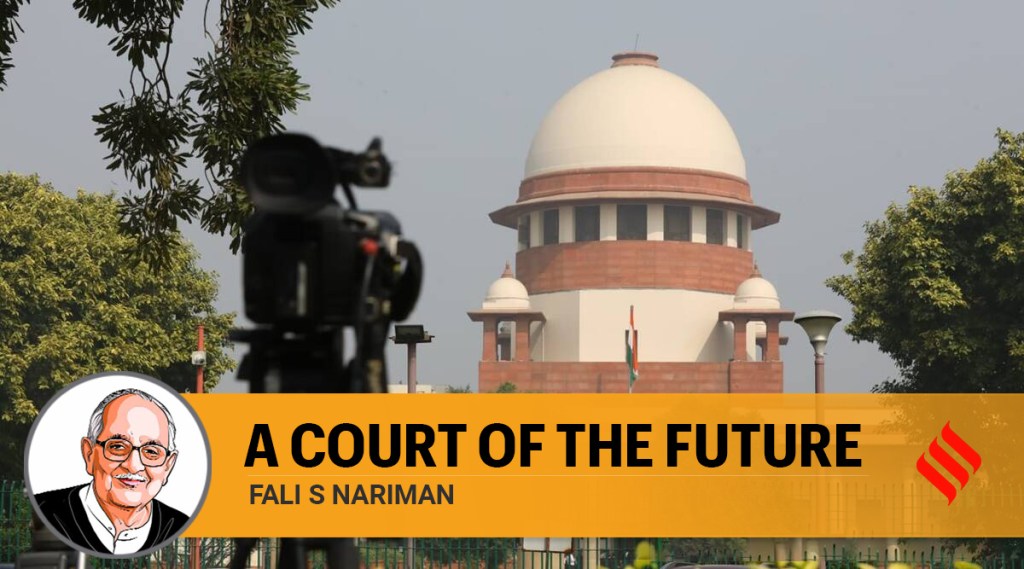 Empowering itself with the trappings of modern technology, India’s Supreme Court has been striving to perform its arduous task. (Express Photo)


 Share


