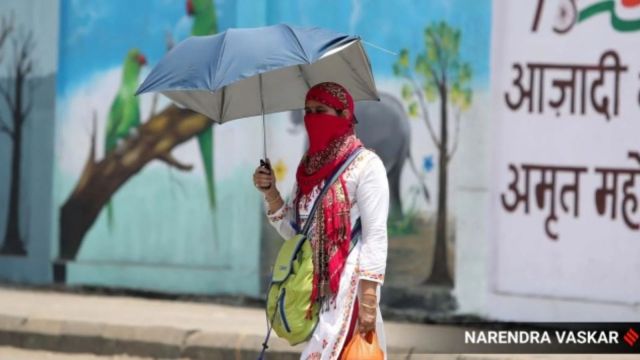
Staggered work hours; mandatory rest breaks; water booths at work sites – these are part of standard operating procedure (SOP) for the outdoor informal works released by the Maharashtra government on Monday, amid rising heat risk across urban centres.
Released by disaster management minister Girish Mahajan, the advisory directs employers to reschedule outdoor work to cooler windows – 6 am to 11 am and 4 pm to 8 pm – and enforce mandatory rest breaks between 12 pm and 4 pm during orange and red heat alerts. The norms apply across construction, industrial and street vending sectors, with additional provisions to ensure women’s safety through adequate lighting, transport and protective facilities.


The move comes as Maharashtra figures among India’s 10 most heat-vulnerable states and Union Territories. The SOP operationalises existing national and state frameworks, including guidelines from the National Disaster Management Authority (NDMA), the Maharashtra State Heat Action Plan and the State Action Plan on Climate Change and Human Health.
Fifteen districts — largely in Vidarbha, Marathwada and Khandesh — have been identified as highly vulnerable to extreme heat: Latur, Amravati, Yavatmal, Washim, Akola, Buldhana, Nagpur, Wardha, Chandrapur, Gondia, Bhandara, Jalgaon, Nandurbar, Dhule and Nanded. The SOP will be operational across municipal corporations, councils and nagar panchayats in these high-risk urban areas.
Mahajan also announced a Rs 184-crore Centre of Excellence in Nagpur to drive research and training on extreme heat and sustainable cooling.
The SOP mandates installation of water booths at key informal work sites — markets, junctions, transit hubs and vending zones — with clear signage and regular refilling. Distribution of oral rehydration salts (ORS) and electrolyte sachets through primary health centres, ward offices and NGOs has been made compulsory.
Urban local bodies have been directed to keep parks and gardens open during peak afternoon hours, create temporary shaded zones at labour nakas and traffic junctions, and, in emergencies, convert public buildings into cooling shelters equipped with fans, drinking water and resting mats.
Health systems have been asked to step up preparedness, including stocking ORS, IV fluids and heat illness kits at primary and urban health centres.
ASHA workers and ward-level staff will be trained to identify and respond to heat-related illnesses, while 108 ambulances will be pre-positioned in vulnerable zones, with response times monitored during high-risk days.
The SOP also pushes for heat-resilient urban design — shaded public spaces, tree plantation, reflective materials and misting systems along with upgrades in dense work zones through permanent shade, cool roofs and water access. Employers and market associations may be incentivised to install cooling infrastructure.
To cushion workers from heat-related risks, the state has recommended expanding access to Ayushman Bharat or equivalent health insurance, exploring compensation for wage loss due to heat stress, and strengthening welfare boards to provide emergency relief, periodic health screening and financial support.
The advisory also calls for widespread heat-safety training through labour boards, unions and cooperatives, and proposes a dedicated helpline to support workers during extreme heat events.