


If one went to the United Arab Emirates in the early 2000s, the Indian community in the Gulf country struck one as a silent, invisible force. They were everywhere, but you had to look for them. At Indian eateries and grocery stores, working as boatmen or porters, as sales force at dozens of Carrefour stores, around the small Shiva temple complex in Bur Dubai’s old souk, or at community events.
Twenty years hence, things have changed drastically.

The Shiva temple, unable to handle the numbers, has shifted to a larger location in Jebel Ali, off Dubai; there is a BAPS Hindu Mandir now in Abu Dhabi – the UAE capital known for its Grand Mosque – while the number of Indian migrants in the UAE has jumped from roughly 0.97 million then to about 3.56 million now.
This makes Indians (NRIs and PIOs included) the largest expatriate group in the UAE, accounting for one-third of its migrant population, followed by Pakistanis, Filipinos and Egyptians. At 3.3 million, Indians make up as much as 35% of the country’s population.
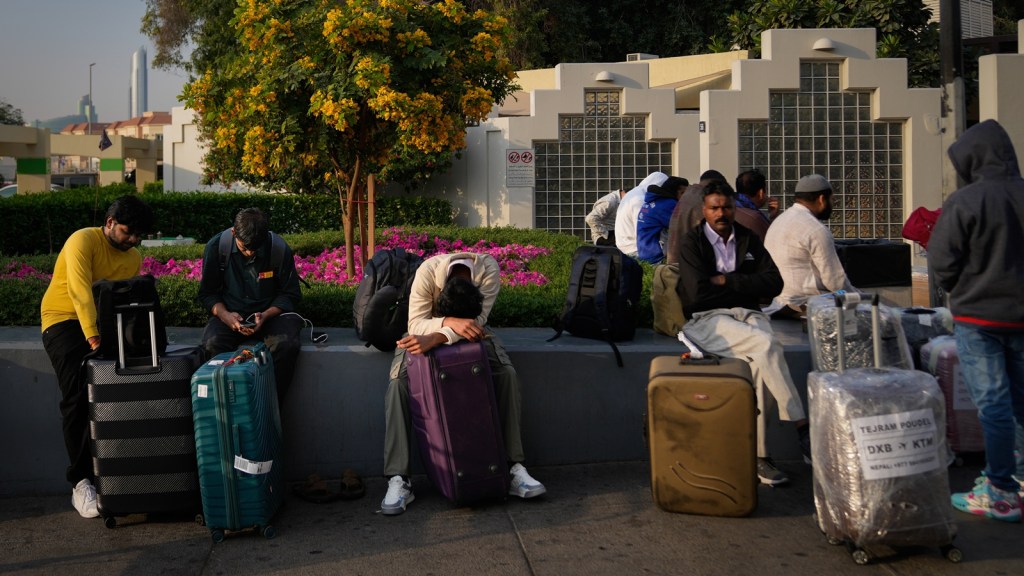
 Passengers arrive at IGI Airport on Tuesday. (Express photo by Gajendra Yadav)
Saudi Arabia, with 2.46 million (7% of its population), accounts for the next biggest group of Indians in the Gulf. At 1 million, Indians make up the largest migrant group in Kuwait as well, constituting 21% of the population.
Indians are also present in large numbers across six other countries of the Gulf — Qatar, Bahrain and Oman — for a total of more than 8.8 million.

As the repercussions of the US-Israeli strikes on Iran spread across the Gulf region, these numbers are among those directly impacted.
On Monday, the Indian government referred to the same in a statement on the situation. “There are almost one crore Indian citizens who live and work in the Gulf region. Their safety and well-being is of utmost priority. We cannot be impervious to any development that negatively affects them,” it said.
 Indian expatriates returning from Abu Dhabi arrive at the Indira Gandhi International Airport, in New Delhi, Monday, March 2, 2026. (Express Photo By Amit Mehra)
The ‘sense of security’
Speaking to The Indian Express recently, a senior Indian diplomat who has served in the UAE attributed the surge of Indian migrants to the “security and stability” provided by the country. “Indians are happy working there as professionals or doing business. It has a vibrant and diverse community, with people from every state of India.”
The ones who are panicking are not NRIs but Indian tourists or businessmen on short trips, who have been caught unawares and want to return home, says owner of a travel agency who has been in Dubai for 30 years
And it’s not just India. As per the International Migrant Stock, a dataset released by the Population Division of the UN Department of Economic and Social Affairs or DESA, the UAE hosted the fifth largest number of international migrants in the world in 2019.
The volume of migration happening in the India-UAE and India-Saudi Arabia corridors is considered one of the largest migratory streams in the world.

In 2012, the UAE was the top source of remittances for India — at $14,255 million, even overtaking US at $10,844 million — followed by Saudi Arabia ($7,621 million), Kuwait ($2,673 million), Oman ($2,373 million), Qatar ($2,084 million) and Bahrain ($690 million).
Together, remittances from the Gulf accounted for 43.5% of the total remittances received by India in 2012 — $30 billion of $69 billion. India in turn accounted for approximately 50% of the total remittances from the Gulf region.
From US $180 million annually in the 1970s, trade with the UAE reached its highest level of US $100.06 billion in 2024-25. Today, UAE is India’s third-largest trading partner and second largest export destination
With Gulf countries not permitting permanent settlement or change in the legal status that permits entry in the first place, migrants mostly remit savings back home.
In November 2021, Narendra Modi became the first Indian Prime Minister to visit the UAE in 34 years, and met Indian migrant workers at the ICAD Residential City in Abu Dhabi, which is home to thousands.
Since then, as per the Indian Embassy in Abu Dhabi, Modi has visited the UAE seven times, the last time in February 2024.
 Indian expatriates returning from Abu Dhabi arrive at the Indira Gandhi International Airport, in New Delhi, Monday, March 2, 2026. (Express Photo By Amit Mehra)
Concern, but no panic
In the wake of the latest Gulf crisis, residents say that while there is some fear, there is no panic.
Speaking to The Indian Express over the phone, Avinash Adnani, 53, who runs a travel agency called Neo Travels and has been in Dubai for 30 years, points out that he is sitting at a mall drinking coffee. The ones who are panicking are not NRIs but Indian tourists or businessmen on short trips, who have been caught unawares and want to return home, Adnani says. Flooded with calls, he adds that 95% of these since that morning have been from such travellers.
On why he is not in panic, despite occasional drones being spotted overhead in Dubai, Adnani says: “The city is my home now.”
Images of UAE president Sheikh Mohammed Bin Zayed Al Nahyan strolling at a Dubai mall have also boosted the residents’ sense of security.
According to Adnani, there is no disruption in essential supplies, food or milk or power, and traffic is running on the roads, albeit thinner. Like him, there are other customers at malls dotting the city.
Rishi Mehta, Virgin Atlantic Airways manager at the Dubai International Airport, also emphasises “normalcy”. “Flights began in a limited capacity at 7 pm on March 2, and are continuing. Work from home, which was previously declared till Friday, has been called off.”
Diya Lalwani, who was a school student in Dubai during the 1990-91 Gulf War, says the tensions have brought back memories of that time — but with a crucial difference. “Many people left at that time, and attendance in school thinned,” Lalwani says. This time, none of her friends or relatives are thinking of leaving the UAE as of now, and are confident the government is on top of things.
While Lalwani now lives in Japan, she goes to Dubai every year.
The UAE has Indian chefs launching Michelin-starred restaurants, high-end jewellery stores and Indian designers setting up shop, and even IITs and IIMs opening campuses.
Last year, Minister of Education, Dharmendra Pradhan launched the first ever overseas Atal Innovation Centre in the IIT Delhi-Abu Dhabi campus. The IIM-Ahmedabad Dubai Campus was jointly inaugurated by Pradhan and Sheikh Hamdan bin Mohammed bin Rashid Al Maktoum, the Crown Prince of Dubai.
Changing nature of migration
Adnani says that post-Covid, there has been a spurt in high-net-worth Indians setting up business in the UAE, a tax haven.
While the early migrants were labourers and professionals employed in infrastructure projects — largely from Kerala, Tamil Nadu and Andhra Pradesh — there are many Indians employed in IT and engineering sectors or running businesses now.
Adnani says that alongside the rich, the flow of blue collar workers continues because people in countries around India looking for similar jobs find it difficult to get security clearance or a visa. In 2025, about 0.2 million Indian blue-collar workers came to the UAE for employment, while 0.13 million went to Saudi Arabia.
On an average, 6-7 lakh migrate every year from India to the Gulf under the Emigration Clearance Required category, covering migrants looking for blue collar jobs.
Another Indian who has been in Dubai for decades says that one reason for the changing nature of migrants is the city’s expanding diversity, and its friendlier environment for expats. Liquor licences are easier to get, and restaurants serve alcohol — a sign, the person who does not wish to be named says, of increasing cosmopolitanism.
Vrushal T Ghoble, Associate Professor of West Asian Studies at JNU, says: “The UAE is a diversified economy. Roughly 70-80% of the revenue is generated only through tourism. It’s a financial hub, and is known for its liberal mindset. The first BAPS temple is an example of this. It has also put in place skill development programmes and is promoting new technology through AI.”
Saudi Arabia, in comparison, is more conservative. For example in 2011, it put in place ‘Nitaqat reforms’ to increase the participation of Saudi nationals in private sector jobs, while in 2017, it introduced a ‘Dependents Tax’ which applies to family members of expatriate workers living with them.
Still, the presence of India in Saudi Arabia is also growing. The number of registered Indian firms in the country jumped from 400 in 2019 to 3,000 in 2023-24, for example.
Indian investments are in sectors like management and consultancy services, construction, pharmaceuticals, IT, telecommunications and financial services.
Most of the Indian migration to the Gulf is from Uttar Pradesh, Bihar, Rajasthan, West Bengal, Tamil Nadu and Kerala, with UP crossing Kerala since 2011 in numbers and Bihar too showing a sharp rise.
Why Gulf?
While India and the region have shared trade links through the centuries, business was dominated earlier by products such as dates, pearls and fish, till the discovery of oil surpassed all this.
The flow of migrants continues parallel to stories of exploitation of workers, due to the Kafala system of foreign labour sponsorship in many Gulf countries. Under this, employers sponsor workers, and are known to use measures such as seizure of passports to ensure they can’t get away.
Often living in harsh, cramped conditions such as semi-constructed buildings or labour camps, many still opt for Gulf countries because of the high demand for workforce, and because the earnings are significantly higher compared to back home.
International Labour Organisation regulations require minimum referral wages to be fixed for Indian labourers engaged abroad, and Gulf countries consistently rank high in this. For Kuwait, for example, this was fixed in the range of $300-1,050 in 2016 across 64 categories of work. In comparison, East Asian countries pay much lower: Indonesia ($203), Malaysia ($231-358).
Bilateral trade has also been on the rise. From US $180 million annually in the 1970s, the trade with the UAE reached its highest level of US $100.06 billion in 2024-25. Today, the UAE is India’s third-largest trading partner and second largest export destination, with a figure of over US $36.63 billion in 2024-25. India ranks as the UAE’s second largest trading partner.
As per the Indian Embassy in Abu Dhabi, many Indian companies have set up manufacturing units, either as joint ventures or in Special Economic Zones, producing cement, building materials, textiles, engineering products, consumer electronics.
Additionally, Indian companies have invested in the UAE’s tourism, hospitality, catering, healthcare, retail, and education sectors, including notable names like the Taj Group, BITS Pilani, Zee Entertainment, Ashok Leyland, Mahindra, and Dabur.
Major Indian companies such as L&T, ESSAR, Punj Lloyd, Engineers India Ltd have obtained a significant number of contracts in the UAE, while a range of public and private sector banks are also operational in the country.
Meanwhile, at the BAPS Temple, Abu Dhabi, there is a rare thinning of numbers. The temple has announced it is shutting till March 9, as a precautionary measure amid war tensions.
But, prayers on the premises are continuing.
- Tags:
- Express Premium
- Iran