


Journalism of Courage
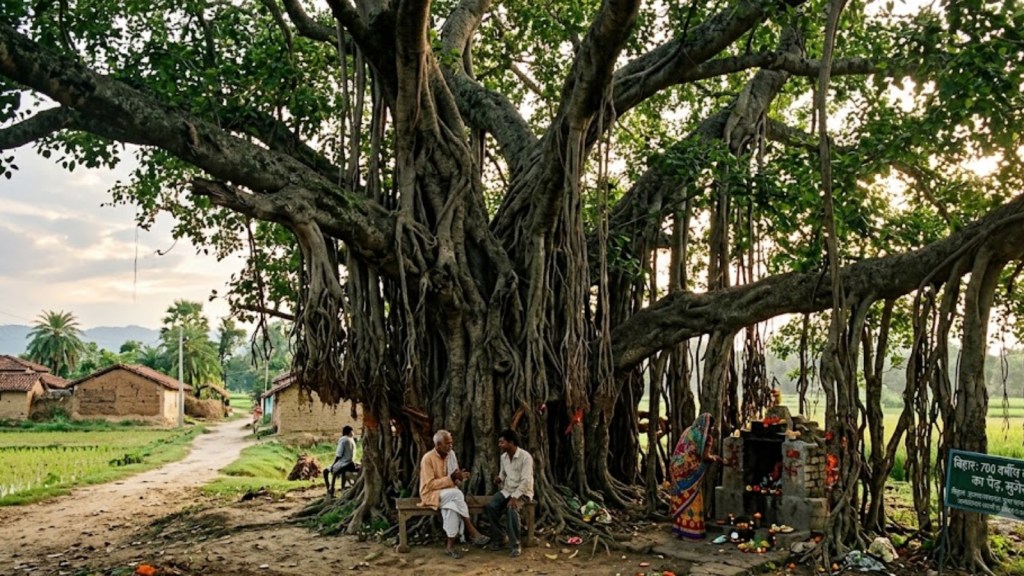 Representational photo by AI
A banyan tree in Munger, Bihar, has now become the oldest accurately dated banyan tree, after scientists established its age to be about 700 years.
Traditionally, estimates of the age of banyan trees, or Ficus benghalensis, have relied on folklore, or local stories. They were not scientifically dated mainly because of the lack of clear protocols.
But a team of scientists from Lucknow-based Birbal Sahni Institute of Palaeosciences, led by Dr Trina Bose, came up with a robust scientific method for accurately dating this tree in Munger using radiocarbon dating. Bose was invited by the Bihar Forest Department to investigate and determine the age of the Munger tree that is associated with lots of folklore in the area.
DISCLAIMER: This article is based on information from the public domain and/or the experts we spoke to.
Recognising the limitations of conventional dating approaches for tropical broadleaf species, Bose, along with her colleagues Mayank Shekhar and Akhilesh Yadav, developed and applied an innovative methodology to establish the age of the tree, according to a statement from the Department of Science and Technology.
View this post on Instagram
The determination of the age to be around 700 years clears earlier speculations that this tree was planted in front of the historic ‘Burra Bunglow’, which, based on architectural style, was estimated to belong to the late Mughal-early British period (about 300 to 350 years old). Instead, the 700-year-old tree is now considered to be a likely surviving remnant of a natural forest that once existed in the region, the statement said.
The research, containing a new scientific method for accurately dating heritage trees, has been published in the journal Quaternary Research. This new method can be useful for forest departments, conservation agencies, and government authorities in identifying and protecting culturally and ecologically important trees. It strengthens the preservation of natural and cultural heritage by replacing uncertain age estimates with reliable scientific evidence.
The methodology can also be applied to other ancient tropical trees worldwide and can help biodiversity conservation, heritage management, environmental education, and research on past climate and historical landscapes.
Beyond establishing the age of a single tree, environmentalist Jasmit S Arora believes that the study represents a milestone for both science and conservation.
Dating tropical trees has always been difficult because they rarely develop the clear annual growth rings seen in temperate forests. “This landmark breakthrough establishes a robust AMS radiocarbon dating methodology using alpha cellulose extraction, successfully ageing the Munger banyan as the oldest Ficus benghalensis,” says Arora.
He explains that conventional tree-ring dating is largely ineffective for tropical species. “Accurately dating tropical trees is notoriously challenging. Because tropical trees lack distinct annual growth rings due to continuous growth and often have complex, hollow, or multi-stemmed structures, traditional dendrochronology is ineffective. By pioneering precise pith targeting and advanced calibration, this research replaces speculative folklore with empirical data,” Arora tells indianexpress.com.
DISCLAIMER: This article is based on information from the public domain and/or the experts we spoke to.


