





You may have come across the word ‘mogging’ while scrolling through Instagram reels, memes, or your social media feed. If you thought it was just another Gen Z slang word that would disappear as quickly as it came, think again.
Well, this internet slang has now made it to the big league, with Collins Dictionary naming it its Word of the Year 2026. But what does ‘mogging’ actually mean? Why is everyone using it, and how did a word that started in online communities become so popular?

“It means basically to outshine someone, show someone up,” explains Dr Mahesh Krishna, Assistant Professor of English, Department of Language, Culture and Society, SRMIST Kattankulathur.
It is often used when someone outshines another person, particularly in terms of physical appearance, fitness, fashion, or overall presence. For instance, someone might say an actor mogged the entire cast at a red-carpet event or that a friend mogged everyone with their outfit. In simple terms, to mog someone is to show them up or make them look less impressive by comparison.
DISCLAIMER: This article is based on information from the public domain and/or the experts we spoke to.
How is ‘mogging’ used?
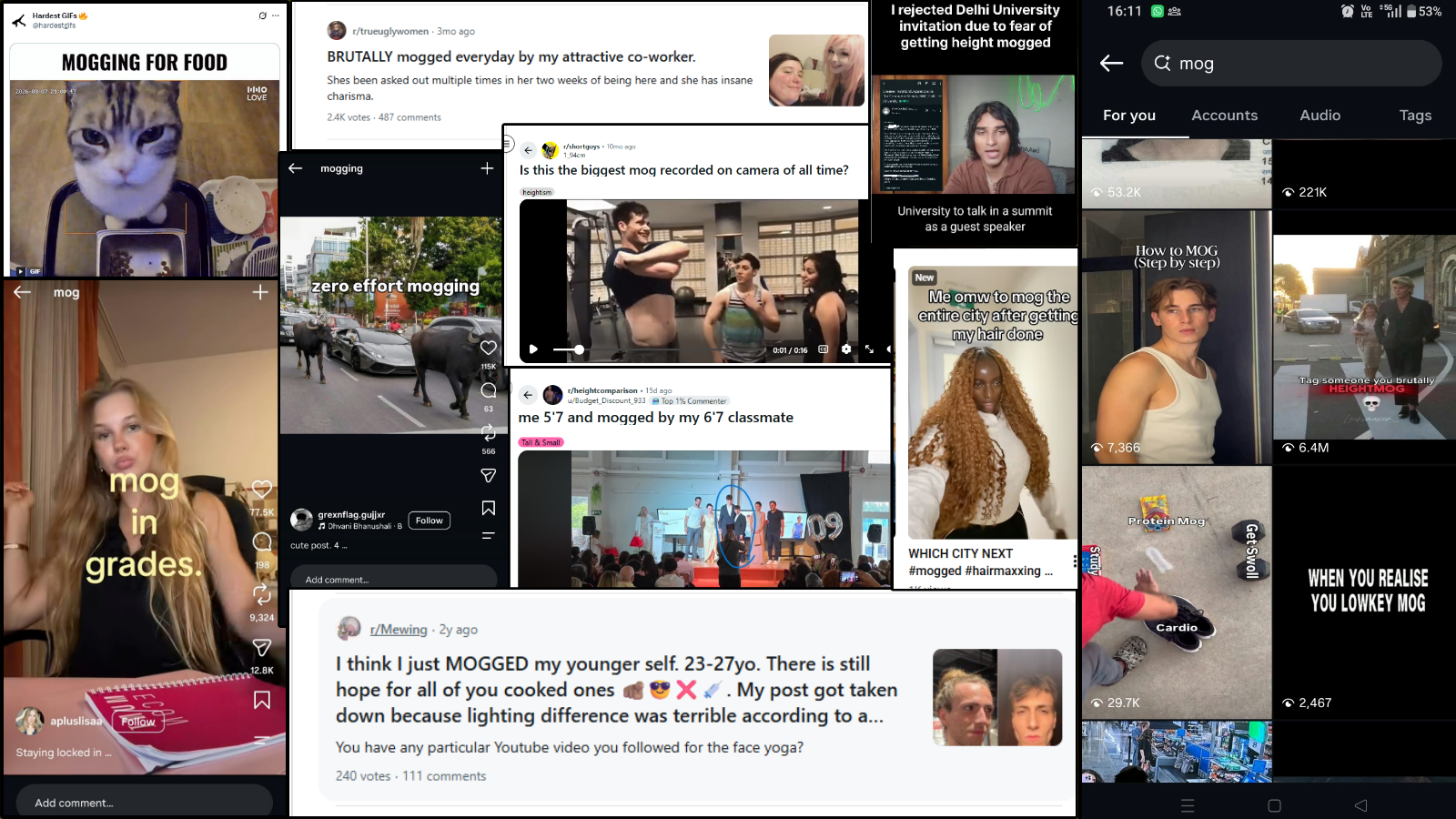 Memes around mogging have been around the internet for a long time now (Images: Screenshots from Vaibhavi Mishra)
As Dr Krishna explains, today, the word is commonly used on social media to describe someone who outshines another person. Young people often use it casually in memes, comments and everyday conversations, sometimes even jokingly among friends.
Collins Dictionary notes that while the word has been around since the 2010s, Gen Z and Gen Alpha have adopted it in a playful and ironic way, particularly when someone is upstaged.
Where did the word mogging come from?
While the term is now used quite casually, its origins lie in online manosphere communities, where men compared their physical attributes to establish who was more attractive or dominant.
“Mogging is a delightfully brutal little verb. It comes out of the manosphere, where ‘AMOG’ (alpha male of the group) named the man whose jawline, muscles, and height quietly demoted everyone else in the room. That is a worldview built on ranking bodies, and it is steeped in a pretty toxic idea of masculinity,” Dr Krishna notes.
However, the word has travelled considerably beyond these online spaces. “Today teenagers use it ironically, and someone can mog you by arriving with better snacks. Slang does this all the time: it takes a hierarchy, shrinks it to banter, and passes it round, as we saw with words like simp and chad,” he added.
What does the popularity of mogging say about us?
View this post on Instagram
Beyond being another internet expression, the popularity of mogging also raises questions about how much importance we place on physical appearance and how frequently we compare ourselves with others. With social media feeds filled with carefully curated pictures, fitness transformations and beauty trends, comparisons have become an increasingly visible part of everyday online life.
Dr Shorouq Motwani, Consultant, Child & Adolescent Psychiatry, Narayana Health, SRCC Children’s Hospital, believes the word’s popularity reflects this growing focus on looks and comparisons.
“Internet culture has become a significant part of speech, especially with young people. ‘Mogging’ might sound like another lived online word, but its popularity shows that society is becoming more interested in looks being attractive and comparing themselves with other people. What is interesting to note is how easy it is for these words to become part of regular conversation,” she said.
She also points out that social media plays a role in making these comparisons more common.
View this post on Instagram
“Social media pushes visual comparisons through carefully chosen pictures, fitness trends, beauty goals, and the influence of popular people. Words like ‘mogging’ give these comparisons a name, which makes it easier to talk about and share them. They can also make it normal to rate people based on how they look,” Dr Motwani explains.
She also raises an important question: are we beginning to judge a person’s confidence and social value based on their appearance? What might start as a harmless internet joke can also make constantly comparing and rating people’s looks seem normal.
For Dr Krishna, the word’s changing usage also reflects how younger generations are engaging with social hierarchies and language.
“It speaks a lot about this generation, how it is constantly breaking down hierarchies. The language we use is a reflection of the people we are, and as someone who works closely with college students, I think the future is in good hands.”
From ranking jawlines and physiques to joking about someone turning up with better snacks, mogging has come a long way from its original online associations. Its rise as Word of the Year is also a reminder of how internet culture is shaping not just the words we use, but the conversations we have around appearance, confidence and social status.
DISCLAIMER: This article is based on information from the public domain and/or the experts we spoke to.