
The Begum’s Speech: Ismat Chughtai was not just a provocative writer who wrote about women
Ismat wrote as she spoke, and vice versa: in the style of women from sharif families in western Uttar Pradesh, a language now known as begumati zubaan.
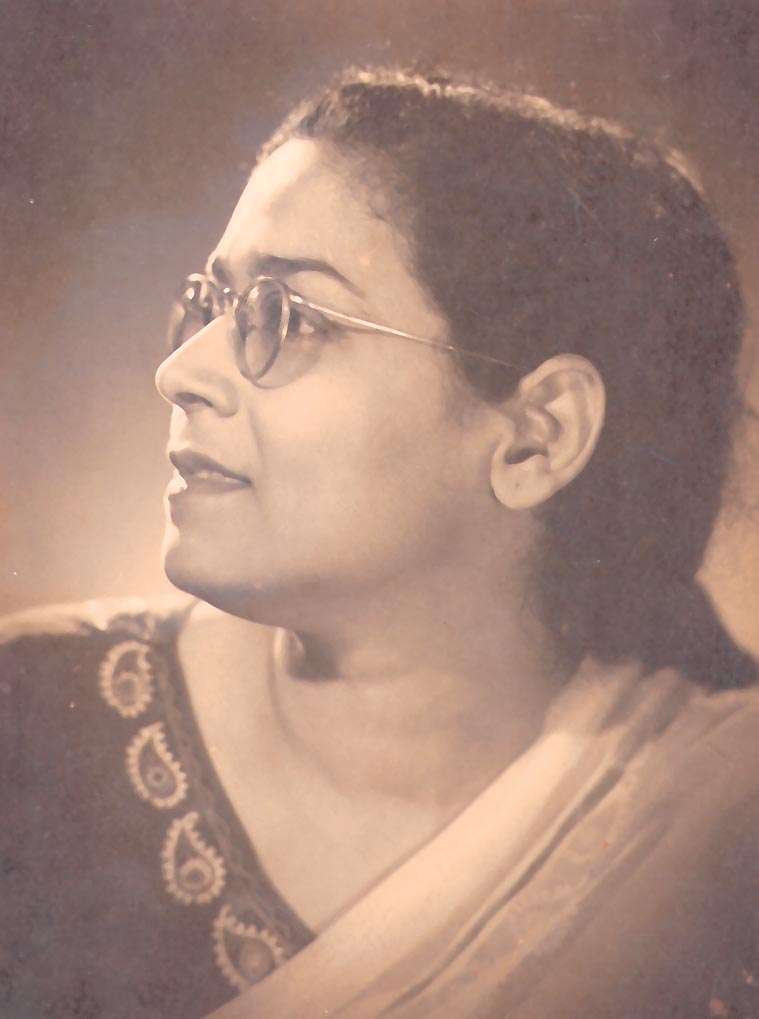 Ismat Chughtai
A simple cotton sari, black-rimmed glasses, a mop of snowy-white hair — she looked like a benign grandmother rather than a firebrand writer when I met Ismat Chughtai in Srinagar in the mid-1980s. But the twinkle in her eye and the mischief playing about her sharp, well-defined lips belied the homeliness of her appearance as she bandied words with my grandfather — the Urdu critic and poet Ale Ahmad Suroor — as we set out for a leisurely walk around the Kashmir University’s scenic campus. Wit and repartee flew thick and fast and my head bobbed like a crazy shuttlecock as I strived to take in the flavoursome and idiomatic Urdu between these two people who prided themselves on being ahl-e-zubaan (literally “people of the language”, but used to mean “native” Urdu speakers). A few years later, she was diagnosed with Alzheimer’s disease; the pen that had written voluminously for several decades was stilled and the child in Ismat was reborn.
Ismat wrote as she spoke, and vice versa: in the style of women from sharif families in western Uttar Pradesh, a language now known as begumati zubaan. She has acknowledged the influence of Dr Rashid Jahan, a communist-writer-doctor-activist, who pioneered short stories about urban, middle-class Muslim families with female protagonists who were a far cry from the “flat” women characters hitherto popular in Urdu literature. Pioneered by Jahan and polished and perfected by Ismat, feminine ecriture came into its own in Urdu by the 1940s; though the term écriture féminine was first coined by Helene Cixous in her essay, “The Laugh of the Medusa” as late as 1975.

“Woman must write her self: must write about women and bring women to writing, from which they have been driven away as violently as from their bodies,” Cixous wrote.
Before Ismat, the woman had existed as a mythologised fantastical creature for the Urdu poet and a personification of either implausibly good or implacably bad qualities for the pamphleteer and prose writer. In Ismat’s hands, the woman became a flesh-and-blood creature, with all the flaws and failings of a human being but also thoughts and ideas that did not necessarily limit her to the zenana.
Yet, Ismat is seen by many as a woman writer who wrote about women on subjects that are likely to be of interest to women alone, such as matrimonial alliances, familial disputes, or merely goings on behind the four walls of a cloistered home. In this, the centenary year of her birth, perhaps the greatest tribute we can offer is a new way of seeing her. Let us not be content to judge Ismat by the few stories that are most often anthologised. There is more to Ismat than Lihaaf (‘The Quilt’), the story about lesbian love that got her dragged to a court of law in Lahore. Let us resolve to read more of Ismat’s writings to view her correctly: as a writer who was constantly challenging accepted notions of morality and urging her readers to examine a woman’s place in society.
A crop of recent writings — available in excellent English translations — might help to correct a seemingly flattering but nonetheless one-sided view of Ismat: that of a provocative writer who enjoyed tilting at windmills and making outrageous statements. Ismat’s non-fiction writings show an independent-minded, strong-willed person, one who had clear views on contemporary events and a coherent idea of a writer’s place in society. As an active member of the literary grouping known as the Progressive Writers’ Association, Ismat was at the heart of a movement that spearheaded socially engaged, politically driven literature. She was part of a core group of the Bombay progressives who, during the high noon of the Progressive movement all through the 1940s and early 1950s, spoke in unequivocal terms of the need for social change and how literature — and by extension other forms of art and popular culture, most notably cinema — can be the engine for change and reform. She wrote stories such as Jadein (‘Roots’) and plays such as Dhaani Bankein (‘Green Bangles’) on communal tensions, as well as essays such as Fasadaat aur Adab on the role of a writer at the time of a great human tragedy such as the Partition of 1947.
Many of her contemporaries too wrote on Partition-related violence but Ismat’s writings are unique in that she wrote of issues that concern men and women from a woman’s perspective. She used wit and satire as tools to sharpen her depiction of harsh social realities and her trademark begumati zubaan gives an extra edge, a piquant flavor that sets her apart from, say, Manto or Krishan Chander. In her hands, Urdu acquired a new zest, an added spice that made it not only more readable but also better equipped to reflect new concerns that had hitherto been considered beyond the pale of literature.
There has been a tendency among Urdu critics to be less than generous towards Ismat and to be either dismissive or indulgent towards her.
Some have gone so far as to view the constant overwhelming presence of Ismat herself in all that she wrote as a flaw and deride the autobiographical nature of much of her writing. To my mind, this particular quality is a strength and a unique one at that: the ability to write of the immediate and personal and yet transcend it, to pick on a small stray injustice and make common cause with a host of related issues such as feminism, secularism, anti-imperialism and nationalism is surely the hallmark of a gifted writer. Read decades after they were written, Ismat’s stories, novels and plays not only open a window into the lives of educated, urban Muslim families but also reflect the currents of contemporary thoughts and ideas.
Rakhshanda Jalil is the author of Liking Progress, Loving Change: A Literary History of the Progressive Writers’ Movement in Urdu. She is editing a selection of critical writings on Ismat Chughtai
 Share


