 Some researchers have argued that infants’ spontaneous smiles exist to make parents feel that their children are adorable and to enhance parent-child communication.
The origin of smiles goes back at least 30 million years, when old world monkeys and our direct ancestors diverged, according to a new study. The study found that when human and chimp infants are dozing, they sometimes show facial movements that resemble smiles.
These facial expressions – called spontaneous smiles – are considered the evolutionary origin of real smiles and laughter, researchers said. They showed that this not only happens to higher-order primates like humans and chimpanzees, but also in newborn Japanese macaques, which are more distant relatives in the evolutionary tree.
“About a decade ago we found that chimp infants also display spontaneous smiles,” said Masaki Tomonaga from Kyoto University in Japan. “Since we see the same behaviour in more distant relatives, we can infer that the origin of smiles goes back at least 30 million years, when old world monkeys and our direct ancestors diverged.”
Fumito Kawakami from Kyoto University caught macaque infants smiling when they were receiving routine health checkups.
“These checkups can take quite long, so the infants tend to nap in between. We took this opportunity to empirically examine the behaviour,” he said. Researchers observed 58 spontaneous smiles from seven macaque infants, all of which showed spontaneous smiles at least once.
“Spontaneous macaque smiles are more like short, lop-sided spasms compared to those of human infants. There were two significant similarities; they both happened between irregular Rapid Eye Movement (REM) sleep, and they show more lop-sided smiles compared to symmetrical, full smiles,” said Kawakami.
“A major difference, though, is that the smiles were much shorter,” he said. Some researchers have argued that infants’ spontaneous smiles exist to make parents feel that their children are adorable and to enhance parent-child communication. On the other hand, this study suggests that spontaneous smiles do not express feelings of pleasure in chimpanzees and Japanese monkeys; rather, the smiles are more similar to submissive signals (grimaces) rather than smiles (play faces).
Researchers interpreted that spontaneous smiles facilitate the development of cheek muscles, enabling humans, chimpanzees, and Japanese monkeys to produce smiles, laughs and grimaces. According to Tomonaga, smiling may be special to monkeys and primates.
“There are case reports about mice laughing when they get tickled and dogs displaying facial expressions of pleasure. It may be the case that many mammal infants display spontaneous smiles, in which case smiling would have an older evolutionary origin,” he said.

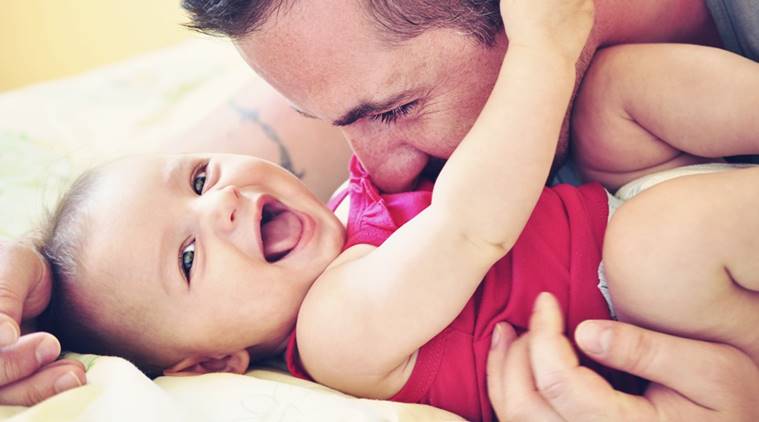 Some researchers have argued that infants’ spontaneous smiles exist to make parents feel that their children are adorable and to enhance parent-child communication.

 Share


