


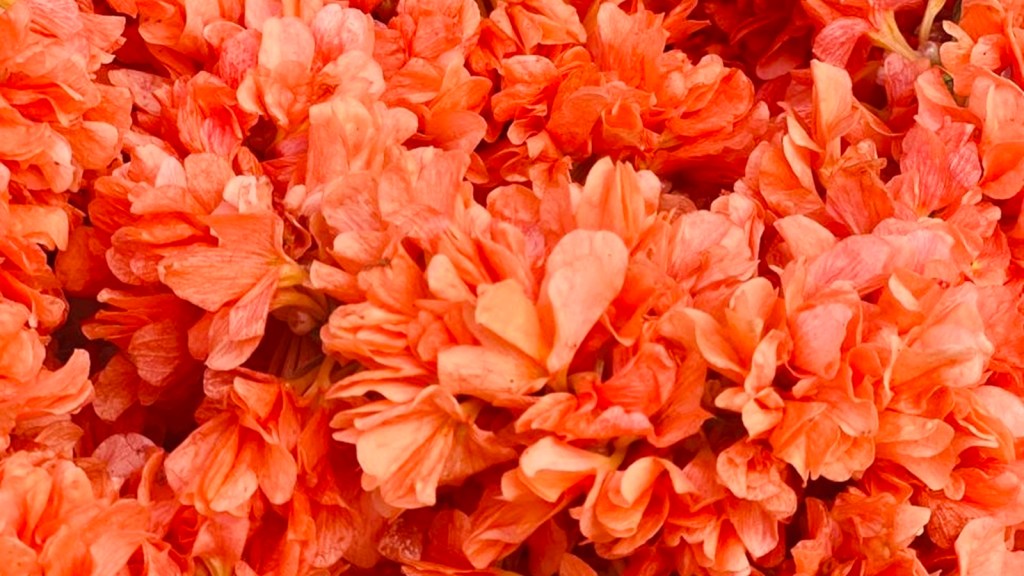


Come monsoon, and vendors in North India dot the streets with jasmine garlands and gajras. In the southern states, jasmin is often woven with “Kanakambaram” or the firecracker flower, with contrasting “venis,” or garlands of subtle orange, green, and white flowers, and leaves.
The name Kanakambaram has its roots in Sanskrit; “kanak” means gold and “ambaram” means ray. Known as “Aboli” in Maharashtra and Goa, it’s often mistaken for the delicate pink oleander or “Kaner”.

In North India, the yellow variety of these flowers––known as “Priyadarshini”––is more commonly found. In some parts of the world, it is called “Orange marmalade,” owing to its tangerine-coloured petals.
While vibrant flowers like Amaltas or “Kanikonna” dominate the festival season in April and May, Kanakambaram, along with jasmine and pink oleander, paints southern India with hues of peach, pink, and white.
During a recent trip to Tamil Nadu’s Kanchipuram and Cuddalore districts, I saw the ethereal beauty of this flower. In Kanchipuram, I saw women weaving flowers into garlands for decoration. Vendors occupy their spaces outside the Vishnu temples of Kanchipuram early in the morning.
View this post on Instagram
Vendors skillfully weave yellow chrysanthemums, jasmine, pink and red oleander, rose, lotus, kanakambaram, and even tulsi into garlands with fondness and speed. Some of these garlands were meant to be offered at the temples, while many, like jasmine and the orange/yellow clusters of kanakambaram were meant to be worn by women as hair jewels. In many cases, small accessories and hairpins were also being sold nearby.
With its calming hue and radiance, the kanakambaram is a popular choice for bridal decor and wear. It is commonly woven into wedding garlands, adding to the festive spirit of weddings. Shobhita Dhulipala, for instance, wore a kanakambaram garland on her wedding day, beautifully complementing her attire.
Horticulture and floriculture play significant roles in farmers’ livelihoods in South India, especially in Tamil Nadu. The kanakambaram becomes especially valuable during peak wedding and festival seasons. On average, these flowers sell for Rs 1,000-1,200 per kg. During the Varamahalakshmi festival in Bengaluru this year, reports indicated the price reached ₹3,000 per kg. This year, according to reports, the flower was priced at Rs 3,000 per kg during the grand celebrations of Varamahalakshmi in Bengaluru, Karnataka.
 Vendors skillfully weave yellow chrysanthemums, jasmine, pink and red oleander, rose, lotus, kanakambaram, and even tulsi, into garlands with fondness and speed. (Photo: Swasti Pachauri)
Realising its enormous potential, research scholars in Prayagraj have successfully cultivated the flower despite varying weather conditions, much to the delight of women and farmers. In Goa, this pleasing peach “aboli” is the state flower, and efforts have been made to revive and conserve floriculture around it.
While many use artificial garlands emulating the colour and style of Kanakambaram, increasingly, bridal decor and jewellery are made of natural flowers, thus contributing to sustainable fashion.