



12.27am, March 21, 1997.

For Javed Ahmed Tak, those numbers are etched in stone, numbers that changed his life forever. At 12.27am on the night of March 21, 1997, a group of militants barged into his house in South Kashmir demanding his cousin and he join them. Minutes later — angered by their refusal — they open-fired. Ahmed, the only one to be injured, was shot in the spine.
The 20-year-old from Bijbehara was nursing his ill aunt that night. That fateful bullet left him in need of nursing for the rest of his life. He is now 39.
But then, Ahmed’s story is not just one of the many tragic tales that dot the bloody landscape of the strife-torn Kashmir valley. It’s also a story of redemption, of how a wheelchair-bound militancy victim went on to change the lives of scores of disabled children, giving them education and, in the process, meaning to his own life.
“That night, I lay there with my eyes open for 2 minutes and woke up in the hospital the next day,” he says.
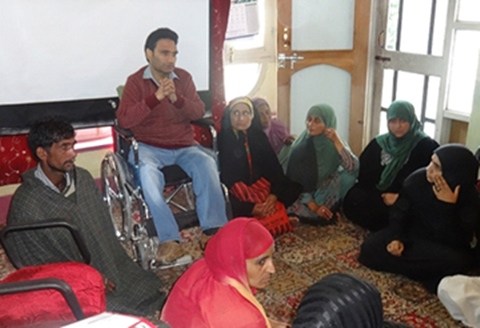
It took Ahmed three years to come to terms with reality. The first year was all about a “number of major surgeries” in the hospital. The next two were spent on a bed in the living room, his eyes mostly on the red floor carpet. “I couldn’t move, do anything on my own. For the longest time, I didn’t even know whether I would be able to move on a wheelchair,” he says.
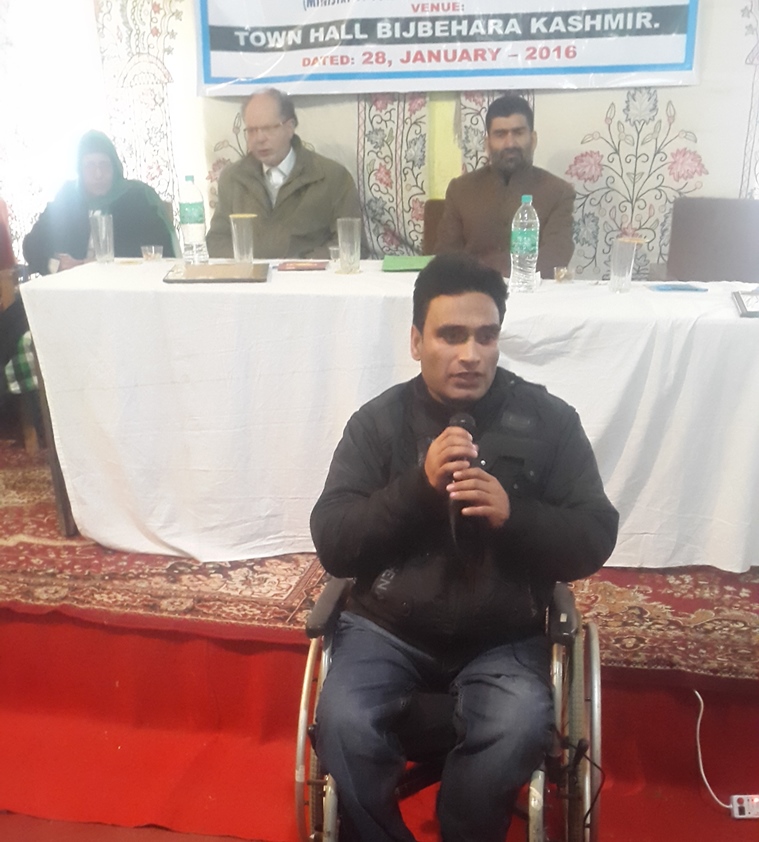
But Ahmed didn’t lose the will to live on his own terms. While still bed-ridden, he started teaching the neighbourhood children for free. As the word spread, more children started coming in. “They would gather around me on the red carpet and I’d teach batch after batch, day in and day out. It was my escape from reality and also a way to face it.”
It was with these children that Ahmed laid the foundation for Humanity Welfare Organization Helpline, an NGO that provides education to disabled children.
“When I started teaching from home, I realised there were no disabled children among the students. It hit me more because I was disabled myself. So, I sent my kids to look for them,” he says. However, out of the 36 disabled children his students met, only five to six turned up. “What can a disabled child do after studying?” asked one parent.
But Ahmed didn’t lose heart, and in 2005, the Zaiba Apa Institute of Inclusive Education was born, where today, 65 disabled children are being educated just so they can make something of their lives.
To fund his venture, the young man finally tapped into the meagre Rs 75,000 compensation the government had given him after the attack and injury — a sum he had thus far left untouched. In 2005, when he decided to open an institute for the kids, he withdrew that money.
“I still remember the first teacher was the only teacher we could afford. He knew Braille and I hired him on Rs 2,500 per month,” he says.
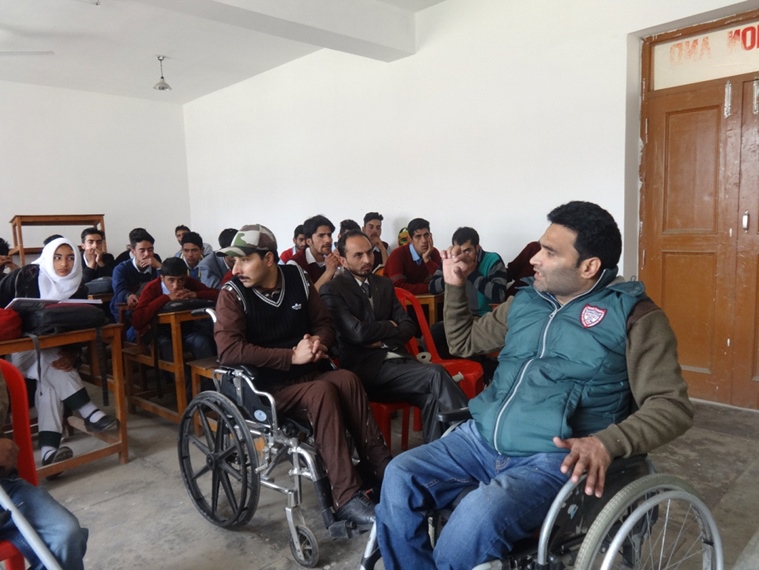
Ahmed, meanwhile, completed a certificate course on computers and human rights, a BEd and a Master’s in Social Work from Kashmir University. “I, myself, teach various subjects at the school, including the basics of computers,” he shares.
That intense desire to teach, in fact, was one of the reasons that inspired him to open his own school. “I would say this is not a disabled-friendly state. I know a blind person who was told by the chairman of a school, ‘You are blind. You’ll only trouble others’. I have experienced something similar,” he adds.
“There are many such stories that are buried in this state. Stories that’ll bring tears to your eyes. May God never let anyone go through the situation that I and many I know have been through,” says Ahmed, breaking down.
So, how did he battle the sadness, the depression of waking up one morning to realise that he would never walk again? “To be honest, I don’t know how I changed and how my depression flew away. But I clearly remember when I was bedridden for two years, the happiness and sadness of this house depended on my smiles and tears. When I laughed, my mother smiled, too. It was as if they have stopped living, too. I guess that gave me strength to move on and not give up.”
Along with 13 teachers, Ahmed continues to fight against adversity — physical, psychological and even social — to give back to society, and pass on the ‘weapon/strength’ of education among the kids of the valley who have anyway lost a lot.
Today, Ahmed’s story is an inspiration for people outside the Kashmir valley too. Recently, he was awarded the People of the Year award by the Limca Book of Records 2016.