4 min read
📣 For more lifestyle news, click here to join our WhatsApp Channel and also follow us on Instagram
© IE Online Media Services Pvt Ltd



 Why is blood pressure high at night? (Photo: Pexels)
While it is a known fact that blood pressure is not consistent throughout the day, drastic fluctuations, especially a higher reading at night, is something that deserves immediate attention. So when a Quora user asked: “My blood pressure in the morning usually is 130/90 mmHg, but at night it is elevated to 140/100 mmHg, 160/110 mmHg, 170/120 mmHg, or 180/120 mmHg. I am 31 years old. Why is blood pressure higher at night?” we reached out to Dr Amit Saraf, director, internal medicine, Jupiter Hospital, Thane, for an answer. According to the expert, for most people, blood pressure dips at night while the body rests. “But when it rises instead, as in this case, it’s called nocturnal hypertension, and it needs attention,” said Dr Saraf.
Nighttime spikes can occur due to many reasons. One common reason in today’s times is carryover stress. “Most people remain mentally ‘switched on’ during and after work hours, stimulating the continuous secretion of stress hormones such as adrenaline and cortisol. These chemicals increase heart rate and constrict blood vessels, thus pushing up blood pressure,” explained Dr Saraf.
Other common causes include poor sleep quality. “Fragmented sleep, insomnia, and especially sleep apnea-where breathing repeatedly stops and restarts-can lead to sharp blood pressure surges at night. Even snoring can be a clue,” said Dr Saraf.
Lifestyle patterns also matter. According to Dr Saraf, late, heavy dinners, high-salt foods, excess caffeine, alcohol, or smoking in the evening can cause nighttime elevations. “Some people also take their hypertension medicines at odd timings that don’t provide adequate overnight coverage,” said Dr Saraf.
 Are you stressed? (Photo: Freepik)
Any underlying medical conditions must also be excluded. “Conditions that can predispose to the condition include overactive thyroid, kidney disorders, hormonal imbalance, obesity, and chronic nasal congestion,” said Dr Saraf, further stressing that nighttime blood pressure is, in fact, a stronger predictor of heart and kidney complications than daytime readings. “So your numbers — especially if they reach 170/120 mmHg or 180/120 mmHg — must be evaluated immediately. At 31, this is not something to ignore,” said Dr Saraf.
Is this situation common and concerning?
Yes, it is more common than most people think among young adults who go through various kinds of stress, disturbed sleep cycles, working late at night, and spending time in front of screens for extended periods, and it is clinically relevant, Dr Saraf said. “A natural ‘nocturnal dip’ in blood pressure is essential for health, and if it is absent or reversed, that is a concern. Sustained nighttime hypertension increases overall long-term cardiovascular risk,” said Dr Saraf.
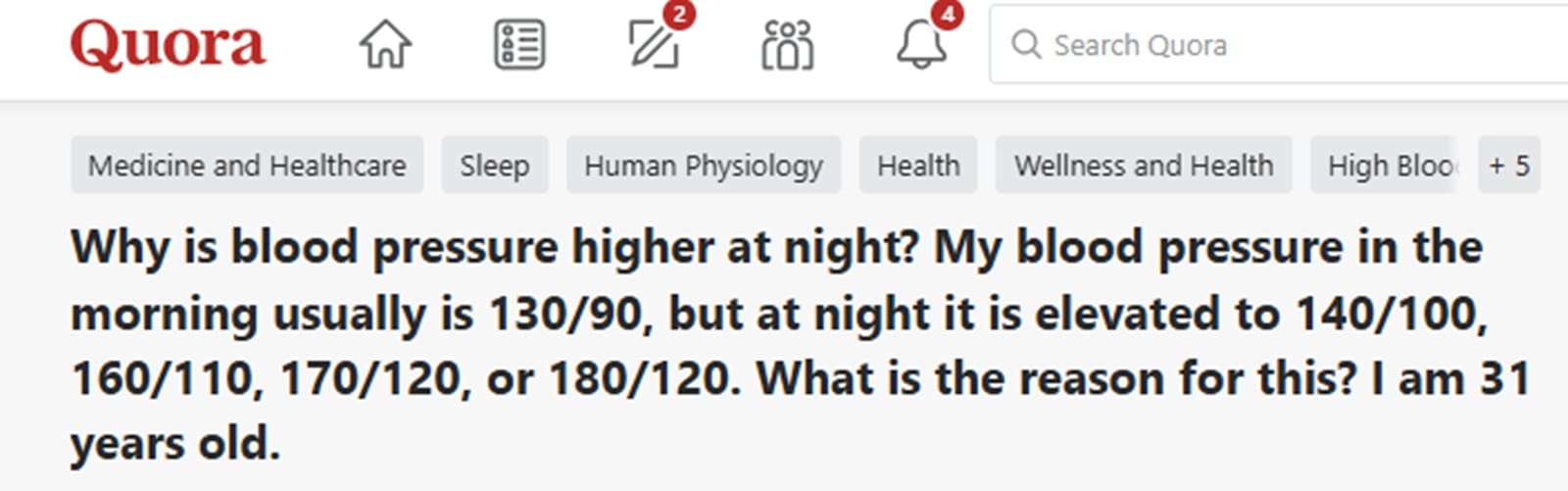 A Quora user asked this question (Photo: Quora)
*Monitor blood pressure at the same time for 5–7 days.
*Discuss a 24-hour ambulatory blood pressure monitoring test with your doctor.
*Review lifestyle triggers like sleep, stress, late meals, caffeine, and alcohol.
Do not neglect readings above 160/100 mmHg; immediate medical evaluation is required, said Dr Saraf.
DISCLAIMER: This article is based on information from the public domain and/or the experts we spoke to. Always consult your health practitioner before starting any routine.