


Journalism of Courage
 Bipasha Basu finds worms in her protein powder. (Source: Instagram/@bipashabasu)
When Bipasha Basu opened her pack of protein powder and made a shake a few days ago, she was greeted with the sight of worms wriggling around in her drink. The actor quickly took out her phone and snapped a photo as evidence, tagging Tukaram Mundhe, Commissioner of Maharashtra’s Food and Drug Administration (FDA), and calling for help.
“You are our only hope… so we don’t get spoiled or adulterated stuff in everything that we purchase,” she mentioned in the caption of her Instagram story.
DISCLAIMER: This article is based on information from the public domain and/or the experts we spoke to. Always consult your health practitioner before starting any routine.
 Bipasha’s Instagram stories.
Responding to her grievance, Sumit Mathur, Country Head & Board Director, Glanbia Performance Nutrition (GPN), parent company of ISOPURE, issued a statement:
“ISOPURE remains firmly committed to maintaining high standards of product quality and consumer safety. We connected promptly with the concerned Indian celebrity consumer, addressed her immediate concern, and appreciate her acknowledgement of our response. Our Quality team is currently evaluating the pack for authenticity and quality.
As part of our established protocols, we undertake regular market-monitoring interventions in coordination with designated authorities to identify and act on suspected instances of counterfeiting or unauthorized distribution. These ongoing measures are intended to help ensure that consumers receive genuine ISOPURE products. We also encourage consumers to purchase through authorized channels and use the unique QR code provided on every pack to verify its authenticity before consumption.”
Basu shared her appreciation for the “quick response” from the brand on her Instagram story, further mentioning: “The adulteration in our country has gotten really bad…a thorough clean up is required.”
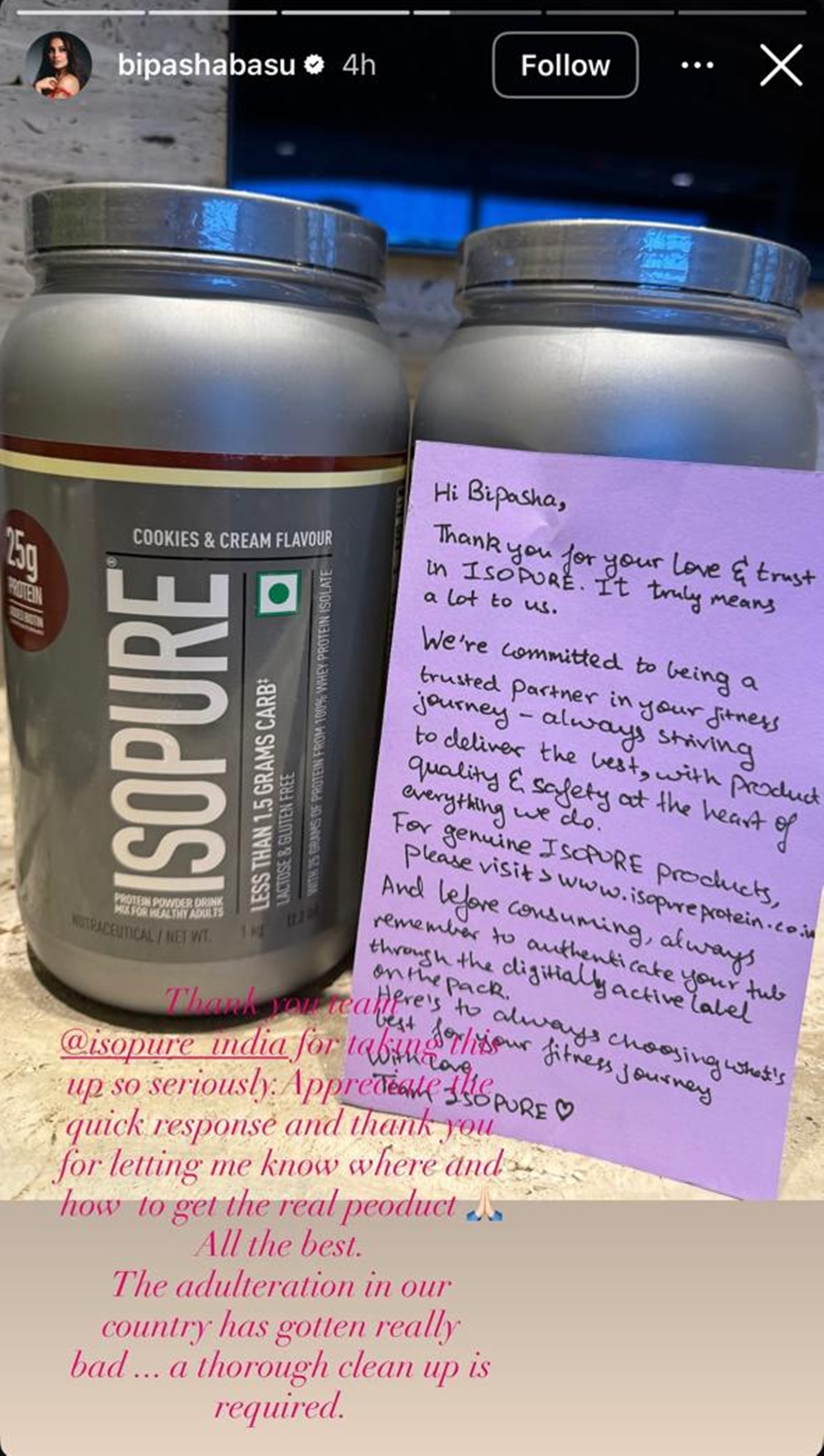 Bipasha Basu’s Instagram story.
With food adulteration making regular headlines in the last year, Basu’s case reiterates the urgent need for stricter frameworks that ensure safety and public wellbeing. Edwina Raj, Head of Services – Clinical Nutrition & Dietetics, Aster CMI Hospital, Bangalore, agrees, adding that protein powder contamination or adulteration isn’t always easy to spot by looking at the product. But there are some things you can look out for.
Raj urges consumers to check for:
She also warns people to stop using the product if anything appears unusual.
“Consuming contaminated powder may cause nausea, vomiting, stomach pain, diarrhoea or food poisoning, depending on the type of contamination,” Raj tells indianexpress.com, adding that some may also develop an allergic reaction. Therefore, severe or persistent symptoms such as “repeated vomiting, dehydration, breathing difficulty or swelling” require medical attention.
When buying protein powder, Raj recommends choosing a reputed brand from an authorised seller. “Check the seal, batch number, manufacturing and expiry dates, storage instructions, ingredient list and nutrition information, as well as look out for appropriate food-safety or quality certifications where applicable,” she lists out.
According to her, consumers should be cautious about products that are unusually cheap, have unclear labelling or promise unrealistic results such as rapid muscle gain or instant weight loss. “Once you open, the powder should also be stored properly in a cool, dry place,” she adds.
Finally, Raj says protein supplements aren’t essential for everyone, and the need for supplementation should ideally be assessed based on diet, lifestyle, and individual nutritional requirements.
‘Tukaram Mundhe’ has been trending on Google for the past 24 hours.
DISCLAIMER: This article is based on information from the public domain and/or the experts we spoke to. Always consult your health practitioner before starting any routine.


