According to Indian mythology, sage Vishwamitra created the tall coconut tree, with its crown of leaves, to catch his compatriot, king Trishanku, who was expelled from heaven by Lord Indra over many misdeeds. However, botanists traced coconut palm’s origin to the Papua New Guinea area, eons ago. How could it possibly have reached India? That coconuts can float for long periods and sprout when they wash ashore could be a possible explanation for the spread.

Literary references to coconuts or narikela appear as early as 300 BC in the Ramayana, Mahabharata. Writings of Greek historian Megasthenes, who lived in Pataliputra, mentioned coconuts in Taprobane island in Sri Lanka. Famous medieval traveller Ibn Battuta also noted that a coconut “resembles a man’s head and the contents, when it is green, are like the brain.” A fascinating description of a coconut by-product comes from Battuta’s writings, where he mentions “coconut honey,” made by boiling down the sweet extract of several palms. Historian KT Achaya suggests this could be a reference to pre-jaggery coconut juice.
In South India, it is called sriphala – the blessed fruit, and it is considered a sin to cut down a palm tree. The coconut is central to Hindu festivals and rituals across India. The Tamil word, “nai” for semi-solid fat seems to come from words like “ngai” and “niu” which are used for coconut oil in Polynesia and the Nicobar Islands.
Coastal South India has a proliferation of coconut trees due to the plant’s ability to thrive in coastal regions. In coastal regions, coconut’s presence can be found in a plethora of dishes. Kerala cuisine, for example, extensively uses coconut. Coconut oil is a primary cooking medium—an acquired taste for some. Aviyal, a stew with green bananas, drumsticks, and other vegetables, uses both coconut milk and coconut oil. Pullisseri is a dish of ash gourd or raw mangoes cooked with coconut, curd, and chili. Kopra-mittai is a sweet made by setting dried coconut shreds in thickened jaggery or sugar. Two of the most popular desserts in Goa are made with coconut – the many-layered bebinca made with egg yolk, flour and coconut milk, and Dos de Grao, prepared by baking besan, grated coconut and sugar.
Coconut oil is a primary cooking medium—an acquired taste for some. (Photo: Freepik)
One of my favorite dishes is Moilee, a coconut milk-based gravy often made with fish, introduced in then-Madras by the British. Here, I’ve included an easy recipe for one of Bengal’s favourite dishes, Narkel Chingri – coconut prawns, which a friend once shared with me.
Ingredients:
Medium sized prawns – 250 gm [cleaned and deveined]
Desiccated/finely grated coconut – 2 cups
Garlic – 7-8 cloves (finely chopped)
Slit green chillies – 7-8
Curry Leaves – 10-15
Tamarind paste – 2 tbsp
Mustard oil – 1/2 cup
Mustard Paste – 2 tbsp
Salt/Sugar – To taste
Method:
Heat mustard oil in a wok and add finely chopped garlic, half of the slit green chillies, and half of the curry leaves.
Let it splutter before adding desiccated coconut, stirring continuously until the coconut starts to brown.
When the coconut turns golden brown, add the prawns and stir for three-four minutes.
Add tamarind and mustard paste with 1/2 cup of water, then season with salt and sugar to taste. Add the remaining green chillies and curry leaves, cover, and let it boil.
After two-three minutes, when the water evaporates, sprinkle some more oil and stir until the mixture turns dark brown. Garnish with more slit green chillies and serve.
ALSO IN THIS SERIES
How India added a little (starter) culture to the world of dairy and created curd
Mind your temper(ing): demystifying tadka, a very common cooking procedure
Pachadi: Relish this South Indian pickle that has been around for over 1,500 years
From taboo to tradition, how paneer found a place in Indian cuisine
Garam masala: Bringing a little heat into the kitchen and your dishes
Is vegetable biryani just dolled up pulao? Which came first?
Cutting chai to Earl Grey tea: Journey of the Chinese hot beverage to India via Britain
‘Ande ka funda’: A deep dive into the history and popularity of eggs in India
Next week, I’m going to talk about the 122-year-old Jewish bakery Nahoum’s, a landmark in Kolkata, the concept of the puff pastry, and how a “patty” can be many things to many people.

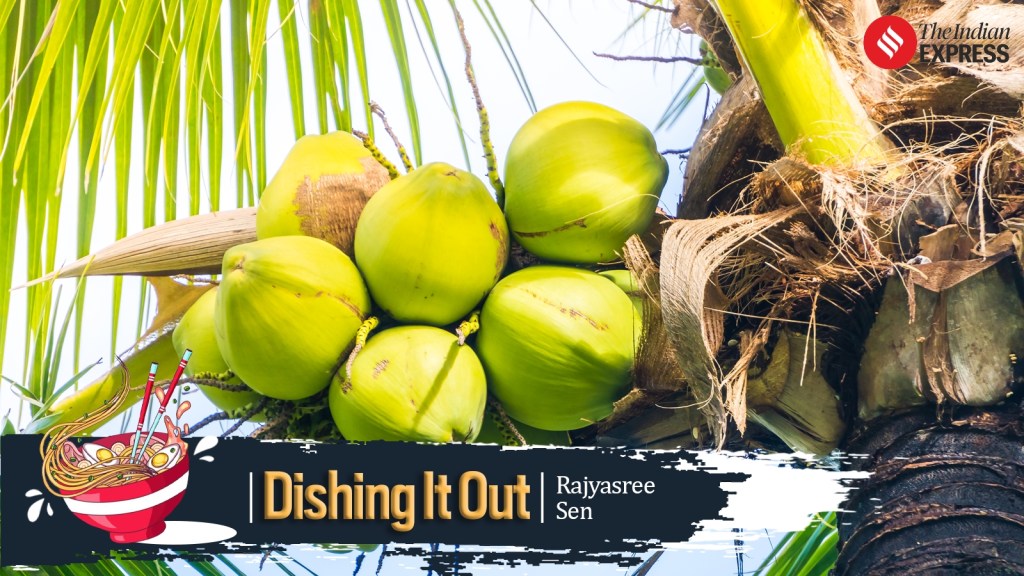 Literary references to coconuts or narikela appear as early as 300 BC in the Ramayana, Mahabharata. (Image by mrsiraphol on Freepik)

 Coconut oil is a primary cooking medium—an acquired taste for some. (Photo: Freepik)


 Share


