


Journalism of Courage
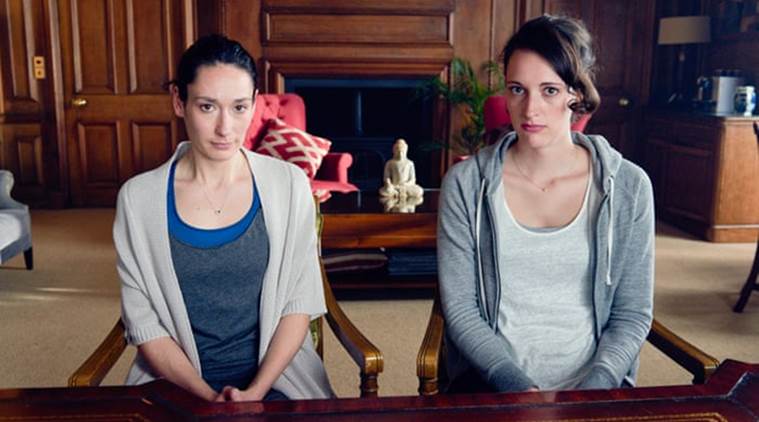 Fleabag is streaming on Amazon Prime. (Source: Amazon Prime)
“I love you but I am not sure I like you all the time,” Fleabag’s father tells her, in what presumably is their most intimate conversation in both the seasons. The words — said with marked nonchalance — could have hurt but they don’t. The protagonist looks surprised, not wounded: the glint in her eyes tells you she has heard it before, the wry smile reveals she, perhaps, even perversely enjoys it.
The eponymous protagonist in Fleabag (written and directed by Phoebe Waller-Bridge) — largely tactless, curiously addicted to sex and stealing things, prone to disrupting family dinners and relationships — is not easy to love. She is as scathing as self-denigrating, as unrepentant as remorseful.
The six-part BBC series — with its second and finale season streaming on Prime at present — through the eyes of its protagonist presents an intimate portrayal of a dysfunctional British family and Fleabag — with her unprovoked rebellion — appears as the product of the insidious emotional bankruptcy running in the members (her father, living with their Godmother, is saddled with guilt for not being able to be there for his daughters and also struggles with the need for his daughters to be proud of him, her sister Claire is stuck with an alcoholic husband, and he, in turn, tries to kiss Fleabag on his wife’s birthday).
ALSO READ | Emmy Awards 2019: Game of Thrones disappoints, Fleabag wins big
Rooted in these debilitating relationships is the bond shared by Fleabag and Claire, no less dysfunctional than the rest. But it is precisely this dysfunctionality, often regarded as the fundamental and accepted tenet of sisterhood, that makes the relationship most functional.
Sisters are sisters. Not friends
Fleabag and Claire are not friends. They are not supposed to be. As Claire reminds us, they are sisters: their relationship not built on choice but on compulsion. They are not kindred souls but are compelled to forge kinship over their differences. On the surface, they exist as each other’s antithetical counterparts: Claire thrives in taking control of herself and others (she even arranges her own surprise birthday party), takes pride in having her life laid out for herself the way she desires it to be, and, contrary to her broke(n) sister, owns two degrees, a husband and a Burberry coat.
The nameless singleton then stands at the farthest corner of the spectrum occupied by Claire, deriving pleasure in scattering the reins of her life that her sister struggles to hold on to, albeit with trembling hands. Claire, using Fleabag’s recklessness as a cautionary tale, holds on to love and life as the latter tries running away from it, and attempts to write her story with a different ink. As a result, Claire has an enviable job and a husband who loves her. Fleabag has a dead friend and a guinea pig-themed cafe that is struggling to stay afloat. Claire is frightened by Fleabag’s impetuousness. She is even secretly jealous of it.
Bond rooted in shared history
And yet, their bond presupposes a certain unaccounted familiarity that both define and ease the edges. It differs in texture from the ease of a friendship but is rooted in shared history. The intimacy, carefully hidden, is akin to Claire’s top, Fleabag, without her sister’s knowledge, had worn at the feminist lecture: the trench coat might be hiding it but it still threatens to peep from the fringes. Fairly early at the show, in a telling moment at the lecture, when asked if anyone present would trade five years of their lives for a perfect body, it is the sisters who raise their hands. The moment might demand political correctness, but the deep-rooted candour so intrinsic to their relationship, makes no allowance for it.
Their bond then is seeped less in mutual admiration and more in acknowledgement of each other’s vices, giving rise to a love that is at once laboured and innate, informed and unconditional. The jaded familiarity of such a bond knows when it hurts, knows too when to hurt back.
Echo of this paradoxical love — which has one foot each on apathy and tenderness — is evoked in the 2018 Pakistani film Cake (streaming on Netflix) and illustrated in the volatile relationship of Zara (Sanam Saeed) and Zareen (Aamina Sheikh). Their father’s sudden illness leads to a hasty reunion of the sisters, but as the domestic drama progresses, cracks in their relationship begin to show, questions of responsibility resurface and ultimately a fine distinction between liking a sister from loving her is made. In a moment charged with hurt and secrets, Zareen not only reveals the reason that had impelled Zara to leave home and her love behind in a rush, ten years back, but also shares the many (mis)steps she had taken to ensure that nothing holds her sister back.
ALSO READ | Stars arrive for Emmy Awards 2019
The scene stands out not only as a timely reminder of how intimately sisters can wound each other but also, how they overlook, and look over each other’s faults. Zareen had been her sister’s secret keeper for all these years, loving her in spite of what she had done, and in a striking scene that follows this, she — exhibiting a kind of irrational kindness peculiar only to sisters — reasons why she never told Zara all of this earlier. “You would not have been able to take it.” Zareen might be struggling to like her sister, but her love was firm.
Fleabag and Claire’s relationship, much like them, does not revolve around the promise of braving tragedies together but having transacted and witnessed some, standing next to each other. As we navigate through the terrain of their tumultuous relationship well into the second season, their bond is deepened and strengthened.
It begins with a family dinner, and the sisters admit of not having met each other in a year. Intimacy soon creeps in. Fleabag, the only one to notice her sister has been missing from the table for far too long, goes to the loo, looking for her. “Claire? You’ve been ages. Are you pissed off, or are you doing a poo?” she asks, assuming the two alternatives she is all too familiar with. Seeing blood, Fleabag conjectures her sister is on her period only to be corrected that it is a miscarriage.
The two later return to the table: Fleabag aghast and Claire feigning an act of cheerfulness. The former soon interrupts the party like only she can, announcing to the world that there was a miscarriage, but also claiming it to be hers. This deflection not only gives Claire time to process the tragedy silently but, in a startling moment reveals that the private, gaping brokenness of the sisters curiously resemble each other. In spite of their apparent differences, one’s tragedy fits into another’s, just right: Fleabag was mourning, just like Claire was, over an untimely loss.
The poignancy of their relationship is further acknowledged in the gut-wrenching ending. By the end of season two, both the sisters are caught in matters of the heart, struggling viscerally against themselves to emerge out of it unscathed. We root for Fleabag, who in turns roots for Claire. It is the perpetual-transgressor, Fleabag who deserved an airport ending, it was she who was supposed to disrupt the wedding (she is even told, rather warned, by her Godmother not to make a scene), yet it is Claire who leaves the wedding mid-way. Claire, running to pursue her love at the airport, is a delightful reminder of how the tricks younger sisters are often scolded for, are in fact imbibed from the elder ones.
Sisters in one team
It is, however, in the ending of season one that both, ruptures their ties and bears an unpretentious and primal testimony to their sisterhood. Posited among the dysfunctionality of her family, Fleabag chooses us among the rest, over her sister even to confide and confront. She wins our confidence and we find a confidante. Her scattered control of her life invites a more personal identification than her sister’s immaculately planned life. Her glaring dissimilarity with the “uptight and beautiful” Claire assures us of our conviction till we catch them in a private moment.
Fleabag could have been grieving for her friend, Boo’s death but she was also responsible for her demise. We did not know that, Claire did. It is precisely at that moment that Fleabag defamilarises before our eyes: she transforms from a grief-stricken friend to a reckless adult, and our faith in her wavers. We are hurt, not because she turned out to be flawed, but because she had fooled us into believing that we were aware of all her flaws. It was Claire who was aware of them, and was willing to help her broke sister in spite of that.
Claire was protecting Fleabag from our judgement, while we thought we were shielding our broken protagonist from Claire’s critical eyes. It was the sisters who were in the same team, not us.


