


Journalism of Courage
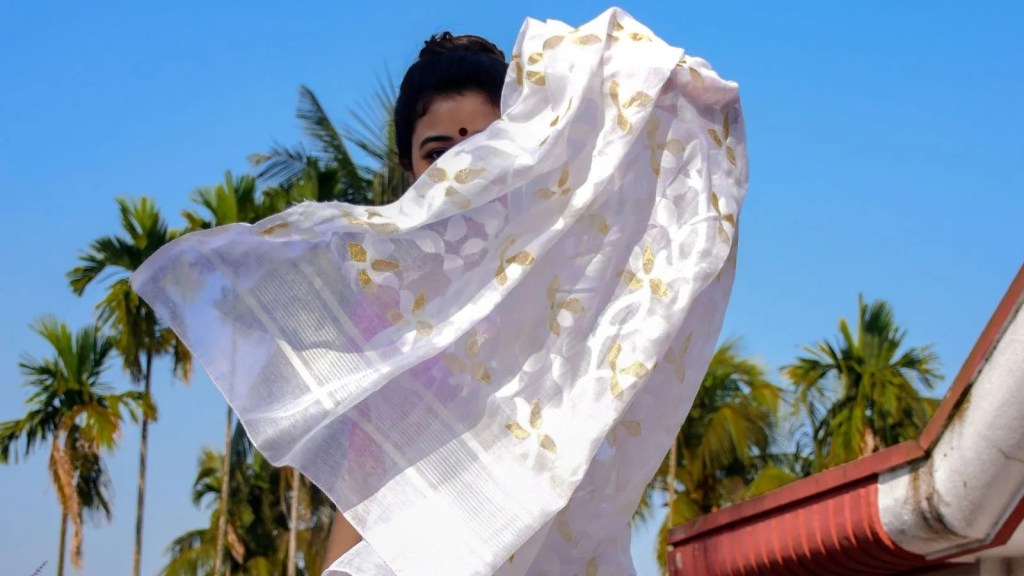 From kaata washing to breathable storage, experts share ways to preserve the beauty of a Dhakai Jamdani sari (Image Source: Unsplash)
Dhakai jamdani sari is celebrated for its fine cotton fabric and intricate motifs woven directly into the textile. However, you must take care to preserve its quality and charm. In a recent video, content creator Dr Khonika Gope, known for her reels on traditional drapes, says that water is the number one enemy of the Dhakai jamdani sari. “You cannot soak the jamdani in water. That means that you cannot wash it.”
Elaborating on the sari’s washing technique, she further adds, “You cannot hand wash it. You cannot machine wash it. Second, you also cannot dry wash it.”
So, what can you do if your dhakai jamdani gets soiled?
Dr Khonika advises that the best option is to contact the seller and send the sari to them so they can take care of it with a kaata wash, which works like magic.
DISCLAIMER: This article is based on information from the public domain and/or the experts we spoke to.
Sneha Yadav, Fashion Consultant, Brand & Image Strategist, and NIFT alumna, says jamdani certainly deserves specialised care, but she would be cautious about calling water the textile’s enemy or claiming there is only one acceptable way to clean it.
“From the point of view of the fabric and the design, the care needed really depends on how the individual sari is made. The kind of fibre it has, the yarn, the dyes, the weave, the zari or any decorations and the finishing,” she says, adding, “The real problem is not water by itself, and a careful and soft wash can be very different.”
View this post on Instagram
Traditionally, an authentic handloom Dhakai jamdani is cleaned through a specialised process known as ‘kaata wash’.
Explaining what the technique is all about, Dileep Kumar Goli, CEO, Missamma says, “The name is derived from the claw-like clips, known as kaata, that are used to pin the sari onto a bamboo frame to stretch the fabric. This ensures that the fabric and the threads used for the weaves and the motifs stay flat and taut without sagging, thereby preventing any shrinkage or loosening of threads by any pulling during the cleaning process.”
Going into details, he adds:
As per Dr Khonika, kaata wash is the best way to clean a dhakai jamdani sari. Although Sneha agrees, she also says it isn’t the only right way for every Jamdani. “I would not say that washing by hand or using dry cleaning is always wrong. For a Jamdani that’s expensive, it is best to learn about the specific fabric first and then follow the care instructions from the weaver or from a professional who works with handwoven fabrics.”
But if washing at home, Nabanita Ghosh, Co-founder & Director, Abritee, recommends doing it only when necessary, that too in cold water with a mild, pH-neutral liquid detergent, without rubbing, scrubbing, twisting or wringing.
“Handloom Dhakai Jamdani saris should never be machine-washed,” she warns, adding, “The saree should be dried in a shaded area with good ventilation, and, for storage, it is to be kept completely clean and dry, preferably without heavy starch, and wrapped in soft muslin or breathable cotton.”
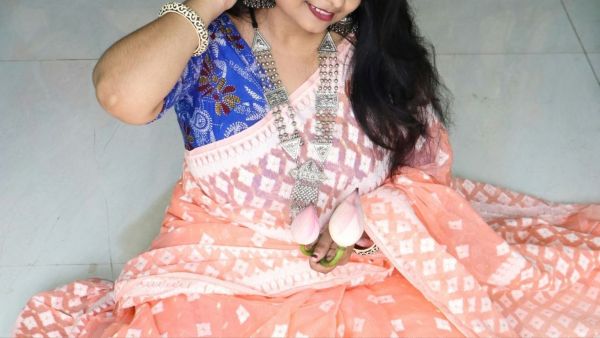 A delicate Dhakai Jamdani sari needs careful cleaning and storage to protect its fine weave and intricate motifs. (Image Source: Unsplash)
The best way to send your Jamdani for cleaning is to take it to the seller you bought it from. He will ship it to the weavers for cleaning and washing.
The entire process, Dileep says, could take a few days to a week, depending on the logistics involved, as most Jamdanis are made around Dhaka and Narayanganj in Bangladesh.
Talking about the costs, Dileep adds, “Given the specialised nature of kaata washing and the logistics involved, the cost for getting a Jamdani cleaned could start from a few hundred rupees – which involves only washing – to a couple of thousand bucks if any restoration or repair work is also required. Costs may also vary depending on the fabric used and its age, as kaata washing of antique Jamdanis will cost more.”
Nabanita advises never to treat a Dhakai Jamdani like an ordinary cotton sari, as its fine motifs and delicate weave need minimal mechanical stress.
Sharing ways to store the sari, she says, “Always fold the saree with the zari side facing inward. This minimises friction against other surfaces and protects the delicate metallic threads from losing their sheen over time. It’s a small adjustment, but something that can make a significant difference in preserving the beauty and radiance of a Dhakai Jamdani for years to come.”
Moreover, Dileep advises avoiding plastic or polythene bags and instead using bags made of breathable fabrics such as cotton to store a Jamdani. This also allows the saree’s fabric to breathe.
DISCLAIMER: This article is based on information from the public domain and/or the experts we spoke to.


