


Summer exhibitions at many German museums tend to be about lighter topics, but Michael Fuchs, curator at the Museumsberg Flensburg in northern Germany, felt that he couldn’t stay indifferent to the current state of the world. “We had planned a different exhibition for this summer,” he told DW.
“But, after war broke out in Ukraine, I had the feeling that I could not display something easy-breezy, and I absolutely wanted to do something on this topic and contribute towards peace, if possible,” he said.

🚨 Limited Time Offer | Express Premium with ad-lite for just Rs 2/ day 👉🏽 Click here to subscribe 🚨
In March, Fuchs received a call from the Berlin-based Russian photographer Dmitry Vyshemirsky, who also suggested organizing an exhibition on the lines of the Ukraine-Russia war.
“And then he suggested we include his friend Yuriy Kosin, who was fleeing Ukraine at that point,” Fuchs said. Kosin lived in Irpin, which was heavily bombarded by Russian forces.
Kosin was forced to leave on foot, fleeing to Kyiv and then to Krakow, where his daughter lives.
“Dmitry reached him on the phone. Yuriy told me later that it was a very, very important moment for him. He knew he had to flee, but on the other side, someone was waiting for him and there was a project being planned there. That gave him courage,” Fuchs recalled.
Ukrainian with a Russian passport
It wasn’t easy to get pictures from the artists. “Let’s say, it was a very unusual exhibition that I had to curate, because I could not invite the photographers for the process [of selecting the images],” Fuchs said, explaining that when Yuriy Kosin fled, he only took the things he could carry with him.
“I first had to organize a laptop for him,” Fuchs said. “I transferred the money so that his daughter could buy one. And then he sent me the photos that he had saved on a hard disk.”
Finally, Fuchs did manage to get high-resolution pictures, which he printed out for the exhibition in Flensburg. It was easier with Vyshemirsky, who lives in Berlin. Fuchs could exchange thoughts with him over the internet, the curator said.
The exhibition is also unusual in the sense that it brings a Russian photographer’s works together with a Ukrainian photographer’s.
Vyshemirsky often says he is a “Ukrainian with a Russian passport,” Fuchs said. Born in Ukraine to a family that was considered “politically unreliable” under the Soviet Union’s repressive regime, Vyshemirsky was forcibly moved by officials many times and finally settled down in in the semiexclave of Kaliningrad, and that is why he has a Russian passport.
“For me, Russia and Ukraine are together in my heart. I have two cultures. I feel sorry when I hear that many artists from Ukraine don’t want anything to do with their Russian counterparts,” Vyshemirsky told German broadcaster NDR.
Kosin also sees the enmity between the people of the two countries as pure propaganda. “There is no conflict between Russians and Ukrainians,” he told NDR. “They have been friends for years.”
All that is getting lost in the war
A soldier’s sharp blue eyes gaze into the camera, children hiding behind a wall, boys splashing around in a stream, people holding the edges of the blue-and-yellow Ukrainian flag at the Maidan: These are some images of Ukraine seen through Vyshemirsky’s and Kosin’s eyes.
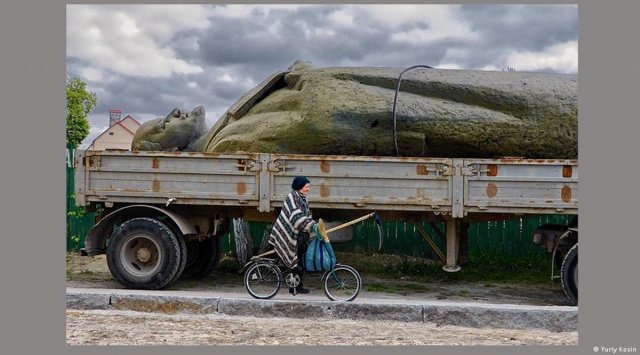
“One of my favorite photos is by Yuriy Kosin,” Fuchs said. The image, taken in 2004 during the so-called Orange Revolution, shows a huge statue of Lenin that was brought down from its pedestal and loaded onto a truck to be transported away. At that moment, a woman farmer rides by on her bicycle, carrying her harvest. “I find that such an amazing photo because I can think of nothing else that captures the end of the Soviet Union so succinctly,” Fuchs said.
Many photos were taken 20 or even 30 years ago.
The photos retell the stories of the Orange Revolution, the Euromaidan and the Chernobyl tragedy, Fuchs said, adding that, ultimately, the aim of the exhibition is “to show the public in Germany what kind of a country Ukraine really is, its history and culture. What kind of people live there? What affects them and what all are we losing in this war?”
📣 For more lifestyle news, follow us on Instagram | Twitter | Facebook and don’t miss out on the latest updates!


