This is an archive article published on September 5, 2018

The Feminine Principle

An exhibition chronicles the changing face of women in artist-pedagogue KG Subramanyan’s oeuvre.

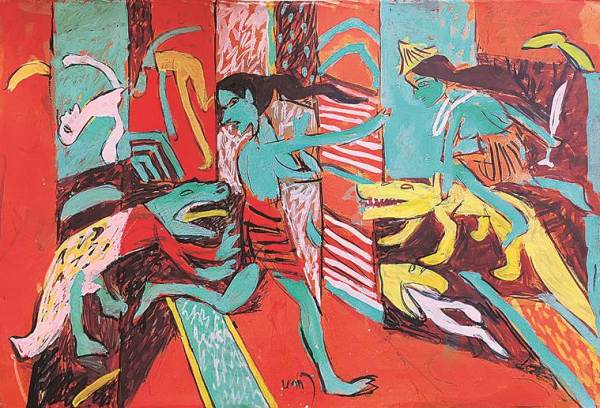
Untitled watercolours on paper from 2006.

I am by nature a fabulist. I transform images, change their character, make them float, fly, perform and tell a visual story. To that extent, my pictures are playful and spontaneous. I do occasionally build round a well-known theme, and give it new implications. The matysa avatar motif, for example, generates the vision of a fish goddess, symbolising elegance and grace or a conference of mermaids. It is unproductive to explain each image as it destroys the mystery of its birth,” said artist-pedagogue KG Subramanyan in conversation with art historian R Siva Kumar in 2014, two years before his death.

Placed as wall text next to his 2014 reverse painting Mermaids Face to Face, the words reflect his thought process from the very beginning of his engagements as an artist, especially in the manner in which his female protagonists altered over the years, which is the focus of the ongoing exhibition at Triveni Kala Sangam in Delhi. Titled “Women Seen and Remembered”, comprising the showcase are over 100 works, interspersed with poems on the walls. “I think there is a clear progression. He is going from women being just by themselves, more submissive at times or a more simplistic depiction, to an empowering nature with multiple layers,” says Tariq Allana, Associate Director, Art Heritage.

Curated primarily from the collection of the Seagull Foundation for the Arts, and with some works from the collection of theatre veteran and renowned art collector Ebrahim Alkazi, the chronological display commences from the early ’50s, when Subramanyan was a young art graduate from Santiniketan, who had recently joined as lecturer at the then newly established Faculty of Fine Art in MS University. The early drawings are studies of models. As Siva Kumar notes in the publication Women Seen and Remembered, “Their main aims being training in observation and an accurate rendering of the visible”.

In the following set, the female body is broken in numerous units, as if the master was developing a method of construction. “Subramanyan tends to underscore the joints and give a certain independence to the component parts, as if they were puppets or mannequins. This allowed him to manipulate each unit independently and with a certain freedom, especially the hand and its gestures,” notes Siva Kumar. In the 1970s, he adds, “The focus shifts from the language of art to the subject of art — in this case, woman, seen from the perspective of a male artist or male viewer”. So the watercolours have women more conscious of their bodies, moving to the ’80s, where the artist notes that a union between a male and female is not always pleasant or even suggests a non-platonic relationship between two women.

Born in Kuthuparamba, North Malabar, Subramanyan might be more known for his socio-political commentary through art, which bridged the traditional and the modern, but the exhibition testifies that he depicted the complexities of the female mind and their multiple roles. The references are wide — if she appears as Durga in a ballpoint pen on paper work from the late ’80s, in the ’90s his women become masked entities that seem to have stepped out from Geek theatre. “For Subramanyan, the mask allows his figures to hover disquietingly between the worlds of reality and artifice, illusion and reality, the known and the unknown, even male and female. The masked person presents him/herself as a not completely definable entity, floating in an amorphous space,” reads the wall text. Another set of drawings from 2005 to 2007 are more corporeal.

Allana directs us to a rather unique series by Subramanyan painted in 2006, where he experiments with the image of the Virgin Mary in gouaches that depict her Annunciation. Mary is not majestic, like she has been portrayed in Renaissance Art, but an “ordinary woman”and angel Gabriel “as a diminutive man with butterfly wings, hovering over her with mischievous intentions”. Subramanyan, after all, was always building connections and playing the role of an “artist-activist”.

The exhibition is on at Shridharani Gallery and Art Heritage, Triveni Kala Sangam, Delhi, till September 9

Vandana Kalra is an art critic and Deputy Associate Editor with The Indian Express. She has spent more than two decades chronicling arts, culture and everyday life, with modern and contemporary art at the heart of her practice. With a sustained engagement in the arts and a deep understanding of India’s cultural ecosystem, she is regarded as a distinctive and authoritative voice in contemporary art journalism in India. Vandana Kalra's career has unfolded in step with the shifting contours of India’s cultural landscape, from the rise of the Indian art market to the growing prominence of global biennales and fairs. Closely tracking its ebbs and surges, she reports from studios, galleries, museums and exhibition spaces and has covered major Indian and international art fairs, museum exhibitions and biennales, including the Venice Biennale, Kochi-Muziris Biennale, Documenta, Islamic Arts Biennale. She has also been invited to cover landmark moments in modern Indian art, including SH Raza’s exhibition at the Centre Pompidou in Paris and the opening of the MF Husain Museum in Doha, reflecting her long engagement with the legacies of India’s modern masters. Alongside her writing, she applies a keen editorial sensibility, shaping and editing art and cultural coverage into informed, cohesive narratives. Through incisive features, interviews and critical reviews, she brings clarity to complex artistic conversations, foregrounding questions of process, patronage, craft, identity and cultural memory. The Global Art Circuit: She provides extensive coverage of major events like the Kochi-Muziris Biennale, Serendipity Arts Festival, and high-profile international auctions. Artist Spotlights: She writes in-depth features on modern masters (like M.F. Husain) and contemporary performance artists (like Marina Abramović). Art and Labor: A recurring theme in her writing is how art reflects the lives of the marginalized, including migrants, farmers, and labourers. Recent Notable Articles (Late 2025) Her recent portfolio is dominated by the coverage of the 2025 art season in India: 1. Kochi-Muziris Biennale & Serendipity Arts Festival "At Serendipity Arts Festival, a 'Shark Tank' of sorts for art and crafts startups" (Dec 20, 2025): On how a new incubator is helping artisans pitch products to investors. "Artist Birender Yadav's work gives voice to the migrant self" (Dec 17, 2025): A profile of an artist whose decade-long practice focuses on brick kiln workers. "At Kochi-Muziris Biennale, a farmer’s son from Patiala uses his art to draw attention to Delhi’s polluted air" (Dec 16, 2025). "Kochi Biennale showstopper Marina Abramović, a pioneer in performance art" (Dec 7, 2025): An interview with the world-renowned artist on the power of reinvention. 2. M.F. Husain & Modernism "Inside the new MF Husain Museum in Qatar" (Nov 29, 2025): A three-part series on the opening of Lawh Wa Qalam in Doha, exploring how a 2008 sketch became the architectural core of the museum. "Doha opens Lawh Wa Qalam: Celebrating the modernist's global legacy" (Nov 29, 2025). 3. Art Market & Records "Frida Kahlo sets record for the most expensive work by a female artist" (Nov 21, 2025): On Kahlo's canvas The Dream (The Bed) selling for $54.7 million. "All you need to know about Klimt’s canvas that is now the most expensive modern artwork" (Nov 19, 2025). "What’s special about a $12.1 million gold toilet?" (Nov 19, 2025): A quirky look at a flushable 18-karat gold artwork. 4. Art Education & History "Art as play: How process-driven activities are changing the way children learn art in India" (Nov 23, 2025). "A glimpse of Goa's layered history at Serendipity Arts Festival" (Dec 9, 2025): Exploring historical landmarks as venues for contemporary art. Signature Beats Vandana is known for her investigative approach to the art economy, having recently written about "Who funds the Kochi-Muziris Biennale?" (Dec 11, 2025), detailing the role of "Platinum Benefactors." She also explores the spiritual and geometric aspects of art, as seen in her retrospective on artist Akkitham Narayanan and the history of the Cholamandal Artists' Village (Nov 22, 2025). ... Read More


📣 For more lifestyle news, click here to join our WhatsApp Channel and also follow us on Instagram

Advertisement
Loading Recommendations...
Advertisement
Advertisement
Latest Comment
Post Comment
Read Comments