


Journalism of Courage
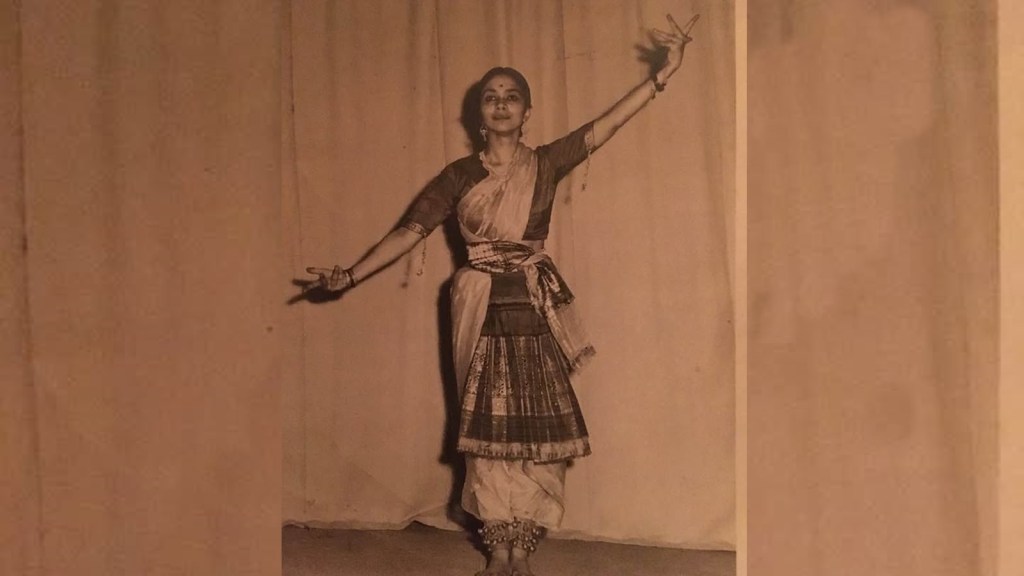 Indu moved back to Karachi in 1951 and married a Pakistani army officer, Aboobaker Osman Mitha. (Instagram/ tehreema_mitha)
The life and times of Bharatanatyam exponent Indu Mitha, who passed away in Dublin at 97 last week after a brief illness, came with numerous twists and turns. The kind that seem as though lifted off a page-turner. Except that Indu’s story isn’t fiction.
In 1951, four years after the bloody Partition, a 22-year-old Indu, daughter of a Bengali-Christian philosophy professor, Gyanesh Chandra Chatterjee, whose family had moved to Delhi from Lahore after Partition, decided to move to Karachi against her parents’ wishes and married a Pakistani army officer, Aboobaker Osman Mitha. The two had met at her uncle’s house party shortly after Partition. A few days later, he saw her again. “I took one look, and my heart turned over… I knew this was the girl I must marry,” wrote Mitha in his memoir years later.
Mitha’s family was as opposed to the match as Indu’s, on grounds of culture and religion, especially amid the divisive space that the Subcontinent had become then. Indu’s older sister, Uma Chatterjee, was married to director Chetan Anand then, which was also not comforting for Mitha’s family, who considered a life around films hardly respectable. Indu’s cousin Kalpana Kartik married Dev Anand in 1954. Indu’s third sister Renu married banker Krishan Khanna, who later became — and remains — a monumental figure in art. Both Renu and Khanna live in Gurgaon.
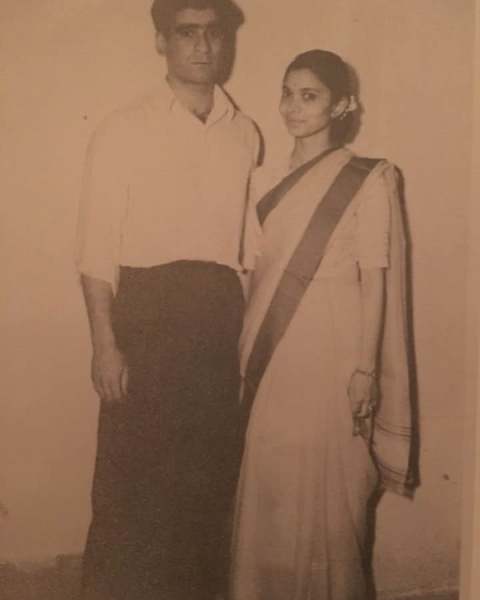 Indu with her husband former Major General of the Pakistani Army, Aboobaker Osman Mitha (Credits: Instagram/ tehreema_mitha)
But despite all odds, Indu crossed over and married Mitha, and the two had three daughters in the following years.
When Indu came to Karachi from Delhi, she brought an unlikely inheritance: Bharatanatyam, the dance form she had imbibed in Delhi and Chennai. Indu had studied philosophy at Delhi University while training in Bharatanatyam under Lalitha Shastry. Shastry was from the first batch of Kalakshetra and had learned under the aegis of Bharatanatyam icon Rukmini Devi Arundale.
Alongside, Indu also studied modern and creative dance with actor and dancer Zohra Sehgal and her husband, Kameshwar Sehgal, at their Zoresh Institute in Lahore while her family still lived there.
Mitha, from a wealthy Bombay family, had joined the British Indian Army in 1942 after graduating from the Indian Military Academy, Dehradun, and served with the Parachute Regiment in Myanmar (Burma then) during the Second World War. After his family moved to Pakistan, Mitha was, in 1954, tasked with setting up the Special Service Group (SSG) of the Army, with help from US Special Forces. He is still known as the ‘Father of the SSG’.
But Bharatanatyam, the art form from Tamil Nadu, was not an obvious choice for a woman making a life in Pakistan, particularly when the country’s cultural ideas became only more conservative with time, mainly in the 1980s. But Indu persisted, and for the next seven decades taught generations of students an art form whose cultural home was far away in the temples and courts of South India — first in Karachi, then in Lahore and later in Islamabad. She taught over 2,000 students. Some of her noted disciples include Amna Mawaz Khan, Iftikhar Masih and her daughter Tehreema, who now runs a dance academy in the US.
“To me, her greatest contribution was teaching young girls in schools in Lahore, who got exposure to Bharatanatyam and later teaching students at her academy, even though there were very few,” says noted Pakistani classical dancer, actor and social activist Sheema Kermani, 75, who was also seen performing classical dance in Ali Sethi’s popular Coke Studio song, Pasoori.
Indu began by teaching dance at Lahore Grammar School and later taught in cantonment houses, schools and academies; performed in drawing rooms and on stages; trained dancers who wanted to and could learn, including her daughter and choreographer Tehreema Mitha. Indu also formed an academy, Mazmoon-e-Shauq, later.
She also experimented with the form’s musical and literary vocabulary, using North Indian instruments and music and setting Urdu poetry to Bharatanatyam, partly because she could not remember all the songs as she was not fluent in Tamil, Telugu and Sanskrit and could not find South Indian orchestras, and partly because she felt that the dance needed to speak to those around her. She translated some of what she remembered into Urdu. This was pioneering work. She was presenting Faiz through Bharatanatyam, rare even in India.
Then came the Zia-ul-Haq years, which were particularly difficult for the arts, especially dance. It was now incompatible with the State’s attempt to define a new Islamic identity. But despite severe odds and many curbs, Indu refused to give up dance and continued to teach. She did so more privately then.
Her daughter’s arangetram in 1986 at the Goethe Institute, as no one else would agree to give them space, took place during the Zia regime. With the organisers providing no help, Indu and Tehreema had to sweep the stage before the performance. Indu contributed to numerous choreographies of Tehreema, including one where a pregnant woman, deserted by her beloved, wants to have the baby.
“This woman’s character is unlike the traditional woman in the classical Bharatanatyam repertoire, who either pines for her lover or portrays her heartbreak… the choreography breaks that mould of traditional Bharatanatyam repertoire and of the female character by raising this unconventional theme and by inherently questioning social mores,” writes Indu’s student Feriyal Aslam in her dissertation Choreographing [in] Pakistan: Indu Mitha, Dancing Occluded Histories in ‘The Land of the Pure’.
Noted Pakistani Kathak dancer Nahid Siddiqui, who trained under Pandit Birju Maharaj in Delhi in the mid-1970s before moving to the UK during General Zia-ul-Haq’s period of martial law, met Mitha in Islamabad at a workshop she conducted at Indu’s academy.
“The spark of an artiste is her life. In a place like Pakistan, where the promotion of classical dance is difficult, and there’s hardly any encouragement, one loses one’s spirit. So, I do think Indu ji felt isolated. But I always saw a sense of calm and peace on her face. She was a very fine woman, always in a sari, and she would almost always attend my performances in Pakistan. But all of us who dance and are from Pakistan have suffered a lot,” Siddiqui, who has been living in exile in London since her popular 13-episode show Payal was taken off the air after six episodes in 1978, says.
But despite this, Indu persevered, teaching those who were willing and making a place for Bharatanatyam in a country where its presence was often complicated.
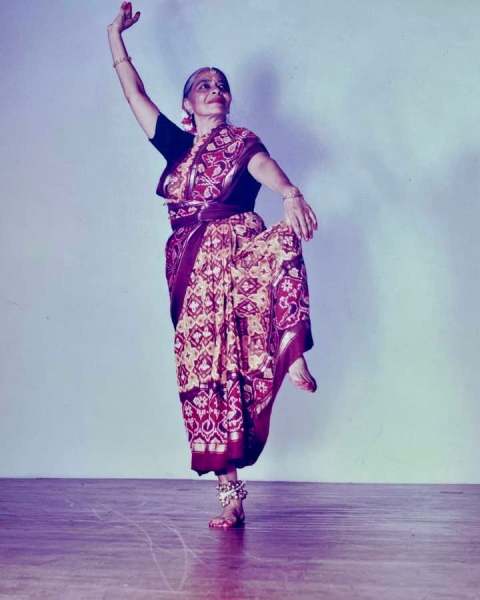 Bharatanatyam exponent Indu Mitha. (Credits: Instagram/ tehreema_mitha)
Sheema Kermani, one of Pakistan’s most prominent classical dancers and choreographers and the founder of the feminist cultural group Tehrik-e-Niswan, met Indu in 1984 after she returned from India after training at Delhi’s Shriram Bharatiya Kala Kendra, where she learned Bharatanatyam under Leela Samson, Kathak under guru Ram Mohan and Odissi under guru Mayadhar Raut.
“I had just come back to Pakistan and was looking for other dancers in the country. Most dancers (like Siddiqui) had left by then. So, from Karachi, I went to see her in Lahore. I tried to understand how she managed. Indu ji didn’t perform very much and mainly taught. Once I invited her to Karachi to act in a play and she did. When I went to India again in 1988 and came back with more training in Odissi, she was very interested in learning about it,” says Kermani, now 75.
Indu also appeared in the documentary ‘How She Moves’ (2020), which followed her and her students as she prepared for what was intended to be her final recital. Indu, however, later objected to the film, writing that the film represented the filmmaker’s ideas, and not hers.
Mitha was awarded the Presidential Award for Pride of Performance in August 2020 for her exceptional contributions to classical dance and the arts.


