


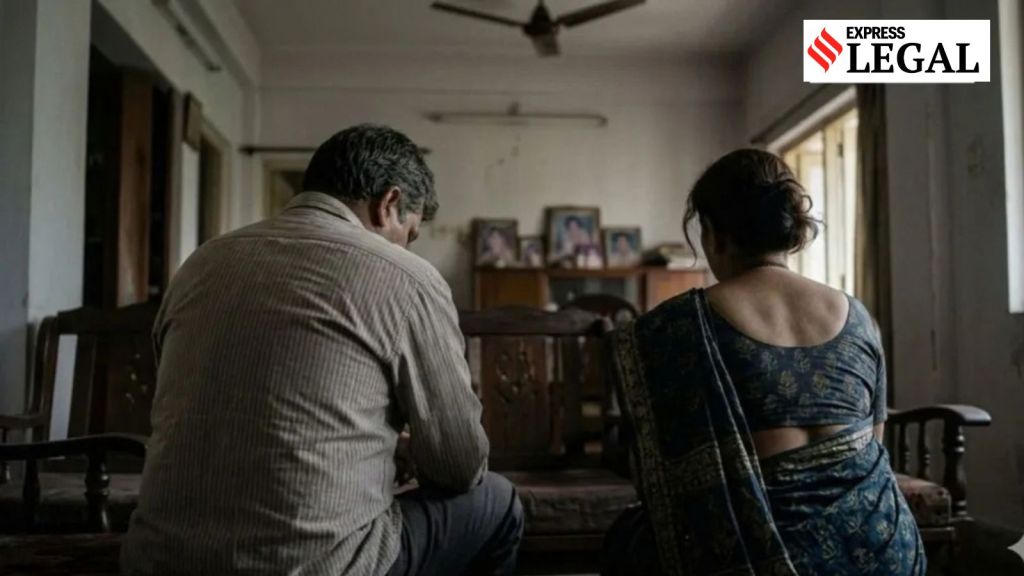
 After examining the evidence and material on record, the court held that the husband failed to substantiate the allegations of cruelty. (AI-generated image)
The Jharkhand High Court recently upheld the dismissal of a husband’s divorce plea, observing that his wife’s wish that he live with her as a “gharjamai” did not amount to matrimonial cruelty. Gharjamai refers to the practice of a married man permanently living in his wife’s parental home.
The bench of Justices Sujit Narayan Prasad and Sanjay Prasad on September 15 dismissed the husband’s appeal against a family court’s order that had rejected his divorce plea on the ground of cruelty.
“Mere wish of respondent-wife that the appellant-husband should live as Gharjamai will not constitute cruelty for the purpose of Hindu Marriage Act,” the order read.
According to the husband, the marital relationship began peacefully, but differences arose after his wife started frequently visiting her parental home. He claimed that her parents wanted him to leave his parents and live with them. He said he refused the gharjamai because there was no one else to look after his own parents.
The husband stated that he has been under tremendous mental pressure due to this incident and also faced social stigma. The wife, however, disputed the allegations. She claimed that she was being physically, mentally and economically tortured, and that despite this, she tolerated everything by remaining silent in the hope of a peaceful and happy conjugal life in the future. It was further stated that she wanted to continue the marriage and live with her husband.
 Justices Sujit Narayan Prasad and Sanjay Prasad said simple issues, which can be described as reasonable wear and tear of married life, cannot amount to cruelty.
The high court noted that the husband claimed cruelty on the ground that his wife and her relatives wanted him to live as a gharjamai, which he did not agree to since his parents were old and there was no one to look after them. The next ground of the husband towards cruelty was that his wife frequently visited her parental house.
The court observed that “cruelty” under matrimonial law consists of conduct so grave and weighty as to lead one to the conclusion that one of the spouses cannot reasonably be expected to live with each other. It must be more serious than the ordinary wear and tear of married life.
It noted that simple issues, which can truly be described as a reasonable wear and tear of married life, cannot amount to cruelty. “In many marriages each party can, if it so wills, discover many a cause for complaint but such grievances arise mostly from temperamental disharmony. Such disharmony or incompatibility is not cruelty and will not furnish a cause for the dissolution of marriage,” the court said.
After examining the evidence and material on record, the court held that the husband failed to substantiate the allegations of cruelty.
“The issue of cruelty as has been alleged by the appellant-husband against his wife could not be proved and the learned Family Judge has rightly observed that that visiting parental house is as good as a right to every bride and mere wish of respondent-wife that the appellant husband should live as Gharjamai will not constitute cruelty for the purpose of Hindu Marriage Act,” the court said.
The court held that such allegations cannot be termed cruelty for divorce by any stretch of imagination, refused to interfere with the family court’s judgment, and dismissed the husband’s appeal.