


Journalism of Courage
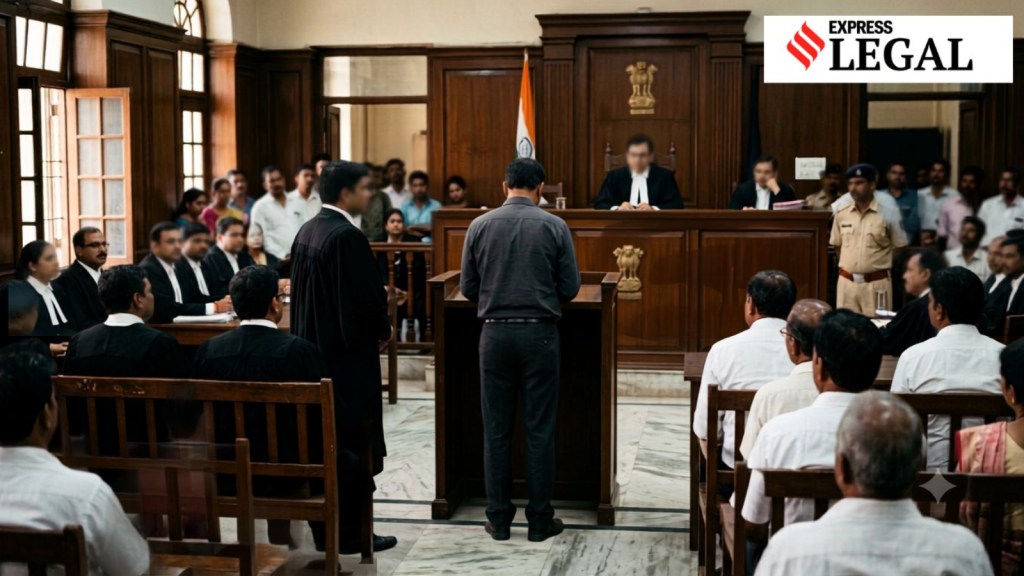 The Calcutta High Court observed that there was no shadow of a doubt that the further prosecution of the husband would operates solely as an instrument of harassment. (Ai-generated Image)
Observing that “an undertaking given to a court of law is not a mere formality or a hollow promise”, the Calcutta High Court has quashed a cruelty case filed by a woman against her estranged husband after it came on record that she had refused to withdraw the case even after getting a divorce by mutual consent.
Justice Uday Kumar was hearing a plea filed by the man, who said that after over three years of separation, a Family Court on April 18, 2023, granted divorce. He claimed that the wife had then given an undertaking to withdraw the criminal case pending against him in Kolkata.
The High Court noted that under the Indian legal system, an undertaking given to a court of law was not a “mere formality” or a “hollow promise” but constituted a “solemn commitment”.
“When a party secures a substantive legal remedy—such as the dissolution of a marriage—by holding out an assurance to the court that they will perform a reciprocal act (such as withdrawing a criminal case), that party is bound by the doctrine of equitable estoppel and the binding nature of judicial records”, the September 15 order read.
According to the court, the refusal of the wife to abide by her undertaking “cannot prejudice the petitioner or keep a dead criminal prosecution alive”.
The couple had registered their marriage on July 19, 2018, followed by a social marriage on December 11, 2019, in Kolkata. The husband claimed that thereafter, the wife resided at the matrimonial home for about 45 days. However, owing to the “temperamental differences and domestic incompatibilities”, they moved to a rented accommodation in New Delhi.
According to the husband, the marital discord escalated sharply and on March 22, 2020, immediately before the nationwide Covid-19 lockdown, the couple permanently separated. Subsequently, the wife filed a plea before a trial court in West Bengal, as a result of which the judge ordered a criminal case to be registered against the husband for ‘subjecting his wife to cruelty’.
However, despite the divorce and remarriage of the wife, she refused to appear before the court to withdraw the criminal case, and the husband remained stuck in a criminal trial in Kolkata.
Advocates Abhay Singh and Abhimanyu Banerjee, appearing for the husband, argued that continuing the criminal case against the husband was an “abuse of the process of law”. The counsel contended that, after getting the benefit of the divorce decree, the “subsequent refusal” of the wife to honour the undertaking given in court would mean “sheer bad faith and a fraud upon the judicial mechanism”.
The High Court recorded that despite service of notice, no one had appeared on behalf of the wife and that her stand was shown in the judicial records of the Delhi Family Court, “where she voluntarily submitted to the jurisdiction of the court, verified the joint statements, acknowledged the receipt of all settlements and stridhan, and consented to the dissolution of marriage”.
Public Prosecutor Priti Kar Bagchi appeared for the state.
The High Court noted that the criminal case was “an offshoot of a matrimonial dispute that has now been fully extinguished by a competent court of law” and all financial settlements have been finalised, properties and stridhan exchanged, and the wife has moved on with her life.
To hold that criminal proceedings must nevertheless continue in a distant court in West Bengal, the court said, would be to ignore the reality of an irretrievably broken marriage and to reduce criminal law into an engine of oppression.


