


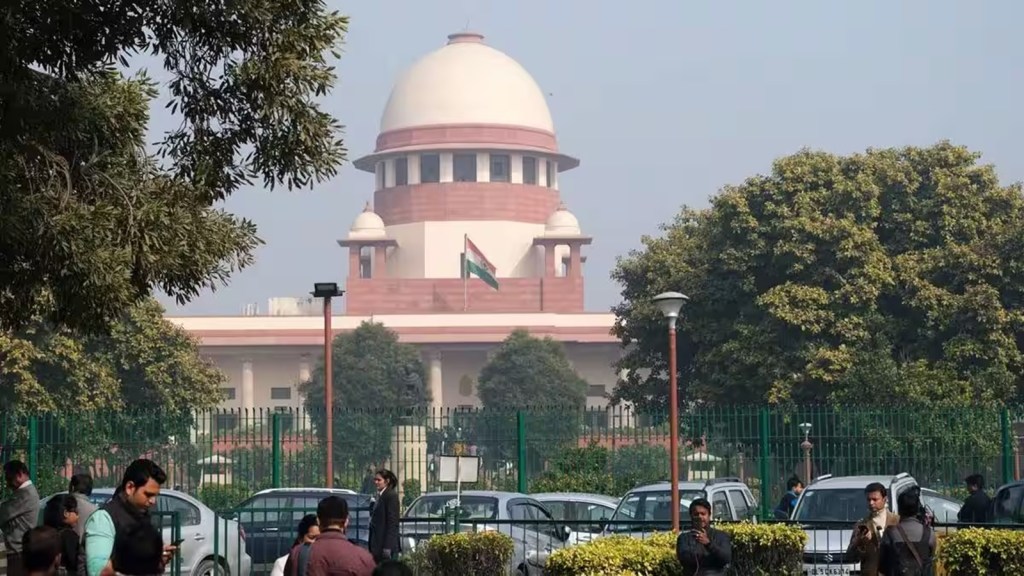
 The Supreme Court has directed a petitioner alleging unauthorised social media uploads of court video clips to first seek their removal through online intermediaries under the IT Act (File photo).
UNDERLINING THAT the development of a child “is integrally connected to the role of an elementary school teacher”, the Supreme Court on Thursday upheld a Public Notice issued by the Member Secretary of the National Council for Teacher Education (NCTE) Executive Committee, requiring Teacher Education Institutions (TEIs) to file annual Performance Appraisal Reports.
In its judgment, two days before the country celebrates Teachers’ Day, a bench of Justices P S Narasimha and Alok Aradhe set aside a March 13, 2023 Delhi High Court order, which held the September 22, 2019 Public Notice of NCTE as arbitrary and illegal.
“In conclusion, we hold that the Public Notice issued by the Member Secretary of the Executive Committee is legal and valid and the Division Bench of the High Court committed an error in setting aside the said Public Notice. The Council as well as the Executive Committee is within its jurisdiction to call TEIs to upload Performance Appraisal Report,” the bench said.
The notice was challenged on the ground that the Council alone could have issued and implemented the notice and not the Executive Committee.
The SC, however, said it is “not in agreement with the approach adopted by the High Court”. “We are of the opinion that there is ample empowerment of the Council as well as the Executive Committee to call for annual Performance Appraisal Report from institutions imparting teacher education,” the court said.
“We fail to understand as to how a regulatory measure of a statutory body, empowered to achieve planned and coordinated development of teacher education system in the country could be restrained from calling upon the TEIs to file Performance Appraisal Report. We are of the opinion that even without a specific empowerment under the statute, such a regulatory measure can always be incidental and ancillary to the duties and functions of a regulator. As there is a performance audit of NCTE itself by the Comptroller and Auditor General of India (CAG), it is but natural and incidental that NCTE would require the stakeholders, over which it exercises the regulatory jurisdiction, to provide the necessary Performance Appraisal Report,” the court said. It added that “it is necessary for the Council and its bodies to ensure accountability of educational institutions”.
Setting aside the HC Order, the SC said Section 23 of the Right of Children to Free and Compulsory Education Act, 2009 (RTE Act), recognises the importance of qualified teachers for effective exercise of the right to education of children and, therefore, provides for an ‘academic authority’ to lay down the minimum qualifications…The ‘academic authority’, contemplated under Section 23, is the…Council, established under the National Council for Teacher Education Act, 1993…”.
The judgment pointed out that the SC had in its January 13, 2026 order in Dinesh Biwaji Ashtikar v. State of Maharashtra & Ors., “declared that the real consequence of identifying the right of elementary education as a fundamental right is in the recognition of five duty-bearers — (i) the appropriate Government, (ii) the local authority, (iii) the neighbouring school, (iv) the parents/guardians and (v) the elementary school teacher”.
The SC said that “in order to fasten these duty-bearers with the obligation to ensure quality education, we must add to the above, sixth and seventh duty-bearers. The sixth being institutions recognised for imparting courses to educate and train teachers, the Teacher Education Institutions (TEIs), as defined under Section 2(e) of the NCTE Act”, and the seventh duty-bearer being the NCTE.
“The Council is entrusted with the duty to achieve planned and coordinated development of the teacher education system throughout the country. The Council is also to ensure that the TEIs imparting teacher education function effectively, efficiently and conduct their affairs with integrity”, the SC said, adding that “we have no hesitation in declaring that the duties to be performed by the Council and the bodies that are constituted along with it, such as the Executive Committee and the Regional Committees, are perhaps the highest of all the duty-bearers”.