4 min readNew DelhiApr 24, 2026 11:31 AM IST
First published on: Apr 23, 2026 at 06:23 PM IST
Supreme Court news: On Day 8 of the hearing on Thursday, in the Sabarimala reference case, the nine-judge bench made some striking observations, ranging from the issue of non-Hindu denominations to the issue of the entry of women in the mosque.
During the hearing, the senior advocate Neeraj Kishan Kaul referred to the Indian Express article, written by Shashi Tharoor, saying that there is never any harm in all humility. If knowledge and wisdom come from any source, any country, any university, they should be welcome. We are far richer in jurisprudence not to accept all forms of knowledge and information at that time, on which Justice BV Nagarathna said, ” But not from WhatsApp University.”

While deliberating on the denominations, Justice BV Nagarathna said, “One way in denomination is…temple follows Shaivite worship, Vaishnavite worship, or Sri Vaishnavite worship at least in South India. They are the practices. Therefore, it is called a denomination.”
She continued, “Now, if it is a Shaivite type of worship, then the Vaishnavites cannot say that it has to be like a Vaishnavite form of worship, but there is a difference…Therefore, that form of worship is protected. That has nothing to nothing to have an organisation. Not necessary. A Hindu is a Hindu. He can go to any temple.”
Justice Nagarathna said that Non-Hindu religious denominations also have to be protected.
Justice Ahsanuddin Amanullah: “Suppose you don’t want to be called a Hindu, but you still have a practice and worship is a part of religion. Now, if you belong to the community, you may not be identified as a Hindu per se, but if you are governed by the personal laws of the Hindus, the marriage laws of the Hindu, then automatically you come under the Hindu denomination, and then the worship is a facet of the religion. You come under the Hindu religion. How are you out there?”
Justice Amanullah raised this question when the senior advocate Jayanth Muthuraj argued, ” Please, don’t test my practice as a whole Hindu religious practice.”
When senior advocate Guru Krishnakumar submitted, “Hinduism swings like a pendulum. Pendulum between the limits of theistic theism and atheistic atheism. That’s the extent to which my lord, the religion swings.” Justice BV Nagrathna said, “You look at it only from the Hinduism point of view. Non-Hindu religious denominations also have to be protected.”
“Basically, it’s for a natural person, not for a juristic person… now they are saying the idol will have a conscience. Will the idol have a conscience?” Justice Nagarathna remarked.
Background
The apex court is hearing the pleas concerning discrimination against women at religious places, including the Sabarimala temple, and the scope of religious freedom under the Constitution.
A nine-judge bench headed by Chief Justice of India Surya Kant is hearing the case, which also includes Justices B V Nagarathna, M M Sundresh, Ahsanuddin Amanullah, Aravind Kumar, Augustine George Masih, Prasanna B Varale, R Mahadevan, and Joymalya Bagchi.
On September 28, 2018, a five-judge bench of the Supreme Court, by a 4:1 majority, lifted the age restriction on women visitors and struck down as unconstitutional Rule 3(b) of the Kerala Hindu Places of Public Worship Rules, 1965, which allowed the exclusion of women on the grounds of custom.

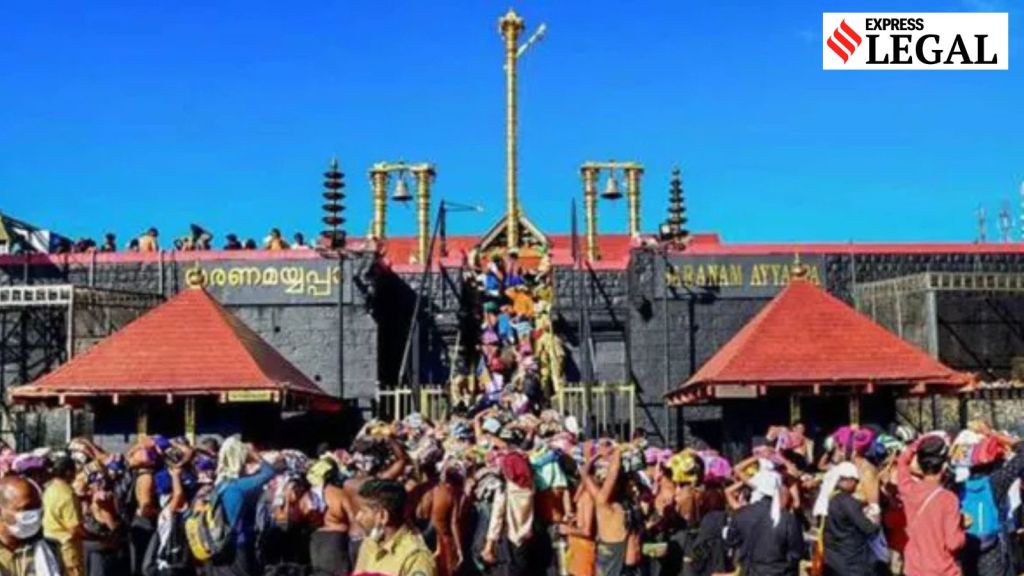 On Thursday, the apex court concluded the Day 8 hearing in the matter. (File Photo)

 Justice Nagarathna said that Non-Hindu religious denominations also have to be protected.


 Share


