


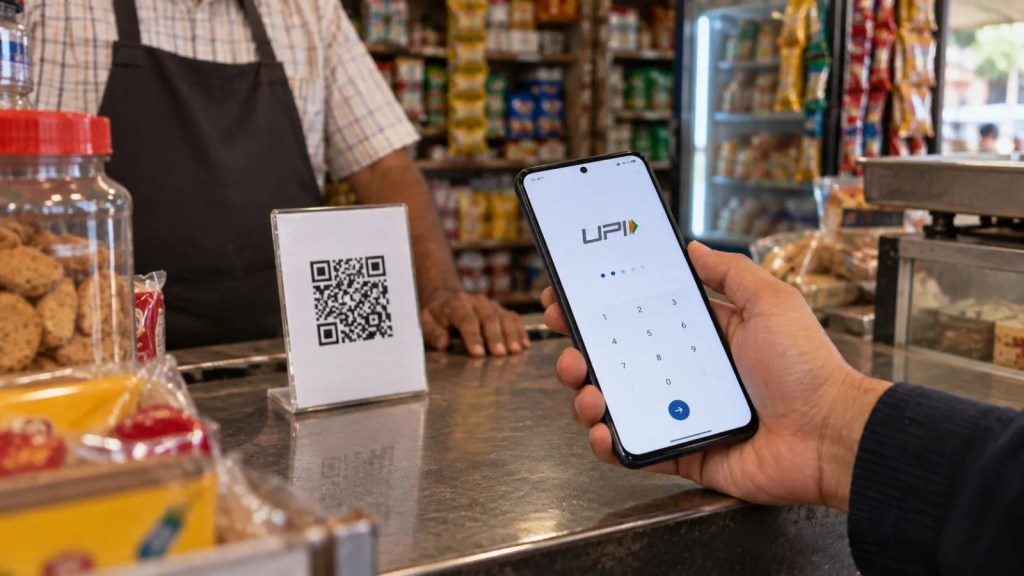
 UPI application providers are “expressly prohibited from imposing platform fees or hidden charges”, the Finance Ministry said.
The Supreme Court Monday refused to stay the Centre’s decision to impose a Merchant Discount Rate (MDR) of 0.4 per cent on specified UPI person-to-merchant transactions above Rs 2,000, even as the government clarified that it is not a tax or fee.
A three-judge bench presided over by Chief Justice of India Surya Kant sought the response of the Reserve Bank of India (RBI) and National Payments Corporation of India (NPCI) on a petition which challenged the gazette notifications issued by the Union Ministry of Finance announcing the Rate.
The bench, also comprising Justices Joymalya Bagchi and V Mohana, made it clear that it was only examining the legal incidence of the decision.
Appearing for the Centre, Additional Solicitor General N Venkataraman said MDR has yet to come into effect and is likely to take effect only on October 15.
“Ninety-six per cent of people using the gateway are exempted, and of the balance 4 per cent, essential services are capped at Rs 5. There is (also) a value cap; any threshold to the merchant beyond Rs 75,000 is capped at Rs 300, whether it’s Rs 1 crore or 10 crore or 100 crore. The collection charges at the moment are less than half a per cent with all these limitations”.
‘Statutory collection’
Justice Bagchi asked whether it’s a tax or a fee, to which Venkataraman said it is neither a tax nor a fee.
“If not, what is the executive scope of making this expropriation?” asked Justice Bagchi.
Venkataraman said, “It’s not an expropriation also”.
Justice Bagchi then sought to know MDR’s character. Venkataraman referred to the case of credit cards and debit cards and said a cost-sharing agreement is involved there too among the stakeholders.
“UPI also involves banks and aggregators. It’s not a statutory collection by the Government of India. NPCI, the nodal body, facilitates. Government of India is not taking a rupee of this,” the law officer said.
The court asked Venkataraman to submit whatever he wanted to say on affidavit, to which the law officer agreed.
Though towards the end of the hearing, the petitioner’s counsel sought a stay, saying the decision would lead to further corruption and black money, the court refused to stay it.
Advocate Anjan Datta filed the Public Interest Litigation, challenging the government’s decision to introduce MDR on certain UPI merchant transactions.
All about MDR
MDR regime for UPI transactions was announced on September 15. MDR is the fee merchants pay to the entities that help facilitate a digital transaction: banks, payment service providers, and third-party apps.
It will be levied on payments to a merchant above Rs 2,000, at a uniform rate of 0.4 per cent (with a few exceptions). This is supposed to be a charge “within the merchant payment ecosystem” — and not on customers making UPI payments.
The government has “advised” banks to ensure that merchants do not pass MDR charges to customers. UPI application providers are “expressly prohibited from imposing platform fees or hidden charges”, the Finance Ministry said.
The government’s new framework ends nearly six years of zero-MDR UPI payments for specified transactions. Under the framework, a 0.4 per cent MDR will be levied on person-to-merchant UPI payments above Rs 2,000 from October 15.
The charge will be capped at Rs 300 for transactions of Rs 75,000 and above.
Certain essential and thin-margin sectors, including railways, telecom, insurance, fuel and agricultural inputs, will instead be charged a flat MDR of Rs 5 per transaction for payments above Rs 2,000.
Transactions involving mutual funds, securities, stockbrokers and dealers will attract a lower MDR of 0.02 per cent, subject to a maximum cap of Rs 300.
Person-to-person (P2P) UPI transfers will continue to remain free, regardless of the transaction amount. Such transfers account for around 37 per cent of UPI transaction volume and about 70% of its transaction value.
The Centre’s framework keeps everyday P2P payments and small-value merchant transactions outside the new charge while introducing MDR for specified higher-value merchant payments.