


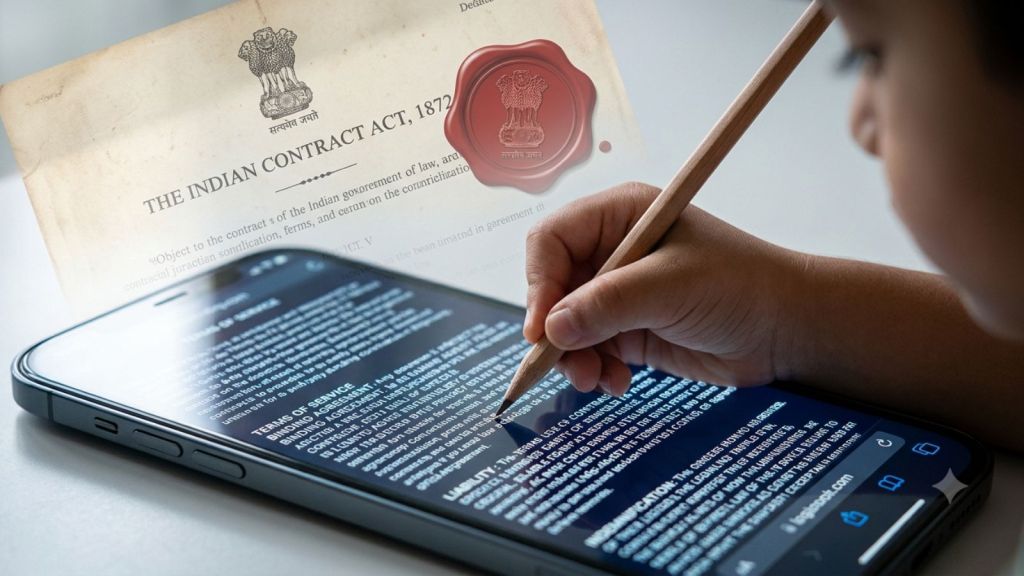
 The petition argues that a minor cannot enter a contract under Indian law and questions how he/she can be allowed to accept online agreements with social media platforms while creating accounts. (AI generated image)
UNDERSCORING THE need for safeguards, the Supreme Court on Thursday sought the Centre’s reply to a petition seeking measures to bar minors from creating and operating social media accounts.
The petition argues that a minor cannot enter a contract under Indian law and questions how he/she can be allowed to accept online agreements with social media platforms while creating accounts.
A three-judge bench led by Chief Justice of India Surya Kant issued notice to the Ministries of Electronics and Information Technology and Law and Labour on the petition by NGO Just Rights for Children Alliance.
Appearing for the petitioner, Senior Advocate H S Phoolka told the bench, also comprising Justice Joymalya Bagchi and Justice V Mohana, that in the United States a child for social media purposes has been defined as someone under 13 years. He added that under Indian law, a contract cannot be entered into by those under 18.
Agreeing with the concerns, the CJI said, “We need some safeguard in India.” Justice Bagchi added, “There should be some firewalls.”
The PIL filed through Advocate Saksham Maheshwari pointed out that children below the age of 18 years are currently permitted to independently create and maintain social media accounts despite their statutory incapacity to enter a contract under Section 11 of the Indian Contract Act.
“It is well-settled that an agreement entered into by a person who was a minor on the date of execution is void ab initio (void from the beginning). The absence of an effective and uniform mechanism giving practical effect to such statutory incapacity in the digital environment exposes children to foreseeable risks, including online grooming, sexual exploitation, trafficking, behavioural profiling, misuse of personal data, cyberbullying, exposure to age-inappropriate content and other harms affecting their safety, dignity, development and well-being,” the plea stated.
It urged the court to direct the government to ensure that minors are not permitted to enter into contracts with digital platforms, including social media. The plea, however, said minors must be permitted access to educational content through accounts maintained and controlled by their parents or guardians.
The petition also seeks directions to social media platforms to implement effective age-assurance mechanisms and to stop allowing independent accounts of minors. The PIL pointed out that there is a “fundamental legal and regulatory inconsistency” in minors accessing social media. “Under Section 3 of the Majority Act, 1875, a person attains majority only upon completing 18 years. Under Section 11 of the Indian Contract Act, 1872, a person who has not attained the age of majority is not competent to contract,” it said.
Social media platforms operating in India presently permit minors, generally aged 13 years and above, to independently create and maintain accounts by merely declaring their age or date of birth, the petition said.
“Such account creation ordinarily involves acceptance of contractual terms such as Terms of Service, User Agreements, Privacy Policies, etc, governing the relationship between the platform and the user,” it said. The petitioner questioned how a person statutorily incompetent to independently enter a contract could be permitted to maintain a contractual relationship governing accounts on social media intermediaries, gaming and other digital platforms, merely because the contract is concluded electronically.
“Section 10 A of the Information Technology Act, 2000 recognises contracts formed through electronic means but does not confer substantive contractual capacity upon a person who is otherwise incompetent to contract under Section 11 of the Indian Contract Act, 1872. The technological form of acceptance, including click-wrap acceptance or continued use of a platform, cannot therefore alter the substantive legal capacity of a minor,” the petition said.
The NGO said the Information Technology (Intermediary Guidelines and Digital Media Ethics Code) Rules, 2021 prescribe due-diligence obligations upon digital media publishers regarding harmful content, protection of children, grievance redressal and reporting of offences.
The IT Rules, 2021, however, are conspicuously silent on the contractual capacity of a minor to access and use the services of a social media intermediary or digital platform. “Neither the said Rules nor the parent enactment prescribe any verifiable age-gating mechanism, parental-consent protocol or other safeguard to prevent a child below the age of 18 years, who is incompetent to contract under Section 11 of the Indian Contract Act, 1872,” it said.
The NGO said it “has directly assisted children in cases where online interaction has resulted in grooming, removal of children from their homes, trafficking and harassment”. “In a recent instance, two minor girls were rescued after being allegedly lured through Pinterest and a language-learning application with promises of becoming K-pop idols in South Korea. The girls were persuaded to leave their homes and were being moved towards Siliguri and the international border region as part of a pre-planned journey allegedly orchestrated by individuals they had met online,” it said.
“The matter was assisted by Shakti Vahini, an allied organisation of the petitioner. The incident demonstrates the serious risks of online grooming and enticement of minors through social media and digital platforms, including their removal from home and trafficking. The petitioner has compiled several other reported instances from different parts of the country in which minors have allegedly been groomed, enticed, sexually exploited, subjected to blackmail, induced to leave their homes or moved across states through social-media platforms and online gaming applications. The reported instances include cases involving Instagram, Snapchat, WhatsApp and online gaming platforms, showing a recurring pattern of online contact being used to target and exploit children,” it said.