


Journalism of Courage
 The Patna High Court held that quasi-judicial
authorities must decide cases based strictly on facts and law. (Ai-generated Image)
Quoting Shakespeare’s Othello, the Patna High Court reprimanded a District Magistrate for accusing a man of trying to harass his SC/ST neighbours. The court observed that a person’s good reputation is their most valuable possession and that making personal remarks violates the core principle of a fair hearing.
While expunging the remarks, the High Court held, “A quasi-judicial authority is not expected to make passing references to matters outside the record or irrelevant to the adjudication. The uncharitable and unwarranted comments made by the District Magistrate, Sitamarhi, against the petitioner, who happens to be a Sanskrit scholar, need to be reprimanded.”
Justice Alok Kumar was hearing the man’s plea alleging that the district magistrate had passed “unwarranted personal remarks” against him while rejecting his appeal over a complaint about a clogged public drain polluting his agricultural land.
While referring to a famous passage from William Shakespeare’s Othello, the court said that the crux of the passage was about a “person’s good reputation” being the “most valuable possession”. “While money and material wealth are trivial, fleeting, and easily replaced, a good reputation is priceless. Destroying someone’s name does not benefit the slander, yet it leaves the victim completely ruined,” the court said on September 18.
The court noted that “quasi-judicial” authorities must decide cases based strictly on facts and law, personal remarks, insults, or biased observations violate the core principle of a fair and objective hearing. “The scope of a quasi-judicial body is limited to resolving the specific dispute before it; commenting on the personal character, morality or background of a litigant, unrelated to legal merits, is an abuse of power. Superior Courts have repeatedly held that lower Courts, tribunals, and quasi-judicial authorities must use sober, temperate, and respectful language.”
 Justice Alok Kumar stated that a quasi-judicial authority was not expected to make passing references to matters irrelevant to the case.
Acting on the man’s complaint, the Block Development Officer (BDO), Riga, submitted a report before the Sub Divisional Public Grievance Redressal Officer (SDPGRO), Sitamarhi Sadar, pointing out certain defects in the drain.
A further report stated that earlier, with the agreement of the man, the drainage water had been allowed to flow into his land, but the man subsequently stopped it, resulting in no passage of water through the drain that was also confirmed by a further report.
The man also alleged that he had again filed a complaint, where he had sought inspection of the drain and raised his grievance regarding losses because of the seepage. It came on record that based on the complaint, the SDPGRO directed the BDO to repair the drain so that water could flow to the designated government spot, and the case was closed. Aggrieved by the order, the man filed an appeal before the Additional Collector, Sitamarhi, which was also dismissed.
According to the man, his second appeal, which was filed before the District Magistrate, Sitamarhi, was dismissed on February 25, 2023, where, without any valid basis, it was mentioned in the order that the man “appeared to have a mentality to harass persons belonging to the SC/ST communities residing in the neighbourhood” and the Sub Divisional Officer, Sitamarhi, Sadar had been directed to enquire into the matter and submit a report.
Aggrieved by the remarks, the man filed a review petition before the Divisional Commissioner, Tirhut Division, Muzaffarpur, which was also rejected on May 2, 2023, on the ground that there was no law for review under the Right to Public Grievance Redressal Act. The man eventually moved the High Court.
The bench stated that since there was a report from the authorities that no waterlogging was visible on the man’s land, it did not want to interfere with the order of the authorities to that extent. However, the court noted that the uncharitable and unwarranted comments made by the district magistrate required “serious consideration, as they impact an individual’s reputation”.
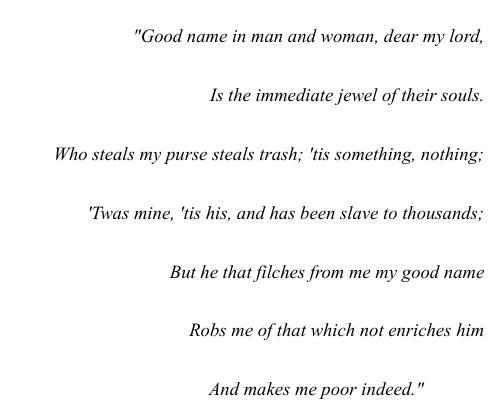 The passage from Othello by William Shakespeare that the court referred to.
Advocate Abhinav Srivastava, appearing for the man, submitted that the action of the District Magistrate of passing “uncharitable and unwarranted remarks” against the man and “branding him as a person harbouring a mentality to harass members of the SC/ST community” was made without any valid basis “only on account of prejudice and preconceived notions and clearly amounts to abuse of power”.
The counsel contended his client was a “law-abiding citizen” and a “well-respected” Sanskrit scholar and someone who held the office of vice-chancellor of a state university. “Such remarks, without any foundation, lower his reputation and social standing in society and are stigmatic in nature,” he added.
The State’s lawyer, on the other hand, argued that it was found in the investigation that the drain was dry with no water flow, that some poor families residing at one end of the drain brought water for daily consumption from other places, and that there was no such source from which continuous flow of water could be taking place on the land of the man, and no waterlogging was visible on the man’s land. The counsel defended the remarks, saying they were protected under law and were made in good faith.


