
“The requirement to give reasons by the Medical Board is crucial, critical, decisive and necessary for the purpose of granting or denying disability pension and it is not a mere formality,” the court said on September 2. It held that reasons supporting a medical board’s opinion are essential when that opinion can determine a serviceman’s discharge and entitlement to disability pension.
Kumar was enrolled in the Army Medical Corps on April 30, 1998, and discharged on April 30, 2022, in the low medical category during an extension of his service limit. The judgment records that he had rendered 27 years, three months and two days of service.
Justices Alok Mathur and Amitabh Kumar Rai noted that the Medical Board had failed to record Kumar’s medical history or give adequate reasons for its opinion. (Image enhanced using AI)
Seizure disorder during service
The release medical board held at Military Hospital, Bareilly, on March 3, 2022, assessed Kumar’s disability, described in the order as “Seizure Disorder (G40.9)”, at 20 per cent for life. It nevertheless concluded that the disability was neither attributable to nor aggravated by military service in the Army, leading to rejection of his disability pension claim.
The medical proceedings examined by the high court recorded the first start of the seizure disorder as August 5, 2018, at Lucknow. The records also showed that he was treated at Base Hospital, Delhi Cantonment, from August 20, 2018. The court noted that there was no record of the disease when Kumar entered the Army.
The applicable rules provide that a disease leading to discharge would ordinarily be deemed to have arisen during service in the Army if it was not noted when the serviceman entered the armed forces. But the court made clear that this did not, by itself, establish that the seizure disorder was caused by military service in the Army. A causal connection between the disability and service conditions is required for it to be treated as attributable to or aggravated by service.
Story continues below this ad
Unexplained medical conclusion
The Union government relied on the medical board’s opinion, pointing out that the seizure disorder first surfaced while Kumar was on leave at Lucknow, a peace station, with no evidence of service-related trauma or infection. However, the high court found the board’s reasoning inadequate.
The board had marked “NO” on both questions of whether the disability was attributable to or aggravated by service, but gave only a brief justification based on his being on leave in a peace area and the absence of trauma or infection.The bench noted that the medical records contained little detail and did not record Kumar’s medical history.
It said the board had failed to give sufficient reasons for its conclusion. The court stressed that medical boards are required to state reasons for their opinions. It held that if a serviceman is discharged or denied disability pension on the basis of an unexplained medical opinion, such action cannot be sustained in law.
Peace posting
The high court also considered the argument that Kumar was at a peace station when the condition was first recorded. It noted that the applicable regulations make it immaterial whether the cause of a disability arose in a field or active service area or under normal peace conditions. The rules also require direct and circumstantial evidence to be considered and provide for the benefit of reasonable doubt to the individual where applicable.
Story continues below this ad
The court referred to the tribunal’s observation that peace stations also involve rigorous military training in the Army and associated stress and strain. The tribunal had found that the reasons given by the medical board were insufficient to deny Kumar disability pension.
The high court also referred to medical guidance stating that seizure disorders may develop at different ages without an obvious discoverable cause. It noted that sleep deprivation, emotional stress, physical and mental exhaustion, infection, fever and loud noise may trigger seizures.
The high court did not disturb Kumar’s discharge from service in the Army on medical grounds. Instead, it held that the denial of disability pension could not stand because the medical opinion relied upon by the authorities was not supported by adequate reasons. The bench directed that Kumar be granted disability pension with immediate effect, along with all attendant benefits, as per the rules.





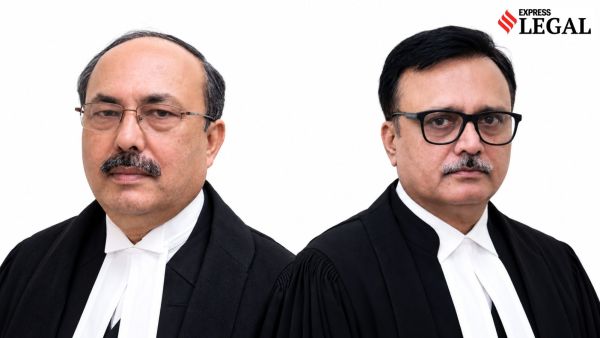 Justices Alok Mathur and Amitabh Kumar Rai noted that the Medical Board had failed to record Kumar’s medical history or give adequate reasons for its opinion. (Image enhanced using AI)
