


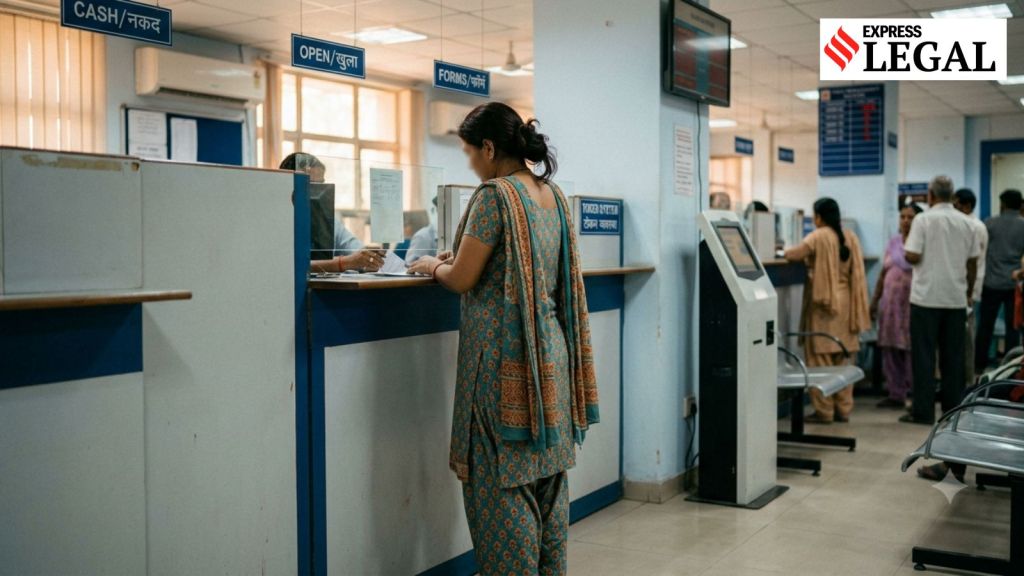
 The petitioner said that she had no privity of contract with the Bank and the recovery was not legally permissible. (Image generated using AI)
The Allahabad High Court recently directed the State Bank of India (SBI) to immediately refund Rs 19.90 lakh that it had debited from a woman’s fixed deposit to recover a personal loan taken by her late husband, observing that the bank had no legal basis to debit money from an account belonging to a person with whom it had no privity of contract.
A division bench of Justices Shekhar B Saraf and Abdhesh Kumar Chaudhary, in its September 10 order, also directed the bank to pay the woman Rs 1 lakh as exemplary and punitive compensation for its actions.
“The deplorable action of the Bank authorities in the present case, requires exemplary and punitive compensation to be paid to the petitioner. Though the petitioner has claimed a sum of Rs 25 lacs for the egregious mental agony, emotional trauma and flagrant violation of her fundamental rights, we are of the view that an amount of Rs 1 lac would be appropriate keeping in view the overwhelming circumstances narrated herein-above,” the order read.
 Justices Shekhar B Saraf and Abdhesh Kumar Chaudhary imposed Rs 1 lakh costs on SBI.
According to the facts of the case, the petitioner’s husband had taken a loan of Rs 15 lakh from the bank. Later he died of Covid 19. Admittedly, the petitioner was neither a signatory nor a consenting party thereto as a co-applicant, co-borrower, guarantor, surety, indemnifier, or nominee. There was no privity of contract between the petitioner and the bank.
It was stated that SBI issued a legal notice to the woman seeking payment of Rs 13.87 lakh, along with interest, and warning of legal proceedings if the amount was not paid. The bank subsequently put her salary account on hold. She approached the Reserve Bank of India Ombudsman, following which the hold was removed. While the parties were negotiating, the bank encashed a fixed deposit belonging to the woman and debited Rs 19,90,693 from her account.
The bank told the court that the standing instructions, given by the husband of the petitioner while obtaining loan, legally permitted it to recover the said amount from the gratuity etc.
The court took exception to the manner in which the bank dealt with the woman’s account.
“This fixed deposit account had been opened by the petitioner in the year 2025 in Ashiyana Branch of the State Bank of India. It appears that this account was transferred allegedly on the request of the petitioner to Jankipuram Branch of the State Bank of India, wherein the loan had been taken by the petitioner’s husband. Immediately, upon transfer of the account the amount was debited from the account of the petitioner and transferred to the State Bank of India (this amount was the amount that was due and payable by the petitioner’s husband to the State Bank of India). Having done so, the account was once again transferred back to Ashiyana Branch of the State Bank of India,” the court noted.
It observed that the entire process appeared to be mala fide on the part of the State Bank of India not only with regard to the procedure adopted in debiting the fixed deposit account but also with regard to substantive law that did not allow the bank from debiting an account of an individual with whom they had no privity of contract or any relation under law.
The court said that the bank may have a legal right to proceed against the petitioner as the legal heir of the deceased and recover the amount of dues, but it has to be done as per the due process of law established in India and not in an arbitrary, capricious and whimsical manner.
The bench said the sequence of events indicated that the bank had acted “surreptitiously” to achieve its purpose. “The entire process is abominable and clearly an anathema to banking practice. The action of the Bank cannot be justified in any manner whatsoever,” it remarked.
Directing immediate relief, the bench ordered SBI to refund the entire Rs 19,90,693 debited from the woman’s account, along with interest at the fixed-deposit rate she had been receiving.
The court further held that the bank’s conduct warranted exemplary and punitive compensation. It thus awarded Rs 1 lakh to the petitioner.