


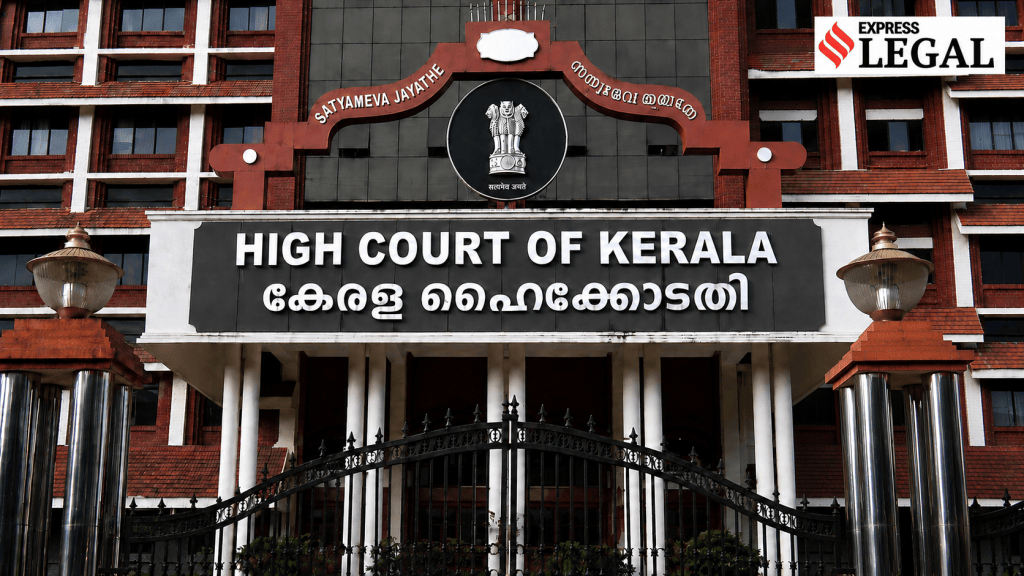
 The Kerala High Court refused bail to the accused who had sought the relief on grounds of trial delay. (Image generated using AI)
Stating that national security and the collective interest of the community must be considered, the Kerala High Court recently denied bail to Popular Front of India’s (PFI) national leader Ashraf Moulavi in the 2022 murder case of RSS activist S K Sreenivasan.
A bench of Justices Anil K Narendran and Muralee Krishna S passed the order on the bail plea of the accused which sought the relief on grounds of delay in the trial.
“The courts, while dispensing justice in cases under the UA (P) Act, should keep in mind not only the liberty of the accused but also the interests of the victims and their near and dear ones and, above all, the collective interests of the community and the safety of the nation,” the order dated August 21 read.
 Justices Anil K Narendran and Muralee Krishna S refused to grant bail to the PFI leader.
Sreenivasan, 45, a former district leader and office-bearer of the Rashtriya Swayamsevak Sangh (RSS), was allegedly attacked by a six-member gang at his motorbike shop in Melamuri, Palakkad. The attackers are said to have arrived on three bikes, carrying swords, before they stormed into the shop and hacked him multiple times. The murder took place barely a day after local PFI leader A Subair was killed, allegedly by RSS men.
The case was registered on the allegation that PFI leaders and members conspired together with the intention to create terror and communal divide in the society, conducted recce of several Hindu leaders of that locality and later selected and brutally murdered Sreenivasan. The central government later directed the National Investigation Agency (NIA) to investigate the case.
After completion of the probe, a final report was filed against the appellant and others under different sections of the Indian Penal Code (IPC) and the Unlawful Activities (Prevention) Act or UAPA, 1967. A special court dismissed the appellant’s earlier bail application, and he moved the high court challenging that.
Senior counsel for the appellant, Aditya Sondhi, said no written grounds of arrest was served and that he underwent over three years and eight months in custody. It was further stated that there was no possibility that the trial would either commence or conclude in the near future.
On the other hand, special public prosecutor for NIA, Sasthamangalam S Ajithkumar, argued that the grounds of arrest were communicated and explained to the appellant and that the final report, along with the evidence collected, disclosed a preliminary case for commission of offences.
The court noted that the special court, in its order, found that the evidence before it disclosed material indicating that the appellant was a PFI leader and it also indicated his presence at the place where the conspiracy was allegedly hatched as well as at the scene of the incident, and pointed to his alleged role in commission of the offence.
The high court observed that the final report, along with the evidence collected during the investigation, disclosed a preliminary case against the appellant. Noting that murder is punishable with death or imprisonment for life, the court said the appellant’s period of custody could not be considered to have already constituted a substantial part of the prescribed sentence.
The court held that, in view of the gravity of the offences and the prescribed punishments, the period of incarceration could not justify his release on bail on the ground of delay in the trial. It rejected the argument that his continued detention amounted to a violation of his rights under the Constitution and held that he was not entitled to bail either on the ground of prolonged incarceration or delay in the trial.