


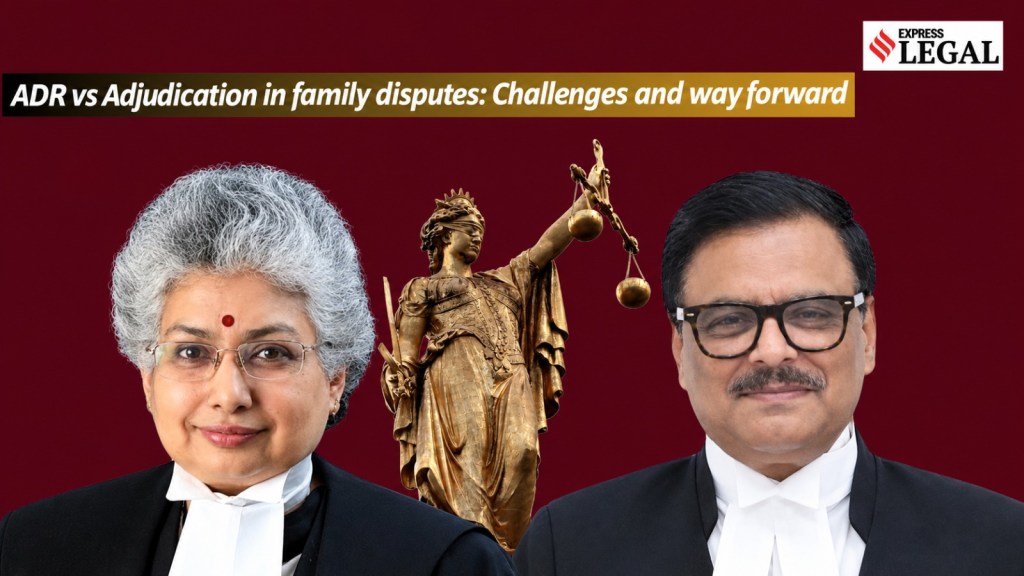
 While Justice B V Nagarathna said mediation must adapt to a family’s circumstances, Gauhati High Court Chief Justice Ashutosh Kumar noted that family disputes require judges to understand various dynamics.
The legal process can itself turn into a form of punishment in family disputes when litigation is used to cause humiliation and difficulties, Supreme Court judge Justice B V Nagarathna said at a family courts conference in Guwahati on Saturday.
Terming it the “weaponisation of litigation”, Justice Nagarathna said that in such a situation, “the process is itself the punishment, and the goal is to subject someone to the rigours of a court proceeding for the purpose of causing them humiliation and financial strife.”
She was speaking after inaugurating the Eastern Zone Regional Conference on ‘Alternative Dispute Resolution (ADR) vs Adjudication in Family Disputes: Challenges and Way Forward’. The two-day conference, organised by the Supreme Court’s Committee for Family Court Matters in association with the Gauhati High Court, brings together judges, judicial officers, lawyers, mediators and experts to discuss family justice, including domestic violence, marriage and divorce, child custody, and maintenance.
Justice Nagarathna, who chairs the Supreme Court’s Committee for Family Court Matters, said exaggerated pleadings in family disputes can make parties take “very, very stout” positions and unwilling to consider settlement. “In family disputes, it is the family and not the cause of action which requires resolution,” she added.
Gauhati High Court Chief Justice Ashutosh Kumar, who presided over the conference, said family disputes are “fundamentally different from other disputes”. The aim in family disputes, he said, should be to resolve them through the “process that’s most appropriate to its nature, while preserving dignity, protecting rights and whenever possible preventing the permanent destruction of families.”
The objective here, CJ Kumar said, must be to know “when to mediate, when to adjudicate, when to employ both the techniques”, requiring the judges to develop specialised skills in understanding family dynamics.
Judges, he said, must also be “communicators” with a “keen eye” for vulnerabilities, which can happen only when they listen to the parties, including when “they are unable to speak”.
On child custody, shared parenting and visitation rights, Justice Nagarathna said the welfare of the child must be paramount, while the rights of parents must remain subordinate to it. She said judges can sometimes become focused on determining which parent’s rights have to be adjudicated, while losing sight of the child at the centre of the dispute.
In contested custody cases, she said, lawyers representing each parent are often required to establish that the other parent is unfit. In such cases, a parenting plan could be a “better instrument than a custody decree,” Justice Nagarathna added.
She also stressed the need for specialised professionals in custody-related mediation. A qualified child psychologist should be part of the mediation process itself “rather than consulted afterwards for a report.”
She suggested child-inclusive mediation, in which a trained professional could ascertain the child’s views and convey them to the parents.
“Despite their nomenclature, (family courts) were never intended to be spaces that encouraged adversarial actions,” she said, with the role of lawyers being limited to assisting the courts as amici curiae. However, she said, family courts have instead come to function as civil courts, “merely under a different name.”
She called for permanent staff in family courts – a permanent, qualified counselling and mediation unit, with psychologists and social workers on regular establishment rather than annual contract. “Training be a condition rather than an afterthought,” she said while talking about mediators, adding that being sufficiently sensitised was a “pressing priority”.
With changing social trends and family dynamics, she said, mediation skills must also adapt to the circumstances of each family, including the occupations and professional lives of parents. “It is also important to acknowledge the unique factors that prolonged litigation poses to a woman in particular, bearing in mind her socioeconomic context,” she said while discussing what women in particular gain from resolving family disputes through ADR rather than litigation.
Justice Nagarathna also referred to domestic violence and the difficulties faced by women in prolonged family litigation. Referring to data from the National Family Health Survey, she said 32 per cent of married women between the ages of 18 and 49 have experienced “physical, sexual or emotional violence.”
On divorce by mutual consent under Section 13-B of the Hindu Marriage Act, Justice Nagarathna said the provision “must be accepted as it is” and parties should not necessarily have to wait for the prescribed six-month period.
Justice Nagarathna said Family Courts needed a system that could integrate ADR with adjudication rather than treating the two as competing approaches. “We continue to frame this theme as a contest because we have not yet built a system capable of integrating ADR with adjudication in a manner that would allow for the speedy resolution of disputes in cases where speed is of the essence, but not at the cost of meaningful and just outcomes,” she concluded.
Supreme Court judges Justice Ujjal Bhuyan and Justice N V Anjaria were guests at the conference.