


Journalism of Courage
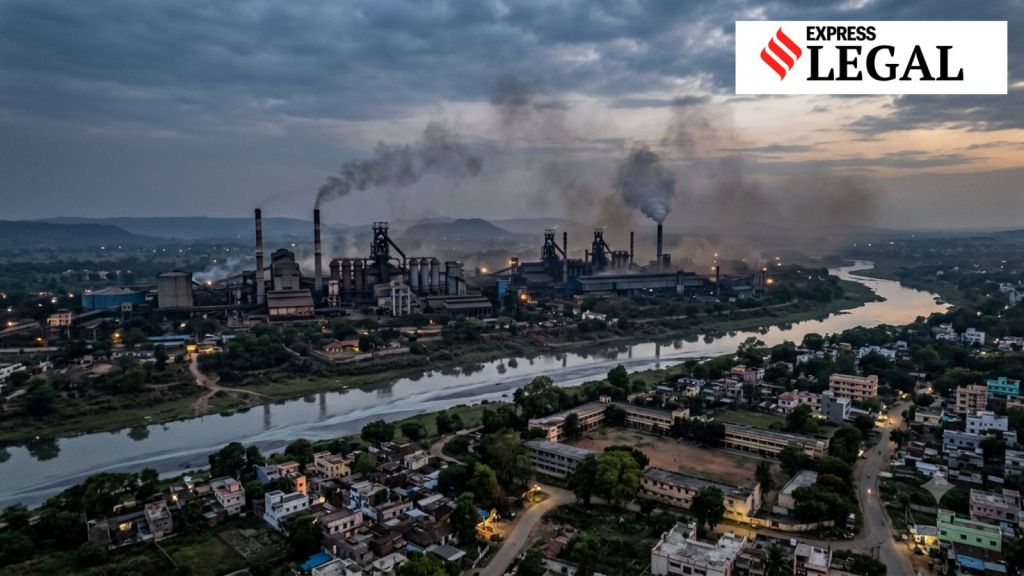 The Jharkhand High Court was of the view that precaution does not require closure of an industry on mere
allegation; it requires the regulator to act before harm becomes
irreversible. (Ai-generated Image)
Observing that “environmental harm routinely transcends its geographical roots”, the Jharkhand High Court recently directed its state pollution control board to conduct surprise inspections and continuously monitor the pollution data of the two factories situated in Ramgarh to ensure continuous compliance with air and water pollution limits
A bench of Chief Justice MS Sonak and Justice Rajesh Shankar was hearing a Public Interest Litigation (PIL) filed in 2024 by a man raising concerns of residents of Ramgarh, an industrial town in Jharkhand where two factories were causing “serious environmental pollution”.
“Environmental harm routinely transcends its geographical roots, forcing vulnerable populations to bear the brunt of actions to which they hardly contributed. This transboundary asymmetry is equally relevant when addressing localised industrial pollution and river degradation. If left unchecked, environmental damage never remains confined to its original territorial limits or to those responsible for its creation. What begins as a site-specific ecological injury will inevitably compound over time, spreading harm far beyond its point of origin,” the September 14 order read.
The man, a resident of Patna, Bihar, but currently residing in Ramgarh, Jharkhand, filed a Public Interest Litigation seeking directions to the authorities to take effective measures to stop air pollution allegedly caused by industries in Ramgarh.
 Chief Justice MS Sonak and Justice Rajesh Shankar stated that environmental governance requires a calibrated harmonisation between industrial development and ecological integrity.
The man contended that the alleged air and water pollution was attributable to industrial activities carried on by Bihar Foundry and Casting Limited and Dayal Steel Limited, both situated at Ramgarh. It was urged that the industries emitted toxic smoke, dust, and gases from their factory chimneys throughout the day, thereby covering the surrounding areas of Ramgarh and causing serious environmental pollution.
The high court noted that “once pollution escapes its source, its consequences travel far beyond where it originates. A polluted river does not pause at a district boundary before carrying the burden imposed upon it upstream.”
“Thus, a failure of environmental enforcement which begins as a local concern does not necessarily remain local in its consequences”.
According to the court, “the issue cannot be viewed merely as a dispute between the petitioner and the industries concerned. If the allegations have substance, they would directly affect the quality of air and water, the region’s ecological equilibrium, and people’s right to live in a clean and healthy environment”.
The court observed that Ramgarh was an industrial town in Jharkhand where residential areas, schools, public institutions, and a jail existed alongside heavy manufacturing units, because of which there were high chances of “environmental friction”. However, only the presence of “sensitive establishments” like schools neither gave immunity to industry nor did it automatically prove a breach of environmental law whenever local health issues arose.
After evaluating the reports and documents submitted by the state pollution control board, the high court recorded its satisfaction with the state of compliance on air quality. But on water quality, the High Court noticed a “marginal exceedance” that required closer verification. The high court disposed of the PIL with the following noteworthy directions to the authorities:
Advocates Sahbaj Akhtar, Richa Sanchita and Risheeta Singh appearing for the authorities submitted that both private industrial units possess the requisite statutory permissions and are operating in accordance with the established environmental legal and regulatory architecture.
Advocates Shivam Utkarsh Sahay and Komal Tiwary, representing the man, contended that “the mitigation measures adopted by the industrial units are merely temporary and fleeting, asserting that effective containment of environmental pollution requires robust, additional judicial directions to the respondent authorities”.


