


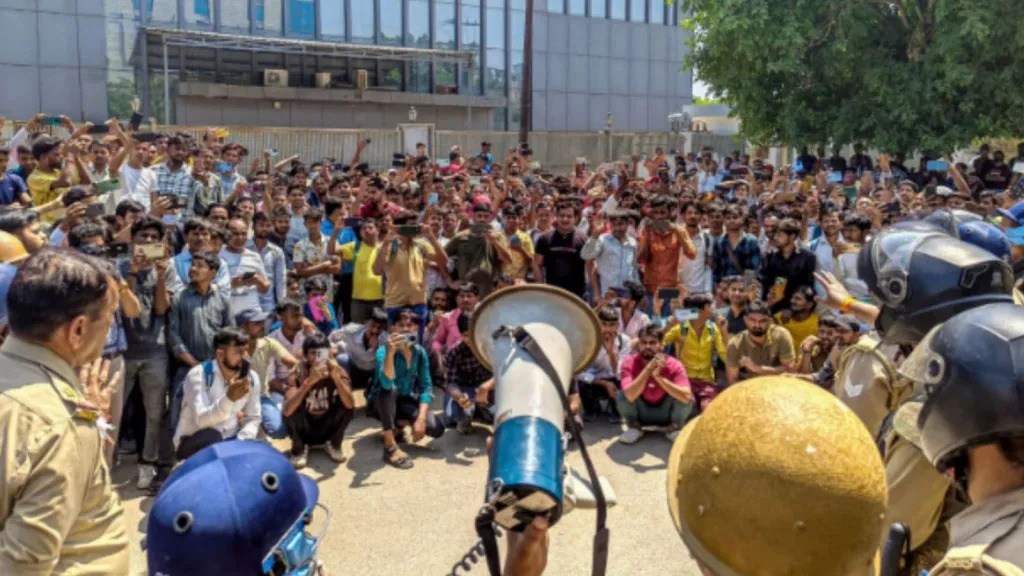
 The protests and the violence that followed had prompted a police crackdown that led to 15 FIRs in which hundreds of people were booked and at least 60 put in jail.
Warning against bureaucratic overreach, the Allahabad High Court’s ruling that quashed the National Security Act (NSA) charges against 25-year-old Delhi University graduate Aakriti Chaudhary delivered a sharp rebuke to state action and cautioned that unchecked abuses of power by UP police and officials risk reducing Uttar Pradesh to an “Orwellian Dystopia.”
Chaudhary was detained in connection with the Noida workers’ protests which took place five months ago. Justice Atul Sreedharan and Justice Achal Sachdev had quashed the detention on September 2.
The 15-page order, made available today, stated in “the bureaucracy and the police, when they act in a manner which is harmonious with their oath of allegiance, the thankful citizens of this State shall elevate them, and very rightly so, to a position which would be envied by the Gods themselves”.
The order continued, “However, every time they ignore that solemn oath and act contrary to it, the people of the State of Uttar Pradesh would view them as an oppressive vestige of the British Empire arousing angst and hatred towards them creating an environment of civil unrest and this Court, while correcting their excesses and/or illegalities, especially those that impinge upon the civil liberties of the citizens without adequate cause or due process (inhering in the procedure established by law), may pass harsh orders to compensate the citizen so wronged, besides recording their despotic conduct. Else, it shan’t be long before the errant in the bureaucracy reduce the State of Uttar Pradesh to an Orwellian Dystopia.”
 Justices Atul Sreedharan and Achal Sachdev said the video evidence showed that the protestors were only “exercising their constitutional right and freedom of speech and agitating their demands for higher pay and humane working hours”.
The protests and the violence that followed had prompted a police crackdown that led to 15 FIRs in which hundreds of people were booked and at least 60 put in jail. A month on, families of the accused – from a mason to a history major, from an NIT graduate to a private firm employee – say they are awaiting clarity on what happens next.
The conduct of the District Magistrate, Gautam Buddha Nagar, who passed the detention order, was found to be “worthy of derision”.
“In a case where the police report against the Petitioner was only allegations without there being any credible material against her, the District Magistrate was expected to be vigilant and examine the record threadbare to determine if there was any material in support of the allegations and even thereafter, assess whether the oppressive provisions of the NSA were warranted against the Petitioner.”
The verdict further noted that the DM ought also to have examined how the general law was inadequate against a female student activist with no previous criminal record, agitating for the rights of labourers, and that the material on record did not disclose that she had in any way incited violence. According to the ruling, the material “reveals that the District Magistrate desired to set an example out of the Petitioner and deter others from exercising their right to freedom of speech and expression in public spaces in support of the labourers”.
“The District Magistrate Gautam Buddha Nagar is guilty of violating her oath of allegiance, making this a fit case for the imposition of compensation to the petitioner.”
Pointing out the “casual and cavalier exercise of authority” by the State through the District Magistrate Gautam Buddha Nagar that “violated the constitutional rights” of the petitioner, and ordered Rs 5 lakh as compensation to her, the bench ordered the amount to be recovered from the “salary of the District Magistrate Gautam Buddha Nagar, who has passed this order of detention without application of mind and from all such other officers who may have been responsible, right down to the SHO”.
The bench went to elaborate on the relationship between the Indian Administrative Service (IAS) and the Indian Police Service (IPS) with that of the citizens of Uttar Pradesh “whom they serve” and said it defined the existence of the rule of law or its absence, as the case may be.
“The officers are endowed with immense powers by law and for very good reasons, as they bear the responsibility of improving the lot of the citizens by maintaining that delicate balance of upholding the constitutional and legal rights, dignity, honour and welfare of the citizens by just and good governance, while ensuring the stability of the State and the unity and integrity of the nation,” it noted.
The court, however, highlighted that “with great powers come great responsibility” and an introspection on the part of the bureaucracy to examine to what extent such a power exerted.
“Else, in the words coined by Rudyard Kipling (spoken publicly by Stanley Baldwin) that ‘power without responsibility – the prerogative of the harlot throughout the ages’, will ring true whenever the power is exercised by the bureaucracy in a cavalier manner, devoid of human sensitivity resulting in deleterious consequences for the citizen The IAS and IPS attract the finest talent in the country from amongst its youth who occupy its hallowed offices after a gruelling three stage selection process after which, those selected are considered to be the best of the best that India has to offer,” the ruling said.
Before they enter active service, the order continued, they swear an oath affirming that they shall bear true allegiance to India and to the Constitution of India as by law established, that they will uphold the sovereignty and integrity of India, and that they will carry out the duties of their office loyally, honestly and with impartiality.
“They should realise that their loyalty is towards the Constitution and not the political executive, and the honesty and impartiality are towards the people whom they serve while bearing in mind at all times that they are the servants who serve the people, the masters in a democracy.”
The State was further called upon to realise “every society has its own tensions and its share of disagreements with the Government in the manner in which it functions and allowing agitations is like the safety valve in a pressure cooker, which ensures that the building up of pressure is released rather than preventing such agitations and bottling up feelings accumulated to such an extent that when people do spill out onto the streets, violence becomes inevitable and difficult for the law enforcement agencies to control and contain”.
The police had relied on video footage showing a large gathering, including men and women in traditional rural clothing, standing near lampposts, alongside an image of a person who appeared to be addressing the crowd.
Debunking the contention, the bench said, “None of these videos discloses that the crowd is agitated or armed with lathi, stones or any such articles, which may be used in an act of violence, but appear to be exercising their constitutional right and freedom of speech and agitating their demands for higher pay and humane working hours.”
The ruling clarified that any detention under the NSA was an exception and not a “substitute to ensure that a person who may receive bail on account of merits of his case” remains detained in custody under a “concocted reasoning” by the State.
Coming down heavily on the District Magistrate, the bench termed the grounds of detention as “repetitive, speculative and only an opinion based without referring to a “shred of evidence/material” in support of sustaining those opinions.
“The grounds of detention must traverse beyond mere allegations and opinion. Allegations which raise a subjective opinion in the mind of the District Magistrate must be supported with reference to material for the formation of such opinion, else the same would be arbitrary,” it said.
Any exercise of such a discretion which directly violates a person’s rights under Article 21 of the Constitution of India cannot be exercised lightly based on surmises, biases, conjectures and opinions, the court said.
The court ruled that detaining someone under the National Security Act (NSA) requires strong evidence — not just assumptions or guesses. A court must review the District Magistrate’s decision and be fully satisfied that, without immediate detention, the person would almost certainly disrupt public order or threaten national security.
“…a constitution court examining the grounds of detention is also satisfied that the subjective satisfaction arrived at by the District Magistrate, crosses the threshold of mere surmises and conjectures and was justly based upon the material on record and not detaining the detenue under the stringent provisions of the NSA would in all probability than not, result in the public order being disturbed or would result in an act by the detenue which is deleterious to national security. The absence of such material would render the grounds of detention and the order of detention unjustified, deserving to be set aside.”
Chaudhary, the court said, “called for citizens in support of the labourers and to agitate for their rights”.
Finding no material to indicate that the agitation would be violent or challenge the authority of the State, the court said, “The freedom of speech and expression extends to coming out on the streets and agitating a cause, and gathering peacefully without arms or without threat to the public order.”
Reminding the State that a peaceful agitation where people collect without arms or ammunition can still be scuttled by mischievous elements, who may be sent by parties interested in ensuring that such an agitation is broken, the court said such elements may indulge in acts of violence which can be later attributed to the entire group, which was “patently unjust”.
“Preventing people from gathering in public spaces or agitating their rights on the grounds of assumed breach of peace, would be throwing the baby out of the bath water. If such a view is taken by the State and approved of by the Courts, it would lead to a cessation of the collective expression of opinion in public spaces. The Constitution protects such a right and the same cannot be trifled with merely on the subjective opinion of the State. The State must also realise that it has a strong and powerful police force, which must be trained in ensuring public order in such large gatherings and also resort to videography of the gathering and the manner in which it is conducted, so that accountability may be affixed, in the event of an outbreak of violence,” the ruling said.