


Journalism of Courage
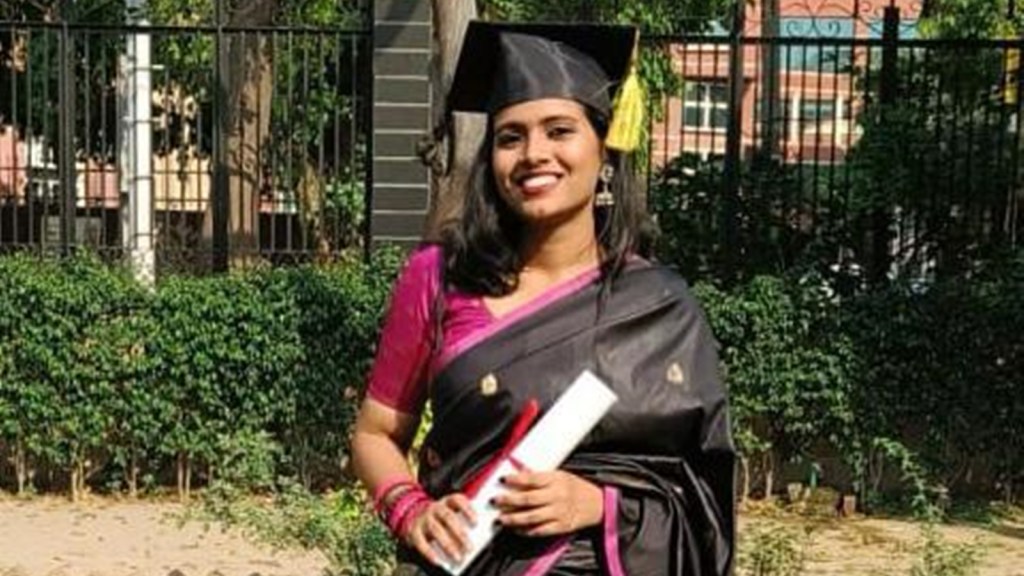 NSA was invoked against Aakriti Chaudhary, 25, in May.
Describing as “worthy of derision” the decision by the District Magistrate of Gautam Buddha Nagar to invoke the National Security Act (NSA) against Aakriti Chaudhary for her alleged role in the of April, the Allahabad High Court has ordered that its “displeasure” with the official and other officers involved be “noted in their service records”.
The order, issued by a bench of Justices Atul Sreedharan and Achal Sachdev, also held the District Magistrate, IAS officer Medha Roopam, “guilty of violating her oath of allegiance, making this a fit case for the imposition of compensation to the petitioner”.
The court granted Rs 5 lakh as compensation to the petitioner, to be “recovered from the salary of the District Magistrate…who has passed this order of detention without application of mind and from all such other officers who may have been responsible, right down to the SHO of the Police Station, who had prepared the initial report warranting the detention of the petitioner under the provisions of the NSA”.
The detailed order was released Monday after the High Court, on September 2, quashed the detention of Chaudhary, a law student and Delhi University graduate from Durgapur in West Bengal, describing the invocation of the stringent NSA in her case as “arbitrary and vague”.
The High Court was hearing the habeas corpus plea of Chaudhary, who was initially picked up on April 11. Subsequently, the UP government invoked the NSA on May 13. She has since been in custody in Kasna jail in Gautam Buddha Nagar.
While Chaudhary had sought compensation of Rs 50 lakh, the High Court found it “sufficient” to grant Rs 5 lakh, since she would remain in jail as an undertrial prisoner till she secures bail in all the criminal cases registered against her over the protest.
In its order, the court said that “in a case where the police report against the Petitioner were only allegations without there being any credible material against her, the District Magistrate was expected to be vigilant and examine the record threadbare to determine if there was any material in support of the allegations and even thereafter, assess whether the oppressive provisions of the NSA were warranted”.
Pointing to the “casual and cavalier exercise of authority by the State through the District Magistrate”, the court also made sharp observations against the bureaucracy, stating that such “errant” action may “reduce…Uttar Pradesh to an Orwellian Dystopia”.
“It goes without saying that those in the bureaucracy and the police, when they act in a manner which is harmonious with their oath of allegiance, the thankful citizens of this State shall elevate them, and very rightly so, to a position which would be envied by the Gods themselves,” the court said.
“However, every time they ignore that solemn oath and act contrary to it, the people of…Uttar Pradesh would view them as an oppressive vestige of the British Empire arousing angst and hatred towards them creating an environment of civil unrest,” it said.
“…this Court, while correcting their excesses and/or illegalities, especially those that impinge upon the civil liberties of the citizens without adequate cause or due process (inhering in the procedure established by law), may pass harsh orders to compensate the citizen so wronged, besides recording their despotic conduct. Else, it shan’t be long before the errant in the bureaucracy reduce the State of Uttar Pradesh to an Orwellian Dystopia,” the court said.
Referring to the case and unanswered WhatsApp messages by the petitioner, the court said that her version that she was taken into custody on April 11 “probabilise as true” and “falsifies the contention of the State that the Petitioner was in the custody of the State only from April 12”.
The court also said the state’s counsel “has not been able to show a single message from the WhatsApp chats between the Petitioner and her associates or any video clip which would reveal any incitement from the Petitioner, either evidently or by necessary implication, which would disclose that it was the involvement of the Petitioner and the conspiracy hatched by her that resulted in the violence which erupted from 13.04.2026”.
The order noted: “Preventing people from gathering in public spaces or agitating their rights on the grounds of assumed breach of peace, would be throwing the baby out of the bath water.”
Chaudhary has been named in 11 FIRs, with charges including attempt to murder, intent to cause death or grievous harm, endangering life or personal safety, and criminal conspiracy. According to Chaudhary’s counsel, she has secured bail in five cases, while the bail pleas over the six other FIRs are yet to be heard in the High Court.
On August 20, The Indian Express had published the findings of its investigation into 106 arrests and 222 related bail orders linked to the Noida protests, each with substantive allegations ranging from rioting and arson to attempt to murder.
The investigation revealed that relief was granted in as many as 188, or 84 per cent, of the cases, with the sessions courts flagging key gaps in the police’s narrative: mere presence at a protest is not evidence to deny bail; lack of specific evidence outweighs gravity of charges; ordinary workers at the protest cannot be equated with those found organising or instigating violence.
This newspaper also detailed the charges against Chaudhary, who was jailed under NSA along with Satyam Verma, a 60-year-old former journalist from Lucknow. It cited court records to show that Chaudhary was accused of being among “proponents of a specific ideology that believes in achieving their objectives through violent means”.
The UP government had claimed that Chaudhary joined a “library in Karawal Nagar, Delhi” run by a co-accused and “formulated a strategy for the proposed violent movement”. The government had also cited the alleged recovery of a book, “Great Martyrs of the Indian Revolution”, describing it as “a controversial work of literature”.
The state government accused Chaudhary of being a member of the Revolutionary Workers Party of India (RWPI) and noted the outfit’s presence at “multiple CAA-NRC protest sites” and role in “Gaza protests”.