
“The mere fact that the recovered body was clean shaven, in the face of the evidence regarding the presence of fresh shaving marks and other circumstances connecting the body with Mohd Hanif, cannot by itself create a reasonable doubt regarding the identity of the deceased,” the court said on September 25.
The high court dismissed Ali’s appeal and upheld the conviction, finding that the prosecution’s circumstances, taken cumulatively, formed a complete chain pointing to his guilt. It also directed Ali to surrender before the jail superintendent within two weeks to serve the remaining sentence.
Body recovered as unidentified
According to the prosecution’s case, Ali worked with Hanif, a businessman who dealt in jackets and collected business payments. The prosecution alleged that Ali took Hanif from his home on January 1, 2000, on the pretext of going to Jaipur for business-related work. Hanif did not return.
Justices Navin Chawla and Ravinder Dudeja noted that there was no eyewitness to the actual murder.
The next day, a body was recovered from a vacant plot near the field of Khachera at Faisalabad, close to Siana Bus Stand in Uttar Pradesh’s Bulandshahar. The police photographed the body and made efforts to establish its identity, but it remained unidentified and was eventually buried as unclaimed.
On January 11, Delhi Police reached the Bulandshahar police station with Ali and Hanif’s son Habib. Habib identified the body from photographs. He also identified the clothes preserved by the police, including a safari suit, jersey, socks and a pair of yellow Pathani shoes, as belonging to his father.
Story continues below this ad
Fresh shaving marks became crucial
The defence questioned the identification because Hanif’s wife had described him as someone who used to keep a beard. The post-mortem report, however, recorded that the recovered body had a clean-shaven face.
The high court relied on the statement of Aslam, a shopkeeper in Bulandshahr, who said that on January 1 he had seen three persons, including Ali, walking with a man who had a beard. The following morning, he saw the recovered body and noticed that it was clean-shaven and had fresh blade marks on the face, appearing as though the person had recently been shaved.
The court said this provided a plausible explanation for the absence of the beard. It observed that there was a possibility the beard had been shaved after the occurrence to prevent the body from being identified. The bench also stressed that the body’s identification was not based solely on photographs but was supported by the identification of the clothes.
The post-mortem examination found four ante-mortem injuries. The doctor concluded that Hanif had died of a coma resulting from the injuries and specifically found one head injury sufficient to cause death. The injuries were assessed to be approximately one and a half days old.
Story continues below this ad
The high court noted that there was no eyewitness to the actual killing and the prosecution’s case rested on circumstantial evidence. It considered evidence that Ali had been with Hanif shortly before his disappearance. An independent dhaba owner said the two had arrived together, eaten and then left together.
The court also considered evidence of a financial dispute. Hanif’s wife said Ali had given her Rs 15,000, while she believed around Rs 1 lakh collected in business payments remained unaccounted for. The court treated the failure to account for the payments as a circumstance indicating motive.
The high court also made it clear that it did not accept every circumstance relied upon by the prosecution. It agreed with the trial court that the alleged extra-judicial confession was unreliable and could not be relied upon.
However, after examining the remaining evidence, the bench held that the circumstances formed a complete chain pointing towards Ali. It found no perversity or illegality in the trial court’s assessment of the evidence and dismissed the appeal.




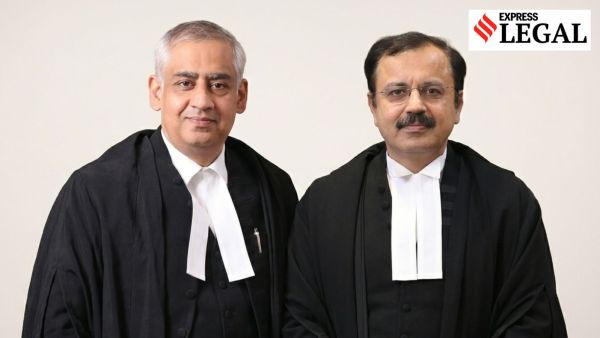 Justices Navin Chawla and Ravinder Dudeja noted that there was no eyewitness to the actual murder.
