
“The allegations contained in the FIR do not disclose any act of inducement, fraudulent representation or delivery of property attributable to the applicant. At the highest, the allegations may constitute a matter relating to service misconduct warranting departmental action,” the court observed on September 11. It further noted that Chadar had already been exonerated of the principal allegation in the departmental inquiry and held that continuing the criminal proceedings would serve no useful purpose and would amount to an abuse of the process of law.
The case began with a newspaper report on November 18, 2024, alleging that another person was teaching in teacher‘s place. An official inspection followed, with the Development Block Education Officer, Malthon, and Development Block Coordinator recording statements of students and residents. The authorities allegedly concluded that one Vikram Singh Lodhi was performing Chadar’s teaching duties.
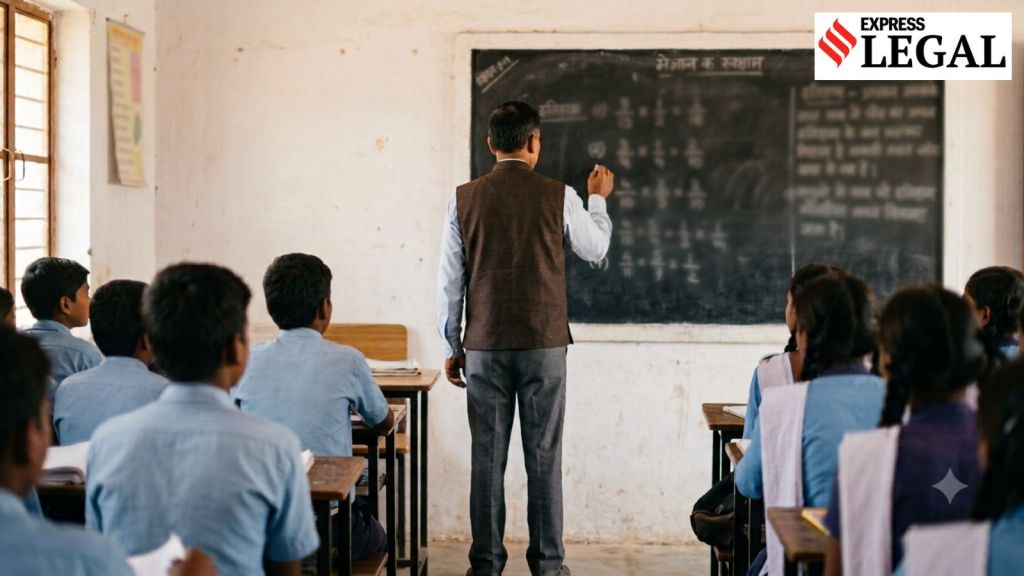
Justice Himanshu Joshi noted that the departmental inquiry had failed to establish the principal allegation against the teacher. (Image enhanced using AI)
Teacher suspended, FIR next day
The teacher was suspended on November 18, 2024 and on the recommendation of the Development Block Education Officer, the FIR was registered on November 19, 2024, for the offence of cheating. A departmental chargesheet was subsequently issued to Chadar, and disciplinary proceedings were initiated against him. A detailed inquiry was conducted, during which the principal allegation that Lodhi was working in place of Chadar was specifically examined.
The departmental inquiry specifically examined the allegation that Vikram Singh Lodhi was performing teacher’s duties in Chadar’s place. The inquiry report found the allegation “not proved”, and Chadar was exonerated of it. However, his services were later terminated by an order dated June 4, 2025, primarily on the ground that the criminal case was pending.
High court examines cheating allegation
Chadar argued that the allegation forming the foundation of the FIR had not been established even in the departmental inquiry. The teacher contended that continuation of the criminal proceedings would therefore amount to an abuse of the process of law.
Story continues below this ad
The high court examined the FIR and noted that the entire allegation against the teacher was that he remained absent from duty while Lodhi allegedly performed teaching functions in his place. The court then considered whether those allegations disclosed the ingredients of the cheating offence for which the FIR had been registered.
It noted that the essential ingredients of cheating include deception, dishonest inducement and consequential delivery of property or wrongful gain. In the present case, the court found no allegation of any act of inducement, fraudulent representation or delivery of property attributable to Chadar.
The court said that, at the highest, the allegations could constitute a matter relating to service misconduct warranting departmental action. However, it held that the material placed on record did not disclose commission of the offence of cheating.
Departmental finding
The departmental inquiry was central to the high court’s assessment. It noted that the main allegation behind the criminal case had been examined and could not be proved, which had “substantially eroded” its factual foundation. The court also noted that a similarly placed co-accused had already received relief in a separate case, while Chadar’s position was stronger because he had been exonerated of the principal allegation.
Story continues below this ad
Opposing the petition, the state argued that the FIR disclosed a cognisable offence requiring investigation and that the high court should not assess evidence at this stage. It also submitted that departmental and criminal proceedings operate in different fields and that departmental exoneration does not automatically warrant quashing of a criminal case.
The high court, however, found the case warranted interference and concluded that continuing the proceedings against Chadar would serve no useful purpose.




 Justice Himanshu Joshi noted that the departmental inquiry had failed to establish the principal allegation against the teacher. (Image enhanced using AI)
