


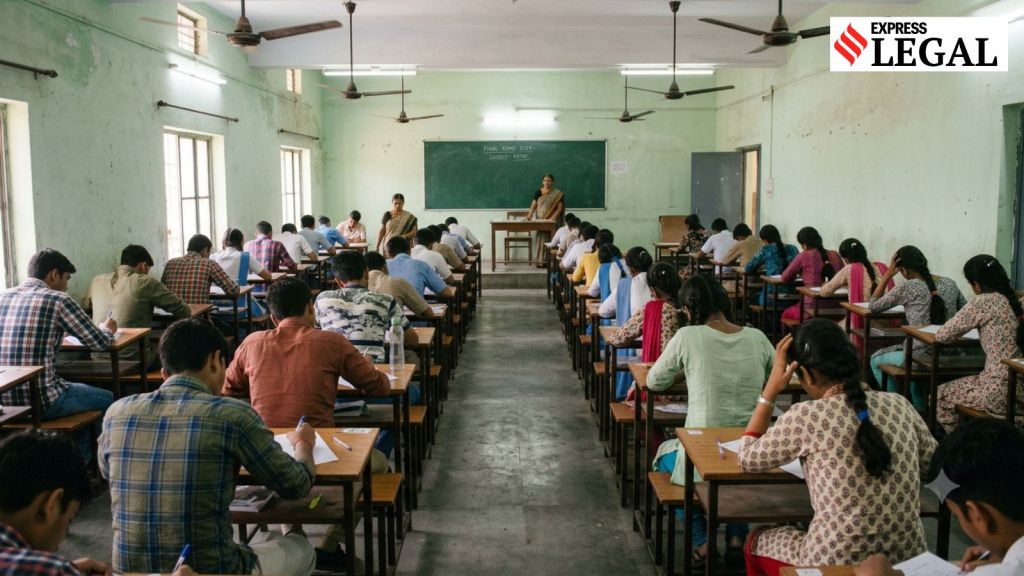
 The assessment board said the girl had Beta Thalassemia Trait, which does not cause any significant functional disability, and concluded that she was ineligible for disability certificate. (AI-generated image)
The Orissa High Court recently set aside a medical assessment board report which held that a NEET candidate with ‘Beta Thalassemia Trait’ did not qualify as a person with disability, directing authorities to conduct a fresh assessment of her percentage of disability.
A division bench of Chief Justice Harish Tandon and Justice Chittaranjan Dash passed the order on September 10 while hearing a petition filed by a student who had sought to avail the disability quota in the National Eligibility cum Entrance Test (NEET).
“The cumulative effect of the various provisions of the said Act (Rights of Persons with Disabilities Act) and the said Notification having relied upon hereinabove, the report of the Medical Assessment Board that the ‘β Thalassemia Trait’ does not come under the category of the disability and not fit for issuance of any certificate in this regard runs counter to the spirit of the Act,” the order read.
Beta thalassemia is a genetic blood disorder that limits the body’s ability to make a key protein that helps create haemoglobin.
The petitioner had appeared for NEET as a person with disability and submitted a certificate from the competent authority indicating that her disability was above 40 per cent. She was later referred to a medical board for assessment.
 Chief Justice Harish Tandon and Justice Chittaranjan Dash said the assessment board’s conclusion was against the legal position.
The board, however, opined that she had Beta Thalassemia Trait, an asymptomatic carrier state that does not cause any significant functional disability, and concluded that she was not eligible for a disability certificate.
The petitioner had earlier challenged the medical board’s opinion before the high court in another petition. On August 20, the court permitted her to make a representation to the chairman of the Odisha Joint Entrance Examination, 2026, and directed the authority to take necessary steps. The appellate authority then issued a notice holding that she was not eligible to claim benefits under the Rights of Persons with Disabilities Act, 2016.
The court, however, observed that the medical assessment board’s opinion was focused on locomotor disability even though thalassemia does not impact the functional ability of a person. It said this could not be a reason to reject the petitioner’s claim that she falls under the category of the “specified disability”.
“The moment the statute has included a particular disease as a disability, the assessment by the Medical Assessment Board should be restricted on the same, and it cannot transgress such boundaries and include the other category of the disability as a benchmark disability,” it said.
The court further referred to a May 13, 2019 notification issued by the board of governors in supersession of the Medical Council of India, which also includes thalassemia among specified disabilities and prescribes percentage-based eligibility criteria for admission to medical courses.
The bench said the assessment board’s conclusion that the petitioner’s Beta Thalassemia Trait was not a disability and, therefore, did not warrant a disability certificate was contrary to the legal position.
“We, at the cost of repetition, made it clear that once the ‘Thalassemia’ is included within the category of ‘specified disability’ and the expression specified disability having used in the definition of a person with benchmark disability and the specified disability having separately and independently defined in the said Act, it should mean and include the disease specified in the schedule,” the court said.
It accordingly quashed the assessment board’s report and directed the Director of Medical Education & Training (DMET), Odisha, to constitute a fresh medical assessment board. The court directed the petitioner to appear before the board, which must assess her percentage of disability to decide whether she meets the eligibility criteria.