Media statement can’t be conclusively treated as dying declaration: Madhya Pradesh High Court

Madhya Pradesh HC made the observation while dismissing a petition by a Jabalpur woman who had alleged her husband was assaulted by police personnel during Covid-19 lockdown in 2020 and subsequently died in hospital.

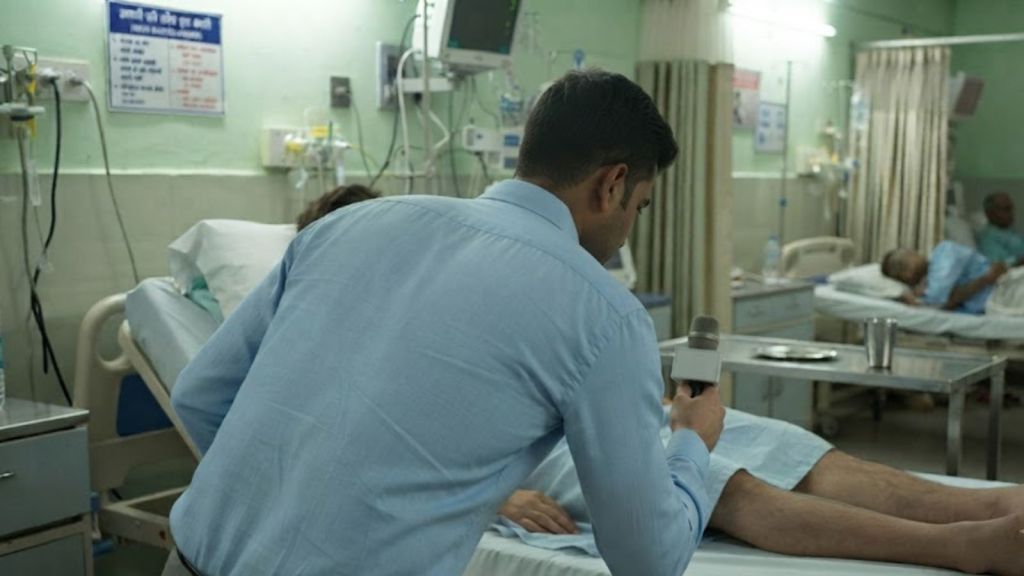
MP High Court FIR plea, media statement, madhya pradesh,The court held that the alleged media statement, its authenticity and its evidentiary value would have to be established in accordance with law, adding they are “matters requiring proof.” (Photo generated using AI)

A statement allegedly made by a man to electronic media shortly before his death, in which he purportedly named police personnel for assaulting him, cannot at this stage be “conclusively treated as a dying declaration” so as to compel registration of an FIR, the Madhya Pradesh High Court has held.

Justice Himanshu Joshi recently made the observation while dismissing a petition filed by the wife of deceased Banshilal Kushwaha, who had alleged that her husband was assaulted by police personnel during the Covid-19 lockdown in April 2020 and subsequently died in hospital.

“The alleged statement of the deceased before the electronic media cannot, at this stage, be conclusively treated as a dying declaration so as to compel registration of an FIR,” Justice Joshi held.

The court held that the alleged media statement, its authenticity and its evidentiary value would have to be established in accordance with law, adding they are “matters requiring proof.”

The case

The case arose from an incident of April 16, 2020, when, according to the petitioner, Banshilal was returning from his field after feeding a cow when he was allegedly assaulted by police personnel posted at Gora Bazar Police Station in Jabalpur. He sustained injuries, was admitted to hospital and died four days later.

The deceased’s wife alleged that before his death, Banshilal spoke to electronic media and named the police personnel he held responsible for the alleged assault. She relied on the statement as material in the nature of a dying declaration and also placed before the authorities photographs, newspaper cuttings, merg intimation (initial police report), panchnama, hospital records and the post-mortem report.

The district administration had also granted Rs 50,000 as ex-gratia assistance to the family. The petitioner submitted complaints to the Superintendent of Police on June 12 and June 25, 2020, but, according to her, no FIR was registered.

Story continues below this ad

She thereafter, approached the Judicial Magistrate First Class, Jabalpur, seeking a direction for registration of an FIR.

The Magistrate, after calling for the police report and considering material collected during the merg proceedings, declined to direct registration of an FIR on September 13, 2021. Instead, the court directed that the matter be proceeded with as a complaint under Section 200 CrPC. A criminal revision against that order was subsequently dismissed by the Second Additional Sessions Judge, Jabalpur on February 17, 2022.

Challenging both orders before the HC, the petitioner’s counsel Arvind Kumar Shrivastava argued that the courts had failed to properly appreciate the material on record, particularly the statement of the deceased before the electronic media.

The petitioner also alleged that the post-mortem report had been manipulated and argued that the photographs, medical documents and ex-gratia payment supported the allegation of assault.

Story continues below this ad

The respondents disputed the allegations and told the HC that the matter had already been subjected to several inquiries. According to them, an investigation had been conducted during the merg proceedings, statements of relevant persons had been recorded, CCTV footage and other material examined, and medical and forensic reports obtained.

The respondents further pointed to a magisterial inquiry and departmental inquiry, contending that neither had substantiated the allegation of assault by police personnel.

‘Bleeding could occur due to illness’

The medical evidence was also relied upon by the respondents. The court noted that an opinion obtained from the Department of Forensic Medicine, NSCB Medical College, Jabalpur, indicated that there was “no injury… and that bleeding could occur on account of illness of the kidney, lungs or liver.” The FSL reports, according to the respondents, did not disclose the presence of any chemical poison.

The High Court declined to undertake a fresh assessment of the competing material while exercising its inherent jurisdiction.

Story continues below this ad

The court also rejected the petitioner’s reliance on the ex-gratia payment as corroborative proof of the allegations, observing that it cannot “by itself establish homicidal death or involvement of the police personnel.”

On the allegation that the post-mortem report had been manipulated, the HC said it was a disputed factual assertion “unsupported by any cogent material.” At the same time, it noted that the respondents had placed medical opinions, FSL reports and inquiry reports on record.

The HC also noted that dismissal of the plea seeking an FIR did not leave the petitioner without a legal remedy.

Anand Mohan J is an award-winning Senior Correspondent for The Indian Express, currently leading the bureau’s coverage of Madhya Pradesh. With a career spanning over eight years, he has established himself as a trusted voice at the intersection of law, internal security, and public policy. Based in Bhopal, Anand is widely recognized for his authoritative reporting on Maoist insurgency in Central India. In late 2025, he provided exclusive, ground-level coverage of the historic surrender of the final Maoist cadres in Madhya Pradesh, detailing the backchannel negotiations and the "vacuum of command" that led to the state being declared Maoist-free. Expertise and Reporting Beats Anand’s investigative work is characterized by a "Journalism of Courage" approach, holding institutions accountable through deep-dive analysis of several key sectors: National Security & Counter-Insurgency: He is a primary chronicler of the decline of Naxalism in the Central Indian corridor, documenting the tactical shifts of security forces and the rehabilitation of surrendered cadres. Judiciary & Legal Accountability: Drawing on over four years of experience covering Delhi’s trial courts and the Madhya Pradesh High Court, Anand deconstructs complex legal rulings. He has exposed critical institutional lapses, including custodial safety violations and the misuse of the National Security Act (NSA). Wildlife Conservation (Project Cheetah): Anand is a leading reporter on Project Cheetah at Kuno National Park. He has provided extensive coverage of the biological and administrative hurdles of rewilding Namibian and South African cheetahs, as well as high-profile cases of wildlife trafficking. Public Health & Social Safety: His recent investigative work has uncovered systemic negligence in public services, such as contaminated blood transfusions causing HIV infections in thalassemia patients and the human cost of the fertilizer crisis affecting rural farmers. Professional Background Tenure: Joined The Indian Express in 2017. Locations: Transitioned from the high-pressure Delhi City beat (covering courts, police, and labor issues) to his current role as a regional lead in Madhya Pradesh. Notable Investigations: * Exposed the "digital arrest" scams targeting entrepreneurs. Investigated the Bandhavgarh elephant deaths and the impact of kodo millet fungus on local wildlife. Documented the transition of power and welfare schemes (like Ladli Behna) in Madhya Pradesh governance. Digital & Professional Presence Author Profile: Anand Mohan J at Indian Express Twitter handle: @mohanreports ... Read More


Advertisement
Loading Recommendations...
Advertisement
Advertisement
Latest Comment
Post Comment
Read Comments