


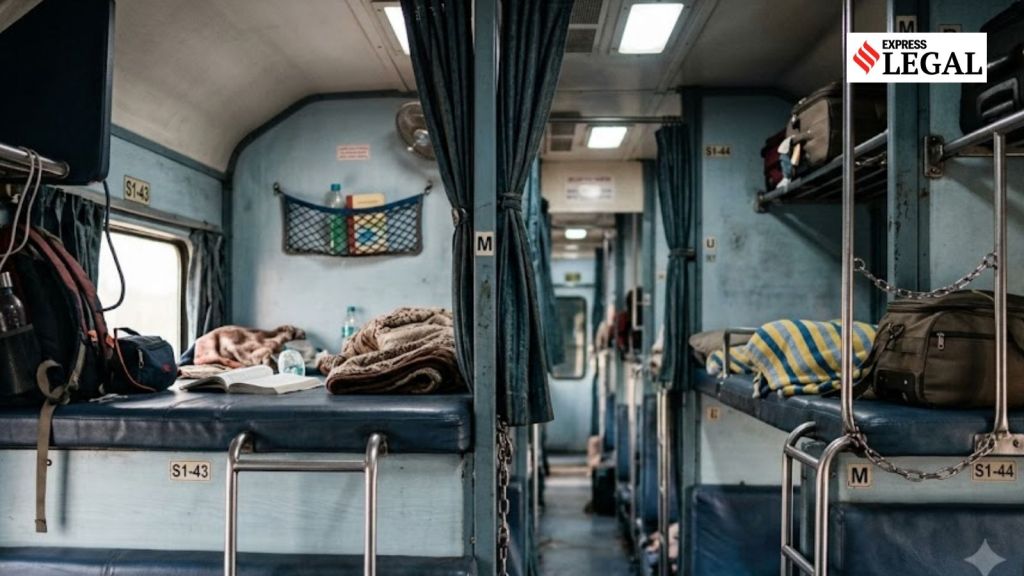
 The man fell from the upper berth after a sudden jerk in the moving train, and was declared dead. (AI-generated image)
The Delhi High Court has held that a passenger’s accidental fall from an upper berth inside a moving train cannot be brushed aside only because the post-mortem report attributed his death to some other medical reason. The court said “accidental fall of the deceased from the upper berth inside the moving train” constitutes an “untoward incident” under the Railways Act.
Justice Manoj Kumar Ohri observed that there was no documentary or medical evidence on record to establish that the late man was suffering from any pre-existing cardiac ailment.
The September 10 order said, “The accidental fall of the deceased from the upper berth inside the moving train constitutes an untoward incident within the meaning of Section 123(c)(2) (defines untoward incident, and includes the accidental falling of any passenger from a train carrying passengers) of the Railways Act.”
The order added that the tribunal, in proceeding solely based on the medical cause of death to hold that no untoward incident had occurred, has failed to appreciate the evidence on record in its proper perspective.
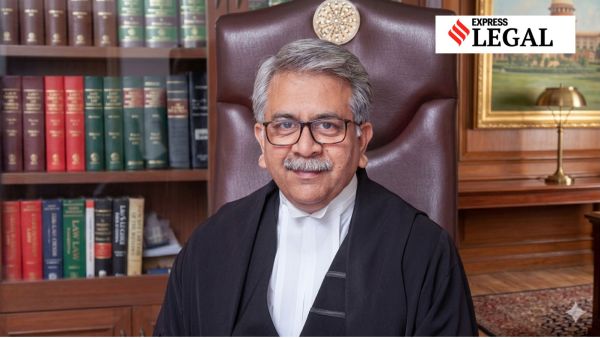 Justice Manoj Kumar Ohri set aside the trial court’s order denying compensation to the late man’s family in a railway accident matter.
On November 10, 2015, Sanjeev Kumar was travelling from Etawah to Agra Cantt with his father, Shyam Singh, on a valid second-class train ticket. While the train was approaching Agra Cantt station, Sanjeev, who was occupying the upper berth, fell from the berth after a sudden jerk in the moving train and became unconscious and was attended to by a railway doctor, who declared him dead. His post-mortem was subsequently conducted at District Hospital, Agra.
Sanjeev’s father and another person approached the Railway Claims Tribunal seeking compensation, saying that his death resulted from the accidental fall inside the train. However, the Tribunal rejected their claim in September 2022, holding that although Sanjeev was a bona fide passenger, his death was not an “untoward incident” under the Railways Act. It relied on the post-mortem report, which said the cause of death was shock resulting from myocardial infarction (heart attack). The family challenged this decision before the Delhi High Court.
Advocates Rajan Sood, Ashima Sood and Megha Sood, appearing for Sanjeev’s father, submitted that he fell from the upper berth due to a sudden jerk in the moving train. The counsel argued that the fact that the post-mortem report recorded myocardial infarction as the cause of death would not, by itself, negate the occurrence of the accidental fall.
The Central Government Standing Counsel Bhagwan Swarup Shukla and Advocate Saumya Srivastav, appearing for the state, supported the judgment and submitted that the post-mortem report categorically records the cause of death as shock resulting from myocardial infarction. It was submitted that no external injuries were found on the body of the late man.
The counsel contended that the death was on account of a natural cause and did not constitute an “untoward incident” under the Railways Act, 1989. It noted that the tribunal has already returned a categorical finding that Sanjeev was a bona fide passenger.
The Tribunal, while answering the issue, principally relied upon the post-mortem report, which recorded the cause of death as “shock as a result of myocardial infarction”.
The court observed that the statement that the late man was being taken to Agra Cantt. for treatment of back pain cannot, in any manner, establish the existence of any cardiac condition or that a cardiac event had occurred prior to the fall.
Considering the material on record, the court held that the appeal deserved to be allowed and set aside the trial court’s judgment, remanding the matter back to the tribunal, and requested it to assess the amount of compensation payable to the appellants in accordance with law. It also directed the authorities concerned to disburse the same within two months from the receipt of a copy of this order.