High Court refuses to quash case against four in Madhya Pradesh hijab row

The court says that while wearing hijab alone cannot amount to an offence under the MP Freedom of Religion Act, allegations of compulsory dress, restrictions on tilak and kalawa, religious practices and prayers, and alleged threats or coercion raised questions that ‘must be tested at trial’

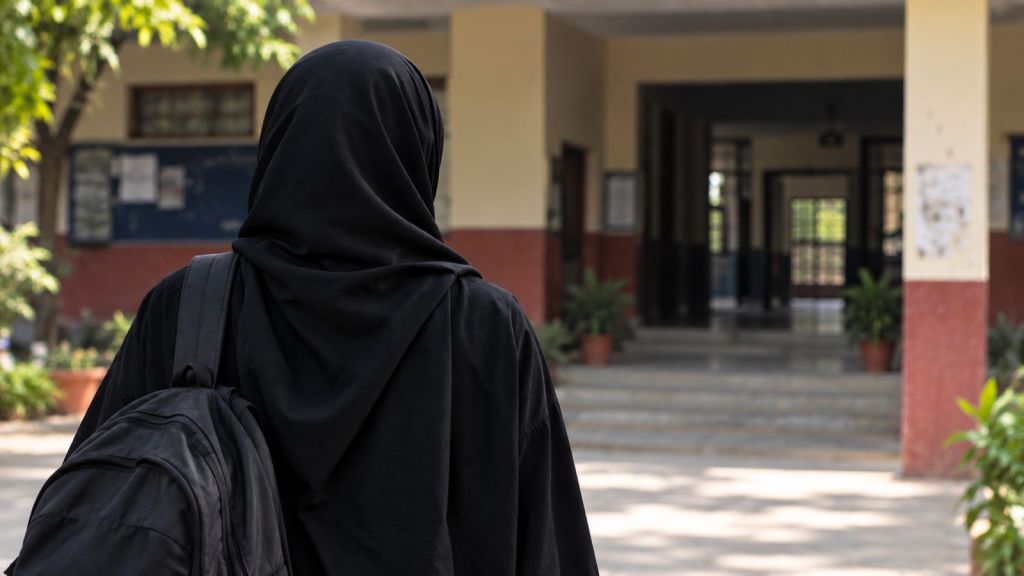
Justice Himanshu Joshi, who heard the case, made an important distinction on the issue of hijab, observing that wearing hijab by itself cannot constitute an offence under the Madhya Pradesh Freedom of Religion Act. (AI generated image)Justice Himanshu Joshi, who heard the case, made an important distinction on the issue of hijab, observing that wearing hijab by itself cannot constitute an offence under the Madhya Pradesh Freedom of Religion Act. (AI generated image)

More than three years after a controversy erupted over the alleged imposition of hijab and religious practices at a school in Damoh, the Madhya Pradesh High Court has refused to quash the criminal proceedings against four accused, holding that the allegations in the FIR and material collected during the investigation could not be termed inherently absurd or incapable of constituting the offences alleged.

Justice Himanshu Joshi, who heard the case, made an important distinction on the issue of hijab, observing that wearing hijab by itself cannot constitute an offence under the Madhya Pradesh Freedom of Religion Act.

“Mere wearing of a particular dress, without the statutory ingredients of conversion or an attempt to convert by the prohibited means, cannot automatically constitute an offence,” the court said.

The court said the prosecution’s case, however, was not based merely on students wearing hijab. It included allegations that a particular dress code was made compulsory, that students were allegedly prohibited from wearing tilak and kalawa, were required to follow certain religious practices and prayers, and that threats and coercion were used.

“Whether these practices were actually compulsory, whether students acted voluntarily, and whether there was an intention to convert through prohibited means were questions that could only be determined after appreciation of evidence,” the court said.

The court rejected the accused’s attempt to have the prosecution terminated at the threshold, saying the allegations could not be described as “inherently absurd” or “inherently improbable”. The defence raised disputed questions of fact concerning the statements of students and other witnesses, the individual roles of the accused and the applicability of the statutory provisions to the facts proved in the case. These fell within the domain of the trial court, the court said.

Two of the accused, Shailendra Kumar Jain and Abdul Wasim Bari, had argued that they were not members or office-bearers of the school’s management committee during the relevant period. The High Court said documents they produced supported their defence regarding the subsequently constituted committee, but the prosecution alleged their involvement and relied on material collected during the investigation. Whether they had any role in the school’s affairs or exercised influence over its functioning would therefore have to be decided at trial.

Story continues below this ad

The court also refused to treat affidavits subsequently furnished by some parents or students as a basis for quashing the case. The affidavits stated that the books supplied to students were government-prescribed books and that no religious education beyond the syllabus had been imparted. Such material, the court said, could be considered by the trial court along with the statements recorded during the investigation and other evidence.

Significantly, the High Court noted that 32 of the 33 prosecution witnesses had already been examined. While making it clear that it was not expressing any opinion on the merits of the evidence, the court said the advanced stage of the trial was a relevant circumstance while deciding whether to exercise its extraordinary inherent jurisdiction to terminate the prosecution.

The Ganga Jamuna Higher Secondary School in Damoh was thrust into controversy in May 2023 after a poster celebrating its Class 10 board results showed several girl students, including those from non-Muslim communities, wearing headscarves. Right-wing groups alleged that the school was forcing Hindu and Jain students to wear hijab and follow Islamic practices. The controversy initially centred on the school uniform, but quickly escalated into allegations of religious conversion and coercion.

Three people were initially arrested in the Damoh Ganga Jamuna school case in June 2023 — school principal Afsha Sheikh, mathematics teacher Anas Athar Ali and school peon/security guard Rustam Ali — after police registered an FIR over allegations that students were being compelled to follow a particular dress code and religious practices. The FIR named several other people connected with the school management, and the subsequent prosecution also named Shailendra Kumar Jain and Abdul Wasim Bari among the accused. Jain and Bari later approached the Madhya Pradesh High Court, along with Athar and Rustam, seeking quashing of the proceedings.

Anand Mohan J is an award-winning Senior Correspondent for The Indian Express, currently leading the bureau’s coverage of Madhya Pradesh. With a career spanning over eight years, he has established himself as a trusted voice at the intersection of law, internal security, and public policy. Based in Bhopal, Anand is widely recognized for his authoritative reporting on Maoist insurgency in Central India. In late 2025, he provided exclusive, ground-level coverage of the historic surrender of the final Maoist cadres in Madhya Pradesh, detailing the backchannel negotiations and the "vacuum of command" that led to the state being declared Maoist-free. Expertise and Reporting Beats Anand’s investigative work is characterized by a "Journalism of Courage" approach, holding institutions accountable through deep-dive analysis of several key sectors: National Security & Counter-Insurgency: He is a primary chronicler of the decline of Naxalism in the Central Indian corridor, documenting the tactical shifts of security forces and the rehabilitation of surrendered cadres. Judiciary & Legal Accountability: Drawing on over four years of experience covering Delhi’s trial courts and the Madhya Pradesh High Court, Anand deconstructs complex legal rulings. He has exposed critical institutional lapses, including custodial safety violations and the misuse of the National Security Act (NSA). Wildlife Conservation (Project Cheetah): Anand is a leading reporter on Project Cheetah at Kuno National Park. He has provided extensive coverage of the biological and administrative hurdles of rewilding Namibian and South African cheetahs, as well as high-profile cases of wildlife trafficking. Public Health & Social Safety: His recent investigative work has uncovered systemic negligence in public services, such as contaminated blood transfusions causing HIV infections in thalassemia patients and the human cost of the fertilizer crisis affecting rural farmers. Professional Background Tenure: Joined The Indian Express in 2017. Locations: Transitioned from the high-pressure Delhi City beat (covering courts, police, and labor issues) to his current role as a regional lead in Madhya Pradesh. Notable Investigations: * Exposed the "digital arrest" scams targeting entrepreneurs. Investigated the Bandhavgarh elephant deaths and the impact of kodo millet fungus on local wildlife. Documented the transition of power and welfare schemes (like Ladli Behna) in Madhya Pradesh governance. Digital & Professional Presence Author Profile: Anand Mohan J at Indian Express Twitter handle: @mohanreports ... Read More


Advertisement
Loading Recommendations...
Advertisement
Advertisement
Latest Comment
Post Comment
Read Comments