


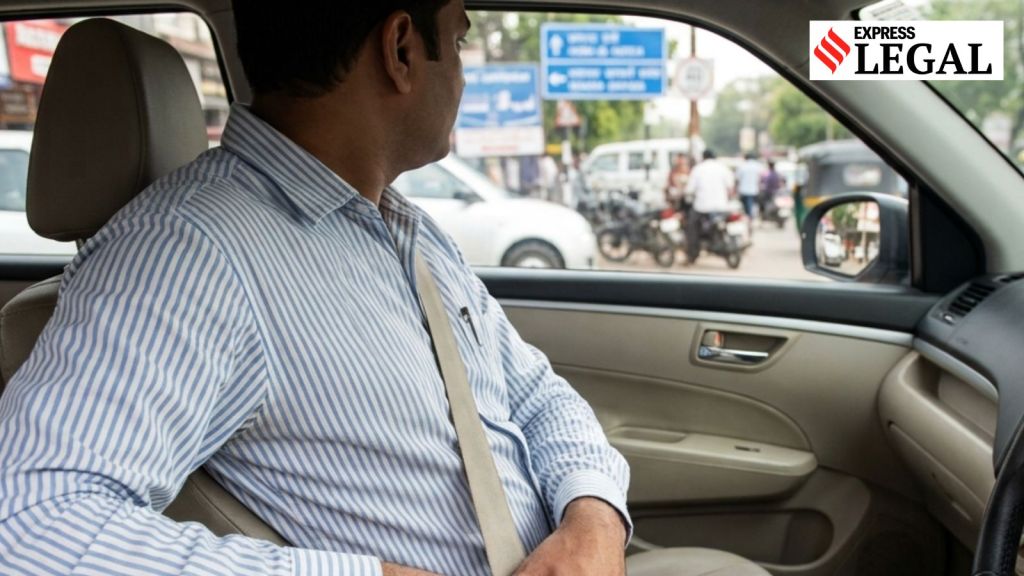
 The petition points out that, despite mandatory seat-belt laws in India, a large number of vehicles, particularly in the back-seat area-have obstructed or non-functional seat-belt sockets. (Image generated using AI)
A diabetes specialist and researcher recently approached the Supreme Court seeking directions to make seat belts mandatory for all passengers of motor vehicles, highlighting that the failure to ensure their actual use continues to expose people to a known and avoidable risk to human life.
Dr Jothydev Kesavadev, who says he has travelled extensively across India and abroad for medical lectures and research for more than two decades, told The Indian Express that the problem became apparent to him during his frequent journeys in taxis across cities including Delhi, Mumbai, Chennai, Bengaluru, Ahmedabad, Kolkata and various parts of Kerala.
“In 80% of the cabs when I am travelling, I have found that in the back seat, the seat belt won’t be functional,” Kesavadev said, referring to his experience while travelling in taxis.
According to him, the problem often arises after vehicle owners install additional seat covers over the original upholstery. The covers, he said, can bury the seat-belt buckle or socket, making it difficult or impossible for passengers to locate and use it.
“I have tried to find out the reason for this. They will buy a new car and then they will have a new seat cover over the original seat. And the buckle, and that is socket of the seat belt, will be buried inside the new seat cover,” he said. At times, he said, even drivers are unable to retrieve the buckle. In some vehicles, the concealed socket may also become damaged or rusted over time, making the safety mechanism unusable.
Kesavadev said his concern was heightened by the attitude he encountered among some drivers. Recalling one incident where he asked a taxi driver why the seat belt wasn’t working, the driver answered, “Don’t worry sir, don’t worry. Seat belt is required only in the front seat.”
He said his concern was not limited to seat-belt compliance but was rooted in his work as a doctor, where he focuses on preventing complications rather than merely treating them. “I believe in prevention of diseases. I work in diabetes where people are dying of complications, but all of them are preventable,” he said. Drawing a parallel with road safety, he added that many deaths in road crashes could also be prevented through basic safety measures.
In his plea filed before the top court through advocate Wills Mathew, Kesavadev highlights the dangers faced by children and seeks effective implementation of child-seat requirements. It refers to road crashes involving young people and argues that age- and size-appropriate restraint systems are particularly important for children.
He said the problem was especially visible in taxis where the focus on protecting the vehicle through additional seat covers could inadvertently compromise passenger safety. “Actually, the car owners are trying to protect the car and not protect the passenger,” he said. The petitioner said the Supreme Court hearing had reinforced his belief that the issue required greater attention.
 Supreme Court has disposed of the plea filed by the petitioner.
Kesavadev said he hoped enforcement would eventually become as routine as helmet enforcement. “Now the Supreme Court has intervened and has instructed the ministry to make a necessary implementation of the law and the states have to do this. Now the law has to be enforced similar to helmet,” he said.
He also appealed to taxi operators and drivers to treat seat belts as a passenger-safety requirement rather than merely a traffic-law obligation. “If you are putting a seat cover, make sure that there is ample space around the socket of the seat belt so that the seat belt can be engaged,” he said.
Kesavadev also said he hoped media would help turn the issue into a matter of public awareness and compliance, particularly among taxi and cab drivers.
The petition points out that, despite mandatory seat-belt laws in India, a large number of vehicles, particularly in the back-seat area-have obstructed or non-functional seat-belt sockets (due to thick aftermarket seat-covers, removal of receptacles or other modifications), which effectively prevents rear-seat passengers from wearing seat belts.
He claims that in around 85 per cent of the taxi services he has used, particularly in India, rear-seat seat-belt sockets were either inaccessible or non-functional. The petition stated that the law becomes ineffective if vehicles do not have functional and accessible seat-belt mechanisms.
The petition cites road accident figures to underline the scale of the issue. It states that India recorded approximately 4.80 lakh road accidents and around 1.72 lakh deaths in 2023, and argues that a significant number of deaths and serious injuries could be prevented through effective enforcement of basic safety measures.