


Journalism of Courage
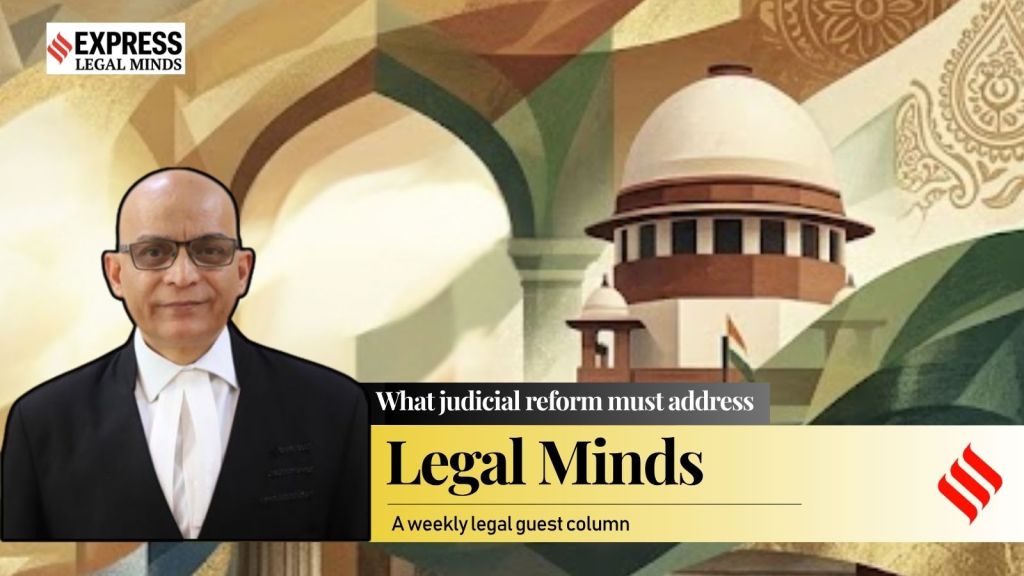 Courts don’t have the power of the purse or the sword, its brand equity is dependent on how it behaves as an institution, says Senior Advocate Rajiv Shakdher. (Images designed by Somya Panwar)
Written by Rajiv Shakdher
The birth of the Indian Supreme Court on January 28, 1950, two days after the Constitution came into force, gave wings to the expectations of every Indian — to secure for them freedom of thought and action; a nation where pluralism thrived; assurance that the rights of poor and marginalised segments of society would matter; equality before law; the right to question those who ran the state apparatus; a nation where disparity in income and wealth would cease to matter for progress in life and where equitability among classes would be the Grundnorm and not a measure that is applied when convenient.
Over 76 years, the court has done much to be proud of, yet one needs to introspect where it has veered off the chosen path.
From being an upholder of the rights of the weak and marginalised, it has allowed the fostering of administrative decisions, which directly affect the lives of citizens. To cite a few instances: the eviction of poor and homeless persons from public land without concern for alternative accommodation and rehabilitation; inability to punish those who perpetrate punishment on purported violators of law in a manner unknown to law (i.e. bulldozer therapy); failure to cull at the threshold petitions which are clearly divisive and propped up to shoot from the court’s shoulder — interim orders only kick the can down the road, as in the case of challenge to the Places of Worship Act, 1991.
Another example is sustaining or delay in grappling with statutes that seek to upend court judgments (e.g. NALSA and Jane Kaushik), not to correct errors mentioned but to emasculate the benefits and rights granted to citizens of the country. Finally, the question of appointments to constitutional courts remains contested, particularly regarding the respective roles of the judiciary and the government of the day.
It is clear that the institution needs a shake-up, and any meaningful reform should begin at the foundation, i.e., the magisterial level. It must be borne in mind that the debate concerning the judge-to-population ratio is endless.
Addressing this imbalance requires involvement of the executive of the day, as well as empirical data concerning the number of cases at each level, studies regarding the average time required by a judge to adjudicate a case — which is jurisdiction-sensitive, as no two jurisdictions are the same— the state of the available infrastructure and, last but not least, manpower made available to a judge both in terms of numbers and quality.
Thus, what we have should be fixed. Magistracy, in a figure of speech, is the “front office” of the institution.
Litigants carry an impression about the institution based on their experiences at this level. Having said that, magistrates cannot be mulcted solely with the burden of improving the quality of services on offer in courts without them being given a helping hand.
Judicial officers at the magisterial level are young. They have little to almost negligible experience at the Bar, life and lived experience. They encounter the administration and police in more than one way. This exposure can be heady. Maturity to handle the Bar and the claptrap of power, both on the judicial and administrative side, requires guidance and mentoring.
Judicial academies do a good job of upskilling officers in various facets of law, but they might also benefit from involving life coaches who are familiar with the judicial ecosystem. Most judicial officers are first-generation judges and enter the profession starry-eyed when they first don the robes of an adjudicator.
They have little understanding of its demands; its pitfalls; allurements that are held out, which are pure and simple baits; its impact on family; feelings of isolation; or the challenges posed by the desire for recognition and the demands of technology and the media.
Judicial officers have long careers, often spanning 35 years plus. Some burn out, and some survive. Those who survive, towards the end of their careers, live with the hope that they will summit by securing the position of a high court judge.
Few have gone beyond and made it to the Supreme Court. Therefore, their judicial careers at the end are spent on attracting the attention of senior judges in the high court. Those who are unable to align, although good at their work, fall by the wayside. This speaks volumes about the weakness of our performance evaluation process.
Annual Confidential Reports (ACR) are often drawn mechanically, with emphasis on “units”— a euphemistic term for the number of case disposals — while the quality of writing and iteration of legal issues are given much less weight than they deserve. There is next to no metric for evaluating judges who handle tough, intricate and complex social and politically sensitive matters.
As a matter of fact, those who dribble past politically sensitive matters invariably climb the ladder. This leads to frustration at the professional front and impacts the mental health of the officers. In the recent past, reports of judicial officers dying by suicide have come to the fore. What does not come into the public eye are the problems they face domestically. Falling out with their life partners and other members of their family is brushed aside or not given importance. Officers are left to fend for themselves. Services of mental health experts are not made available to judicial officers. The institution could make a beginning with this first step.
Besides this, each judge at the high court level should be given a cohort of civil judges at the senior and junior divisions as mentees. This would enable institutional course correction at the appropriate time. Issues concerning propriety, ethics, and methods that could be employed to improve performance and caseload management could be discussed with the assigned mentor.
In judicial functioning, perception matters. However, cliched it may sound — courts don’t have either the power of the purse or the sword; their brand equity is dependent on moral authority, i.e., how we behave as an institution: neutrality, compassion and narrowing the gap between justice and law are at the forefront of it.
Should we fail in committing ourselves to make course corrections, the generations that follow will look upon us dimly. The Supreme Court’s motto “Yato Dharamstato Jayah (Where there is justice, there is victory)”, when applied routinely in daily decision-making, presents complexity. Truth is a conundrum; famously described as “a riddle, wrapped in a mystery, inside an enigma.” Judges do that every day without fail— sift the wheat from the chaff.
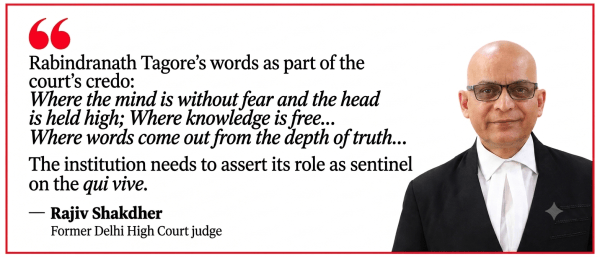
They put pen to paper, which most persons in their daily lives shy away from, and yet an inexplicable gap in perception prevails. We need to correct it; else we will rue this period in the history of our institution. Perhaps the most fitting way would be to meld in the daily business of dispensation of justice. Rabindranath Tagore’s words as part of the court’s credo: Where the mind is without fear and the head is held high; Where knowledge is free… Where words come out from the depth of truth… The institution needs to assert its role as sentinel on the qui vive.
Rajiv Shakdher is a Senior Advocate and a former Delhi High Court judge.
Written by eminent law professionals, the Legal Minds Column aims to break down complex statutory frameworks into insights, both for members of the fraternity and the general public.
For feedback and pitches, write to us at expresslegal@indianexpress.com