4 min readNew DelhiSep 10, 2026 11:15 AM IST
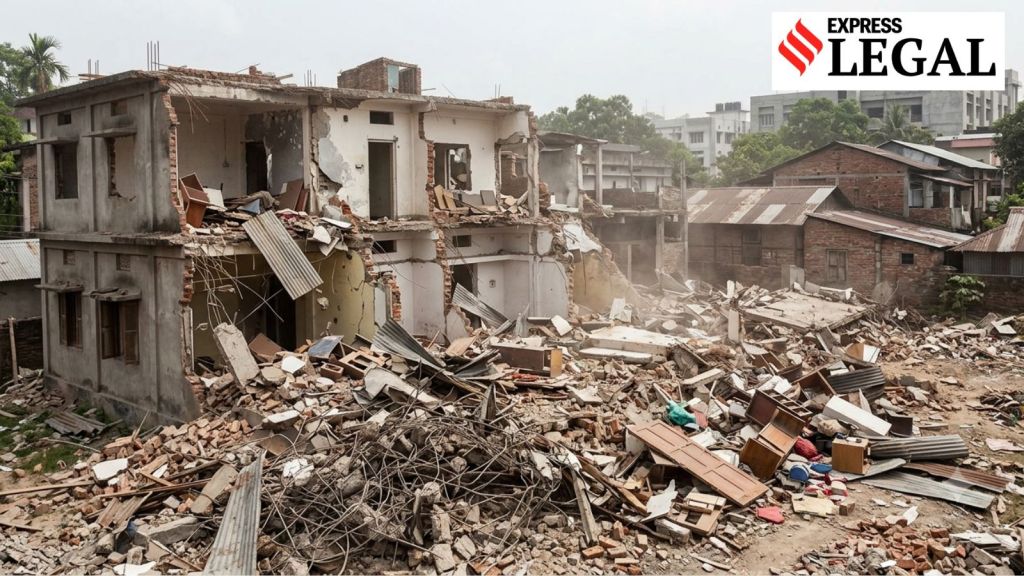
The Gauhati High Court has questioned the recent demolition of multiple houses in Assam’s Goalpara after the residents were given a notice of just 24 hours, and asked the authorities what “imminent danger” made such drastic action necessary. The demolition appeared to be “illegal”, it said, adding that the landholders were not given an opportunity to have a say before their houses were razed. It directed that no further action be taken until the next hearing.
Justice Devashis Baruah was on September 7 hearing a petition filed by 21 residents against the state of Assam, Goalpara district commissioner and the circle officer of Matia revenue circle, challenging the September 5 notices, which threatened legal action if houses constructed on their agricultural lands were not demolished within 24 hours. Their counsel told the court that the houses were then razed in the early hours of September 7.

“The actions on the part of the Circle Officer, Matia Revenue Circle prima facie appear to be illegal and unauthorised and violative of the principles of natural justice, which is a facet of Articles 14 (right to equality) and 21 (protection of life and liberty) of the Constitution. It is absolutely unthinkable in the present day, when there are galore of settled principles, that such notices were issued in this manner without providing even an opportunity to the Petitioners…the notices do not reflect any imminent danger to invoke such drastic powers on private lands,” the judge said.
The court issued notice and fixed the next hearing for September 11.
Demolition on patta lands
Noting that the notices concerned “the patta lands belonging to the Petitioners”, the court said the petitioners challenged the revenue authorities’ action against their dwelling houses.
Justice Devashis Baruah allowed the petitioners to file an additional affidavit bringing on record the demolition of their houses.
Senior Advocate S Borthakur submitted that although the notices were issued on September 5, the dwelling houses were razed early on September 7. He added that the petitioners were not given “any opportunity whatsoever” to have a say before the demolition.
To this, the court examined not just the authorities’ stated legal basis for action but also the manner in which the demolition was carried out. Disapproving of the alleged denial of an opportunity to the residents, the court questioned the urgency of the action and observed that the notices did not indicate any imminent danger warranting such drastic powers over private lands.
Story continues below this ad
‘Explain imminent danger’
S S Roy, the government counsel representing the district commissioner and circle officer, was directed to obtain instructions and inform the high court at the next hearing “as to what was the imminent danger that necessitated actions of demolishing the dwelling houses of the Petitioners.”
The court also took note of the Assam Agricultural Land (Regulation of Reclassification and Transfer for Non-Agricultural Purpose) Act, 2015. Under its provisions, permission from the deputy commissioner is not required when agricultural land not exceeding one bigha is intended to be used or transferred for construction of one’s own dwelling house, provided the construction is limited to two storeys, the judge noted.
However, the court did not finally rule that the petitioners’ individual houses complied with all applicable legal requirements and only recorded the legal provision while considering the challenge to the notices.
The court allowed the petitioners to file an additional affidavit bringing on record the demolition of their houses and the losses they claim to have suffered. It directed that no further action be taken on the lands by the district commissioner and circle officer until the next hearing.




 Justice Devashis Baruah allowed the petitioners to file an additional affidavit bringing on record the demolition of their houses.
