


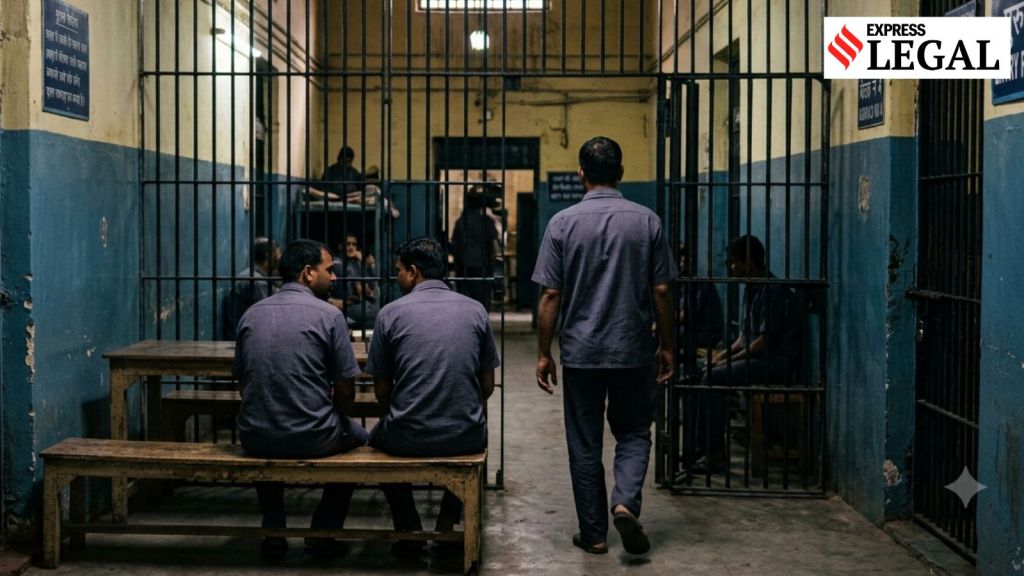
 The Patna High Court suggested a formal mechanism through which prisoners could complain about discrepancies in remission calculations or non-grant of remission. (Image generated using AI)
The Patna High Court has laid down a series of directions and recommendations to make the remission and premature release process for prisoners more transparent, time-bound and accessible, including a fixed timeline for decisions on cases of life convicts on completion of the prescribed period of actual custody and giving prisoners an opportunity of hearing before remission already granted is withdrawn.
In a judgment dated September 18, a division bench of Justices Bibek Chaudhuri and Chandra Shekhar Jha examined the remission provisions under the Bihar Prison Manual, 2012, in a suo motu case registered pursuant to a Supreme Court order.
“The residual concerns regarding transparency, timelines and grievance redressal stand substantially addressed by the suggestions jointly emerging from the Amicus and the State, which we adopt as directions hereinafter,” the bench said.
 Justices Bibek Chaudhuri and Chandra Shekhar Jha passed a slew of directions.
The court made a series of recommendations concerning premature release of eligible prisoners. It recommended that the process of obtaining reports from various authorities on proposals for the premature release of eligible prisoners begin at least six months before a prisoner becomes eligible for consideration.
It suggested fixed deadlines for the reports: 15 days for the Probation Officer, 30 days for the Superintendent of Police and 15 days for the Presiding Officer. If a report is not submitted within the prescribed period, the court recommended treating it as favourable.
The court also recommended that all procedures relating to the required reports should ordinarily be completed at least two months before the convict completes the prescribed period (14 years of actual imprisonment / 20 years including remission), so that sufficient time is available for consideration by the State Sentence Remission Review Board.
It also recommended a reasonable outer time limit for deciding cases of life convicts who have completed the prescribed period of actual custody. The court recommended that a prisoner should be given an opportunity of hearing before any remission already granted is deducted or seized. “An appellate mechanism against such seizure, to be decided by a reasoned order within thirty days, may be provided,” it said.
The court also suggested a formal mechanism through which prisoners could complain about discrepancies in remission calculations or non-grant of remission. “The State Sentence Remission Review Board may be expressly empowered to recommend premature release subject to appropriate, reasonable and non-oppressive conditions having regard to the nature of the offence, age of the prisoner, and the reports received,” the court said.
The court also recommended that the State examine whether prisoners involved in certain categories of serious offences, including specified SC/ST cases, certain cyber offences, mob lynching and acid attacks, should be made ineligible for premature release.
The court suggested that details of all life convicts could be uploaded on a dedicated portal or the Home Department’s official website. “The list of all life convicts, with details of actual custody, remission earned (month-wise and year-wise), case particulars, likely date of consideration by the Board, and the final order of the Board, may be uploaded on a dedicated portal or the official website of the Home Department for the information of the convicts and their families,” it said.
The Court directed the State government to examine the recommendations and make necessary amendments to the Bihar Prison Manual, 2012 or issue suitable executive instructions.