‘Trial delay is no panacea’: No bail to Gujarat man accused in Rs 51.22 lakh drugs case

The Gujarat High Court said the accused can't benefit from delays they contributed to and reiterated that bail is an exception in commercial-quantity NDPS cases.

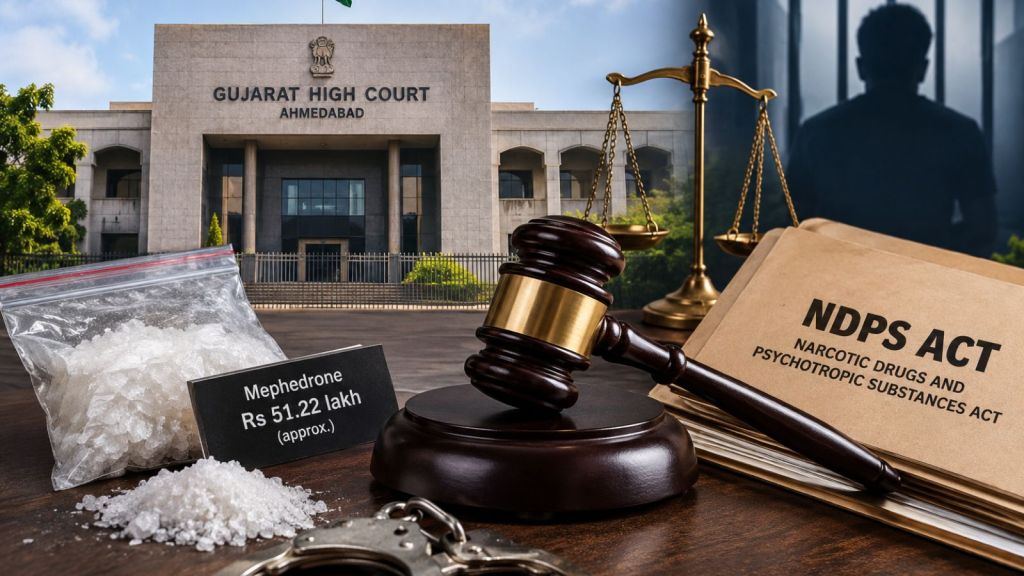
Gujarat High Court, Gujarat HC mephedrone bail case, Mephedrone trafficking case, NDPS Act Section 37, Gujarat HC NDPS case, Surat drug case, Indian Express news, Gujarat High Court newsThe Gujarat High Court directed the trial court to conclude the proceedings within 10 weeks. (AI-Generated Image)

Delay in trial cannot be treated as a “panacea” for every accused facing serious criminal charges, the Gujarat High Court observed while rejecting the fourth bail plea of a man accused of trafficking Mephedrone worth Rs 51.22 lakh.

Justice Hasmukh D Suthar, in an order dated September 2, held that the accused could not rely on the delay in trial after finding that he and his co-accused had themselves contributed to the delay.

The court was hearing a fourth bail application filed by Badrudin Bangdiwala. Bangdiwala has been in custody since March 2024 in connection with a First Information Report (FIR) registered in Surat under the Narcotic Drugs and Psychotropic Substances Act (NDPS).

What is the case

According to the prosecution’s case, as recorded in the order, a raiding team acting on a tip-off intercepted a silver Verna car near the Bhatiya Check Post in the presence of panch witnesses. The team allegedly found three people, including Bangdiwala, travelling from Madhya Pradesh with the contraband.

It recovered 512.2 grams of Mephedrone, worth Rs 51.22 lakh, from two of the accused.

While Bangdiwala is named as accused No. 1 in the FIR, accused No. 4, Iliyas alias Ilu Abdul Hanif alias Annubhai Abdul Hamid Shah, who allegedly supplied the contraband, remains absconding. Accused No. 5, the intended recipient, has already secured bail from a coordinate bench.

Appearing for Bangdiwala, Advocates Zubin Bharda and Kishan Daiya argued he has been in jail for over two years without substantial progress in the trial, and that nothing was recovered from his personal possession.

Story continues below this ad

Additional Public Prosecutor Vrunda Shah, representing the Gujarat Government, opposed the plea, saying it was the fourth successive application without any change in circumstances.

Shah argued that Bangdiwala was allegedly transporting the contraband in his own vehicle and was in direct contact with both the supplier and the intended recipient, who are both still missing.

What the court said

The court rejected the argument that Bangdiwala was not in conscious possession of the contraband. It noted that he had travelled with the co-accused, owned and drove the vehicle, and went to Madhya Pradesh to collect the delivery. In view of these circumstances, the court held that he was “considered to be in conscious possession of the alleged contraband” under the NDPS Act.

The court further held that the allegations attracted the rigours of Section 37 of the NDPS Act. The provision makes the offence non-bailable and imposes stringent conditions for granting bail.

Story continues below this ad

On the issue of delay in the trial, the court considered a report submitted by the 11th Additional Sessions Judge, Surat, and found that the accused were largely responsible for the delay.

The order records that Bangdiwala engaged a lawyer only on December 3, 2024, nine months after his arrest, and one of the co-accused got one on January 30, 2025. Afterwards, the accused filed separate discharge applications on different dates between February and May 2025, further delaying the proceedings.

“No one has the right to play with the system or to take advantage of his own wrong,” the court observed.

‘Bail is an exception’

Citing several recent Supreme Court judgments, the court held that the right to a speedy trial under Article 21 does not override the mandatory “twin conditions” prescribed under Section 37 of the NDPS Act.

Story continues below this ad

It reiterated that where an accused is charged with an offence involving commercial quantities of narcotic substances, “grant of bail is an exception and refusal of bail is the rule.”

The court also rejected Bangdiwala’s claim of parity with accused No. 5, who had earlier been granted bail. It noted that the coordinate bench, while granting bail to the co-accused, had not recorded satisfaction regarding the statutory requirements under Section 37 of the NDPS Act. The court further found that Bangdiwala’s alleged role was on a “graver” footing.

Accordingly, the court dismissed the bail application and directed the trial court to conclude the proceedings within 10 weeks. It asked both the applicant and the prosecution to cooperate in expediting the trial and permitted the trial court to secure the accused’s presence through virtual mode, where necessary.

Aditi Raja is an Assistant Editor with The Indian Express, stationed in Vadodara, Gujarat, with over 20 years in the field. She has been reporting from the region of Central Gujarat and Narmada district for this newspaper since 2013, which establishes her as a highly Authoritative and Trustworthy source on regional politics, administration, and critical socio-economic and environmental issues. Expertise: Core Authority & Specialization: Her reporting is characterized by a comprehensive grasp of the complex factors shaping Central Gujarat, which comprises a vast tribal population, including: Politics and Administration: In-depth analysis of dynamics within factions of political parties and how it affects the affairs in the region, visits of national leaders making prominent statements, and government policy decisions impacting the population on ground. Crucial Regional Projects: She consistently reports on the socio-economic and political impact of infrastructure projects in the region, especially the Statue of Unity, the Sardar Sarovar Project on the Narmada River, the Mumbai-Ahmedabad High Speed Rail bullet train project as well as the National Highway infrastructure. Social Justice and Human Rights: Her reporting offers deep coverage of sensitive human-interest topics, including gender, crime, and tribal issues. Her reports cover legal proceedings from various district courts as well as the Gujarat High Court (e.g., the Bilkis Bano case remission, POCSO court orders, Public Interest Litigations), the plight of tribal communities, and broader social conflicts (e.g., Kheda flogging case). Local Impact & Disaster Reporting: Excels in documenting the immediate impact of events on communities, such as the political and civic fallout of the Vadodara floods, the subsequent public anger, and the long-delayed river redevelopment projects, Harni Boat Tragedy, Air India crash, bringing out a blend of stories from the investigations as well as human emotions. Special Interest Beat: She tracks incidents concerning Non-Resident Gujaratis (NRIs) including crime and legal battles abroad, issues of illegal immigration and deportations, as well as social events connecting the local Gujarati experience to the global diaspora. ... Read More


Advertisement
Loading Recommendations...
Advertisement
Advertisement
Latest Comment
Post Comment
Read Comments