“The failure of the opposite party (machine company) to properly install and commission the machine, provide the warranty certificate and operating manual, rectify the defects within a reasonable time, and ensure that the machine attained the represented performance amounts to negligence and deficiency in service,” the August 31 order read.
Machine did not perform as promised
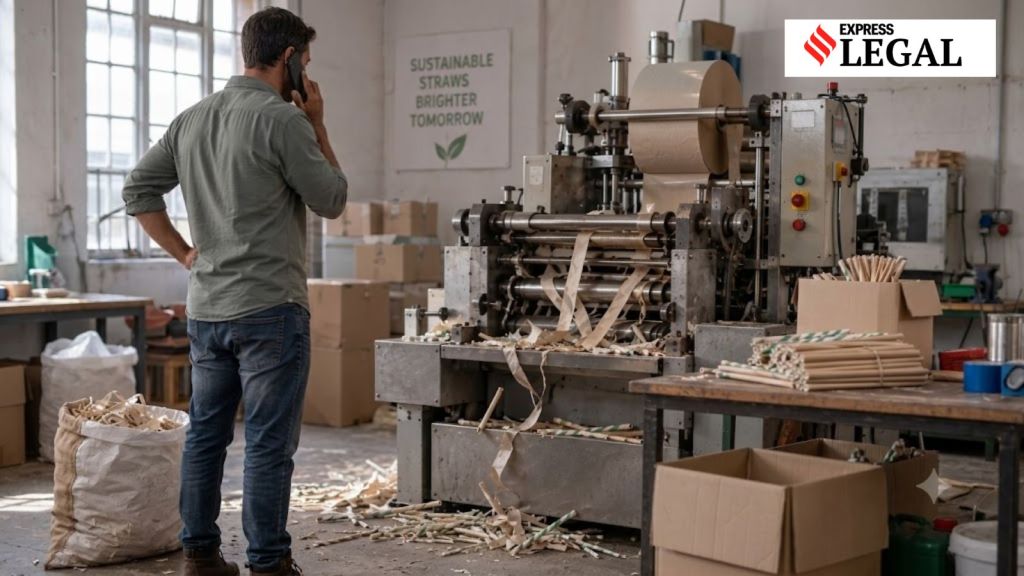
The complainant, the chief executive officer of the firm, claimed that he purchased a fully automatic paper-straw-making machine for Rs 10.62 lakh to start a self-employment venture. The company allegedly represented that the machine would have high production capacity, little or no wastage, free installation, after-sales service and a one-year warranty.
The man received the machine in August 2020 after a considerable delay and alleged that it produced only about 80 straws per minute instead of the promised 90–150. Its 10 mm setting also did not work, while wastage was around 25 per cent.
Despite repeated requests, emails and a lawyer’s notice, the company allegedly failed to fix the defects, replace the servo motor and software, or provide the warranty card. The man then approached the commission seeking a refund, compensation, interest and costs.
The venture and its CEO were represented by advocate Mathew K Uthappachan before the commission.
Story continues below this ad
Company’s defence
The company, through advocate Sunil V Mohammed, argued that the man had carefully chosen a standard fully automatic machine suited to his requirements and budget. It said he had not bought the more expensive high-speed model and that expecting comparable output from a machine costing more than Rs 15 lakh was unjustified.
It also argued that no industrial machine could operate with zero wastage, claiming normal wastage for the machine was between 1 per cent and 3 per cent. It said production efficiency depended on the operator’s skill and how the machine was used.
The company further claimed that its technicians had tested and successfully commissioned the machine and that the alleged defects had not been supported by a contemporaneous technical report.
‘Company misled about machine’s performance’
The commission referred to an independent expert report, which found the machine non-operational and detected problems in its paper-rolling and cutting units. The expert found that the machine could not produce 10 mm straws and had an output of only 92 straws per minute against a specified capacity of 160–240 straws per minute. Around 20 per cent of the output was also wasted.
Story continues below this ad
The commission noted that the man shifted the machine to another premises in August 2021 to reduce the rent burden because production could not be started. It also found that the machine’s installation-completion certificate, warranty certificate and manual had not been provided.
It said buying machinery to earn a livelihood through self-employment does not stop being a consumer transaction simply because the person takes help from one or two employees.
The commission also found that the company’s claim that the machine would produce the promised output with zero or negligible wastage amounted to a misleading representation when the machine failed to deliver that performance.
It further noted that the man had paid Rs 10.62 lakh to establish his livelihood venture, but the purpose of the purchase was substantially defeated because the machine could not operate at the promised capacity and the defects remained unresolved.
Story continues below this ad
The commission said the man could not reasonably be expected to keep a defective and non-operational machine indefinitely and held that a refund of the purchase price was the appropriate remedy, subject to the machine being returned to the company.
Accordingly, the commission directed the company to refund Rs 10.62 lakh, being the price of the paper-straw-making machine, to the man and his venture and ordered him to make the machine, together with the available accessories, ready for return.
It also ordered the company to pay Rs 1 lakh as compensation for loss of use, business disruption, inconvenience and hardship, along with Rs 25,000 towards litigation costs.
Takeaway
This ruling highlights that a company should deliver a product that matches the specifications and promises made to the customer and cannot mislead consumers by showcasing performance that the product fails to deliver.
Story continues below this ad
For consumer-related grievances, individuals can contact the consumer helpline in their respective states and Union territories (Kerala: 1800-425-1550) or call the National Consumer Helpline at 1915 for assistance.
Don’t miss out on these stories:
Rs 1,500 Anarkali dress bought on Instagram never came: Kerala woman wins Rs 16,000
Ordered diapers for 1.5-year-old daughter, ‘never’ delivered: Father wins Rs 22,500
Policy terms ‘not given upfront’: Kerala man wins Rs 2.8 lakh payout from insurance firm