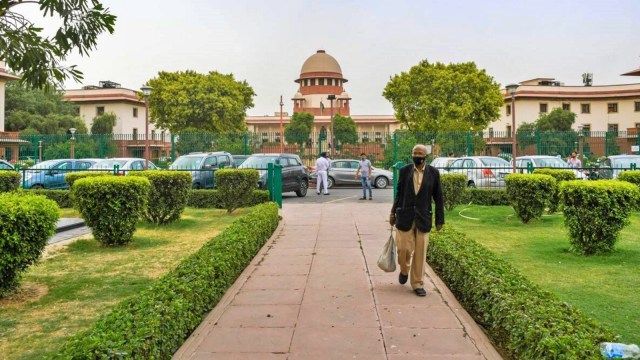
The Supreme Court’s Tuesday verdict that recalled its May 16 Vanashakti judgment against retrospective environmental clearances does not say that such a regime is permissible but has merely found errors in the previous judgment, legal experts say.
The judgment, experts add, will also roll back the orders directing a stay on the government notifications and procedures which had brought in the regime of post-facto clearances and laid down the process.
Environmental policy experts feel that the judgment, now recalled, had paved the way for strict enforcement of the Environment Impact Assessment (EIA) notification, and hoped that the apex court gave an early decision in the matter to prevent misuse.


“The court has not said that post-facto is permissible, they have said that the previous judgment erred. The matter will be heard again, and SC’s verdict thus is not an endorsement of the post-facto clearance regime,” said Ritwick Dutta, an environmental lawyer.
The May 16 Vanashakti judgment was in response to a clutch of petitions against a 2017 notification which spelt out a process enabling regulatory authorities to grant environmental clearance (EC) to projects which did not have prior EC, and a 2021 SOP which laid down a procedure for handling violation cases under the Environment Impact Notification, 2006. Tuesday’s judgment was on a clutch of petitions seeking a review of the May verdict.
Debadityo Sinha, Senior Resident Fellow and Lead for the Climate & Ecosystems team at Vidhi Centre for Legal Policy, said that while the SC’s verdict recalling the May judgment was only on technical grounds, an early decision is essential to prevent misuse of the order in the interim.
Sinha said that granting environmental clearance is a rigorous process to determine whether a project is suitable for a specific location, considering ecological sensitivity and potential impacts, not a mere pollution-checking tool.
“The Vanashakti judgment rightly strengthened environmental rule of law and sought to curtail the misuse of fait accompli, which was reducing the environmental clearance process to a rubber stamp. It enforced the EIA Notification more strictly by halting attempts to legitimise fait accompli — efforts that would have undermined the Precautionary Principle, participatory decision-making and the protection of ecosystems vulnerable to permanent loss,” Sinha said.
The Confederation of Real Estate Developers’ Associations of India (CREDAI) was one of the key petitioners seeking a review of the May judgment that struck down post-facto approvals. CREDAI represents over 13,000 developers across 21 states, and it had said that quashing the environment ministry’s 2017 and 2021 decisions would “paralyse and indefinitely” delay real estate development in the country.
A standard operating procedure was laid out in the post-facto clearance regime in 2021, and it distinguished between violation and non-compliance. In its petition, CREDAI had submitted that as of 2023, about 99,000 estate projects were ongoing, and most of them are governed by EIA notification, requiring environmental clearance.
In his judgment, CJI B R Gavai took on record the Centre’s submissions that 24 projects of the Central government involving an expenditure of Rs 8,293 crore and 29 projects at state-level worth Rs 11,168 crore were pending.


