


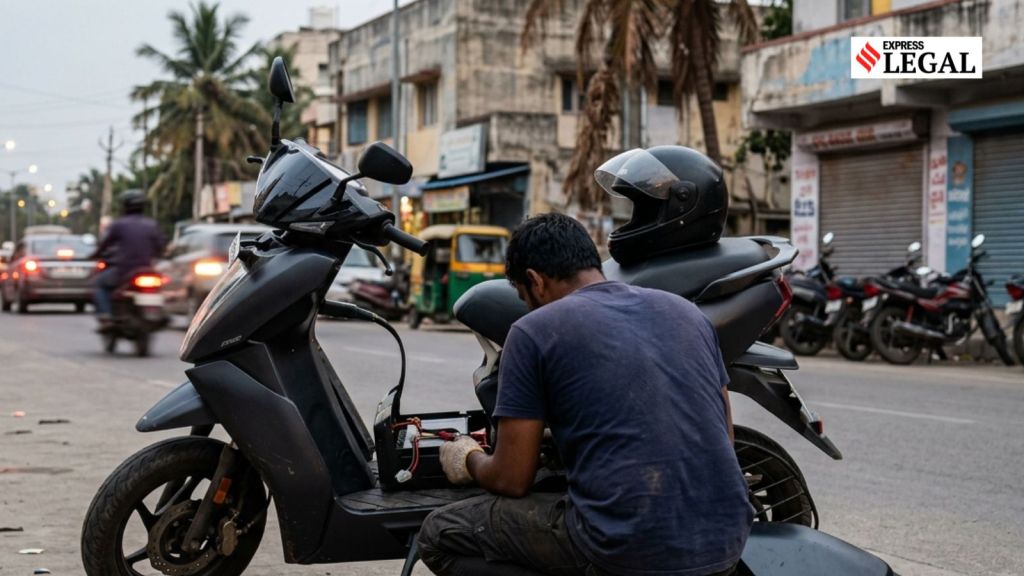
 The manufacturer and dealer denied any manufacturing defect and attributed the reduced mileage to rider weight, terrain, tyre pressure, riding style and high-speed riding. (AI-generated image)
A Kerala consumer commission has held an electric scooter manufacturer liable for a manufacturing defect after a consumer complained of poor mileage despite repeated battery replacements. The commission relied on expert findings and concluded that the scooter travelled only 16 km on a full charge, and directed the manufacturer to refund Rs 88,000 and pay compensation.
President Vinay Menon V and members Vidya A and Krishnankutty N K of the Palakkad District Consumer Disputes Redressal Commission also ordered payment of Rs 55,000 as compensation and Rs 25,000 as litigation costs, adding up to a total of Rs 1.68 lakh.
“Even though the opposite party (manufacturer) had stated a number of causes that might result in the condition suffered by the vehicle, they had failed to prove by evidence that the factors laid out by them were, in fact, the reasons for the complaints suffered by the vehicle,” the commission said on September 30.
The ruling noted that the manufacturer had not produced any documents to show that they had provided effective service to the vehicle even though this issue was raised.
The complainant purchased an electric scooter from the authorised dealer in 2022 for Rs 88,000. The scooter carried a three-year warranty, and the dealer had represented that it could travel 85 km on a six-hour charge. However, the complainant claimed that it initially provided only around 40 km, and its mileage deteriorated despite repeated servicing and battery replacements.
According to the complainant, the batteries were replaced on multiple occasions, including in March and October 2023, but the problem persisted, with the scooter eventually giving only 18–20 km on a full charge.
The complainant also alleged problems with the charger and a loose front-wheel bearing, while the dealer allegedly failed to provide the required spare parts and repairs. He, therefore, approached the consumer commission seeking a refund and compensation.
The manufacturer and dealer denied any manufacturing defect and attributed reduced mileage to factors such as rider weight, terrain, tyre pressure, riding style, temperature and high-speed riding. They also argued that the complaint, filed in December 2024, was barred by limitation.
The commission held that the complaint was not barred by limitation. It noted that the dispute concerned the scooter’s mileage, which persisted despite attempts to rectify the problem and replacement of batteries. The cause of action arose when it became clear that the defect could not be fixed.
The commission found that the scooter had three persistent problems: reduced mileage, a loose front-wheel bearing, and charger-related issues, which remained unresolved despite repeated attempts by the complainant to get them rectified.
It relied on the joint report of two experts, who found an inherent defect in the front-wheel shaft bearing system, inadequate battery voltage, poor charge retention, misalignment caused by an oval-shaped shaft hole, and mileage of only 16 km on a full charge.
Although the opposite parties (manufacturer and dealer) attributed the poor mileage to factors such as riding style, tyre pressure, terrain, temperature and rider weight, the commission observed that they failed to produce evidence establishing that these factors were actually responsible for the scooter’s problems.
The commission also noted that the manufacturer and dealer had objected to the expert report but did not produce evidence to back their claims. They had remained absent for nine consecutive postings and were eventually ruled against ex parte (unilaterally).
This judgment emphasised that manufacturers cannot attribute persistent performance issues to general riding conditions without evidence. Where expert findings establish defects and repeated repairs fail to resolve them, consumer commissions can order refunds, compensation and litigation costs for deficient service and manufacturing defects.
Consumers facing similar grievances may contact the consumer helpline in their respective states (Kerala: 1800-425-1550) or dial the National Consumer Helpline at 1915 for assistance.
Toll plaza ‘double-charges’ him, refuses refund, Haryana man wins Rs 6,800
Insurer denies woman’s death claim over ‘hidden illness’, son secures Rs 5 lakh payout
3 years after insurer rejects fisherman’s drowning death claim, widow gets Rs 5 lakh