5 min readNew DelhiSep 14, 2026 06:30 PM IST
The Calcutta High Court has ordered the authorities to rebuild a two-storey commercial building that they are alleged to have illegally demolished during an anti-encroachment drive, besides providing the affected petitioners free alternative accommodation until the new structure is ready, and paying them Rs 10 lakh in compensation.
Justice Partha Sarathi Sen was hearing a plea filed by one Kabita Manna and another, who alleged that their building in Purba Medinipur was demolished while the authorities were removing encroachments from adjoining government land. The petitioners sought compensation, restoration of the demolished building and a declaration that the demolition was illegal.

“This Court finds no difficulty in reaching to a conclusion on the basis of the materials placed before it supported by sufficient evidence that the respondent authorities have exceeded their limit by dismantling and/or demolishing construction of the writ petitioners,” the court said on September 8.
“Since the property of the writ petitioners has been demolished by the respondent authorities without any lawful authority, the respondent no.2 authority shall arrange alternative accommodation of the writ petitioners preferably in the same locality free of cost till they complete the construction and handover possession thereof to the writ petitioners,” it added.
Demolition dispute
The dispute arose from proceedings over alleged encroachment on government land in Purba Medinipur where the petitioners had constructed a two-storey commercial building after obtaining a sanctioned plan from the local gram panchayat. The second petitioner also ran a business from the premises.
Justice Partha Sarathi Sen observed that the demolition had affected the petitioners’ construction.
The matter has been before the high court since 2024. In August 2024, a coordinate bench directed the authorities to take appropriate steps if they found that there was illegal encroachment over a PWD road. The jurisdictional executive engineer then called for fresh demarcation of the government land.
A revenue inspector inspected the disputed area and submitted a report dated September 10, 2024, along with a sketch map. Another field enquiry followed, with a further report and sketch map prepared on March 17, 2025. The reports showed the relevant plots as contiguous and indicated alleged encroachment over government plots 1 and 12. The executive engineer then ordered removal of the encroachment.
Story continues below this ad
The petitioners challenged the proceedings and obtained an interim stay in March 2025. The dispute later reached a division bench, which on May 19, 2025, recorded that the state had demolished unauthorised construction on government plot. The petitioners, however, alleged that the demolition had also affected their property. They were given the liberty to pursue their allegation of excess demolition.
Court examines record
The state argued that the petitioners had failed to produce material proving excess demolition and said the matter involved disputed questions of fact which should not ordinarily be decided in writ jurisdiction.
The court accepted that writ courts generally should not venture into disputed questions of fact because they do not have the machinery of a trial court to record evidence and examine witnesses. However, it held that where disputed facts are supported by sufficient evidence, a writ court can decide the issue based on the pleadings and material before it.
The judge observed that the demolition process had removed not only the encroachment over plots 1 and 12 but also the petitioners’ construction on LR Plot No. 650.
Story continues below this ad
Authority ordered to rebuild
The court ultimately held that the material before it was sufficient to establish that the authorities had exceeded their limit by demolishing the construction on the petitioner’s plot. The writ petition was thus allowed.
The authority was directed to construct a new building in accordance with the sanctioned plan annexed to the petitioners’ supplementary affidavit dated March 1. The construction must be completed within two years from communication of a copy of the judgment, after which possession is to be handed over to the petitioners.
The court further held that the petitioners’ property had been demolished “without any lawful authority” and directed the authority to arrange alternative accommodation free of cost, preferably in the same locality, until the new building is completed and possession handed over.
As a compensatory measure, the authority was also directed to pay Rs 10 lakh to the petitioners in two equal instalments. The first Rs 5 lakh is due by the last day of October 2026 and the second Rs 5 lakh by the last day of February 2027.


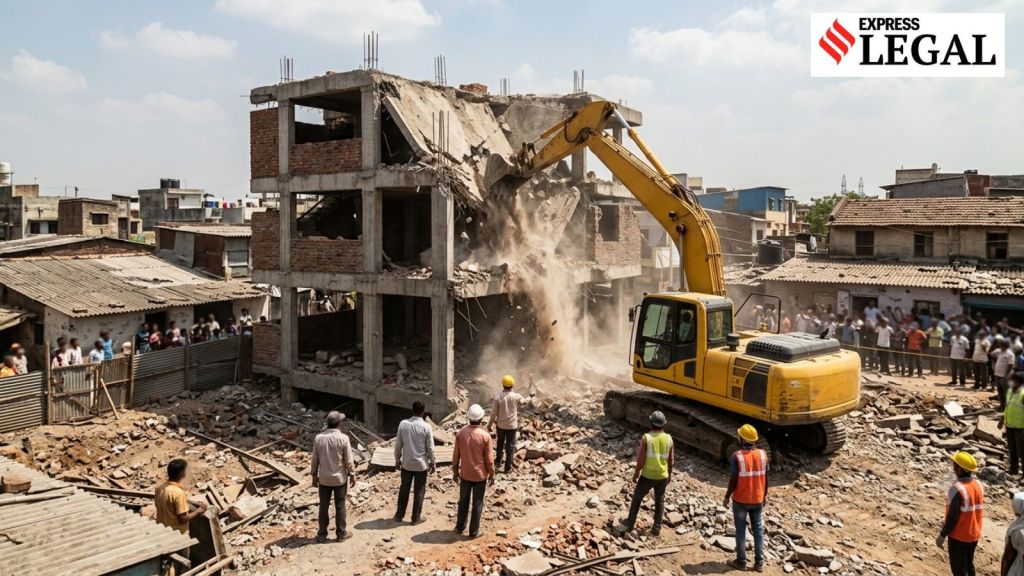


 Justice Partha Sarathi Sen observed that the demolition had affected the petitioners’ construction.
