


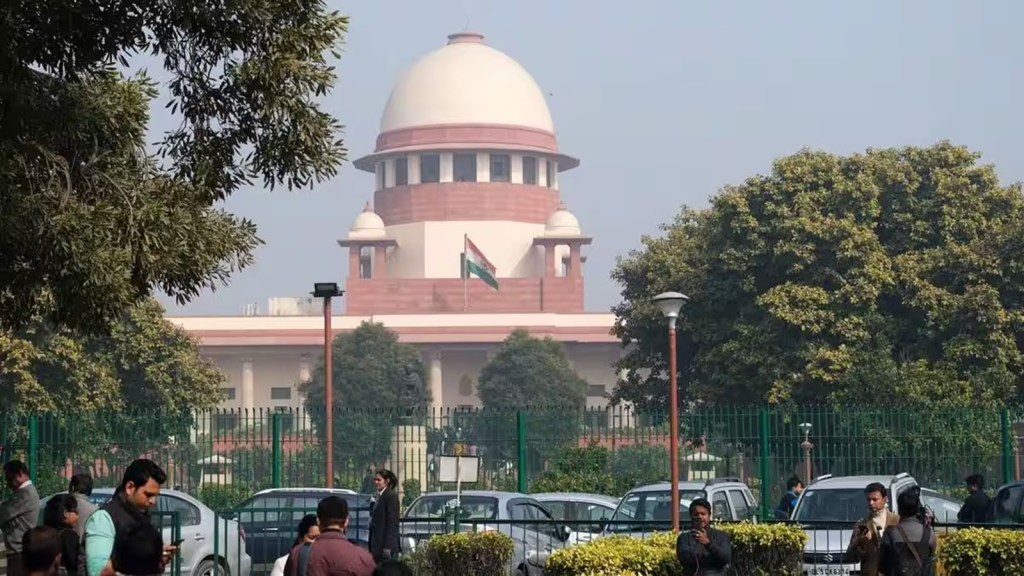
 Supreme Court takes cognisance of recent rape cases in Delhi.
The Supreme Court on Monday took suo motu cognisance of “deeply disturbing” news reports of recent rape cases in Delhi-National Capital Region (NCR), saying they “starkly underline a systemic failure on the part of law enforcement and civil administrative authorities to guarantee basic public safety.”
Taking note of the alleged rape of a minor in August on a sleeper bus, which travelled nearly 47 km from Greater Noida to Old Delhi’s Kashmere Gate, a bench of Justices J B Pardiwala and K Vinod Chandran said, “One cannot help but draw painful parallels to the 2012 Nirbhaya case, calling into question whether systemic law enforcement mechanisms have made any meaningful progress in the decade since then.”The top court referred to the gangrape and assault of a 23-year-old physiotherapy intern in a moving bus in South Delhi on December 16, 2012, which triggered one of the largest spontaneous public protests in India. The woman later died in a hospital in Singapore.
The alleged gangrape of a 17–year-old at Astha Kunj Park in Southeast Delhi by three men posing as policemen on September 21, and another gangrape-murder case from Northwest Delhi earlier this month were among the other incidents that court flagged during the hearing.
The court said the incidents “have raised serious concerns regarding the safety and security of public spaces in and around the city” and issued a series of directions for “examining the broader institutional failures” that may have led to the crimes.
It also asked the Delhi High Court to assign the mentioned cases to a designated fast-track special court, and to ensure that the trials are concluded expeditiously, preferably within a year.
As an interim measure, the top court asked Delhi Police Commissioner Anurag Kumar to “constitute dedicated police teams for each police district, headed by an officer not below the rank of Deputy Superintendent of Police, to conduct an immediate survey and inspection of vulnerable pockets…drawing up a districtwise vulnerability map and sharing it across adjoining police stations…appropriate patrolling and security arrangements at all identified public parks and vulnerable areas at all times a besides an immediate lighting and CCTV audit, in all public parks and vulnerable zones to eliminate blind spots”.
The interim measures have to be undertaken within four weeks, said the bench.
Referring to the South Delhi park gangrape case, the Supreme Court said, it has also brought to light pre-existing complaints of recurrent sexual harassment faced by students of Lady Shri Ram College for Women, situated in the immediate vicinity of Aastha Kunj Park. “Regrettably, these prior grievances failed to serve as a wake-up call for the police or the local administration to rectify institutional security lapses through enhanced patrolling and vigilance before yet another victim fell prey to unscrupulous perpetrators,” said the bench.
The court said that “the right to live with dignity, free from the fear of violence, is an intrinsic facet of the fundamental guarantee of life and personal liberty enshrined under Article 21 of the Constitution. Public spaces, including parks, roads, buses, metro stations, subways, foot bridges, etc. cannot be permitted to become zones of high risk due to grossly inadequate illumination, poor surveillance, lax patrolling, or other preventable administrative deficiencies.”
Even as statements made by public authorities and elected representatives expressing concern over these incidents are understandable, expressions of concern, devoid of accountability, fall short of answering the larger institutional question, said the court. “Expressing solidarity is not the solution to this social evil.
What is required is a measurable response, with responsibility and accountability fixed upon the authorities entrusted with prevention of crime, maintenance of public order and protection of vulnerable persons,” said the court.
The court emphasised that “public spaces suffering from inadequate illumination, deficient surveillance, or a lack of visible police patrolling and prompt interventional response mechanisms inevitably expose every citizen to heightened security risks.” “Where basic measures of public safety remain compromised, no individual, irrespective of age, gender, or sexual identity, can navigate public spaces with a sense of security. The primary obligation of the State and its instrumentalities is to maintain public spaces that are safe, accessible, and secure for all, while remaining particularly attentive to the heightened risks faced by children, women and other sexual minorities,” it said.
The bench made it clear that the scope of the.suo moto proceedings is not directed at assessing individual criminal culpability, but rather at examining the broader institutional failures that transcend any single case.
“The primary objective of the present proceedings is to evaluate whether effective systemic, preventive, and monitoring frameworks are currently in place to ensure safety in public spaces across Delhi-NCR,” it said.
It sought a comprehensive status report from authorities concerned on the measures presently undertaken to ensure adequate safety and security arrangements in public places, including parks, roads, public transport facilities, markets, educational institutions and other areas frequented by women and children, “the manner in which the National Database on Sexual Offenders (NDSO) is presently being utilised by the Delhi Police… and the manner in which the Ministry of Home Affairs is utilising the Investigation Tracking System for Sexual Offences (ITSSO), which was stated to have been launched as an online analytical tool for monitoring and tracking time-bound investigation in sexual-offence cases.”
The court said that the reports submitted shall not be confined to a description of the schemes or infrastructure existing merely on paper” but “clearly set out…whether it is presently operational; the geographical area and population covered; the officer or authority responsible for its implementation; the volume of complaints, calls, cases or interventions handled during the preceding three years; and the average response time, wherever measurable”.