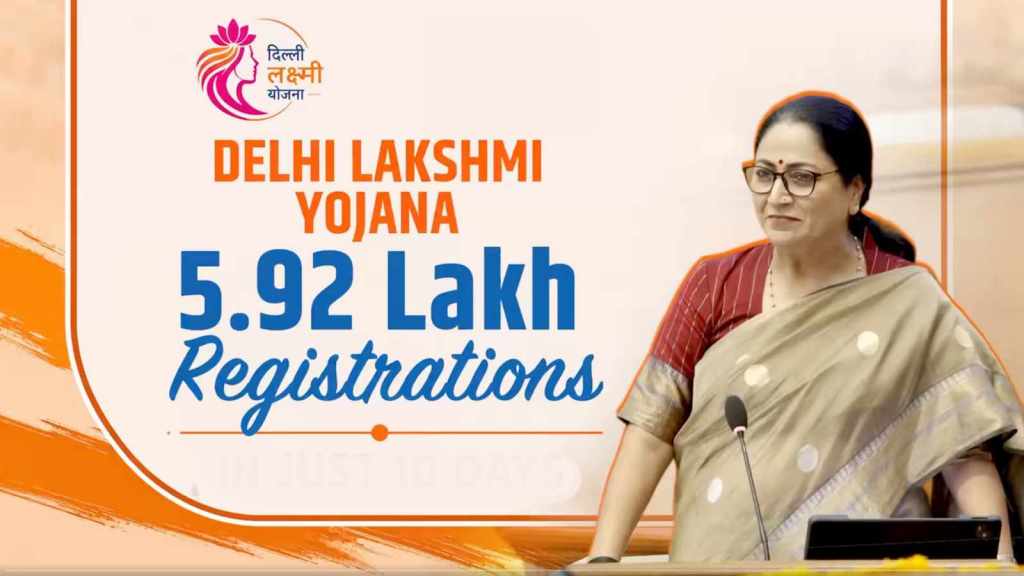
The Delhi government’s flagship Lakshmi Yojana was launched as a direct benefit scheme, promising eligible women in Delhi Rs 2,500 every month. But barely weeks after its launch, one condition attached to the scheme has made it face questions from the Delhi High Court: before a woman can be considered for the benefit, she must obtain an endorsement from her local MP or MLA.
For the second time in less than a week, the Delhi HC on Monday pressed the Delhi government to explain why access to a welfare scheme should require the backing of an elected representative.
“Suppose you don’t know any MP or MLA? If even one person is left out [because of the condition], then the scheme is arbitrary,” the bench of Chief Justice DK Upadhyaya and Justice Tejas Karia observed, asking the government what objective it sought to achieve through the clause. “There are thousands of ways you can identify people.”
The government had been expected to explain the rationale on Monday, after the court sought one on August 19. Instead, the bench directed it to file a short affidavit within 10 days explaining “what objective they are seeking to achieve by adding this clause.” The government has now been given 10 days to file its affidavit.
The government said it would place before the court its justification for the clause, including the Delhi government cabinet’s reasoning and practices followed in other states.
“..(the court) may not agree with us, but we are entitled to say how the cabinet has seen it and what the position is in other States…There is something we want to place on record, we will do it,” ASG Chetan Sharma told the court.
The plea
The court was dealing with a public interest litigation filed by former Congress municipal councillor Abhishek Dutt and sitting Congress councillor of the Aya Nagar ward, Vedpal Chaudhary, seeking the removal of the condition requiring a potential beneficiary to obtain an endorsement from an MP or MLA.
The direct benefit transfer scheme, launched on August 1, provides Rs 2,500 per month to eligible women. However, to be considered eligible under the scheme, one of the conditions includes a mandatory endorsement or recommendation letter from the local MP or MLA as a precondition for processing an application.
The petitioners have contended that this “confers an unbridled discretion upon political representatives and converts a state welfare entitlement into an instrument of political patronage”, adding that, unlike other government schemes, Lakshmi Yojana “introduces an unprecedented and restrictive layer of political gatekeeping.”
Other conditions for eligibility include mandatory ten-year continuous residency or domicile in Delhi, exclusion of women who have more than three living children, and disqualification on grounds of criminal antecedents.
The petitioners have flagged that “for women residing in informal settlements and marginalized colonies, such offices are often situated at considerable distances and are not adequately connected by last-mile public transport.”
“The requirement therefore entails repeated expenditure of time and money, disruption of household and livelihood responsibilities, and substantial physical and logistical hardship for women who are, by the very object of the Said Scheme, amongst its most vulnerable intended beneficiaries,” the petitioners say.
Highlighting that the scheme does not prescribe any SOP, statutory guideline or administrative framework to govern the manner in which a woman applicant has to approach the elected representative for the endorsement letter, the petitioners have flagged that the “absence of these basic procedural safeguards leaves women applicants without any certainty regarding the status of their requests..”



 Share


