


 As per the legal requirement, any citizen having completed a course,
equivalent to MBBS Course, abroad has to appear in a Screening Test for their registration as a
medical practitioner of allopathic system of medicine in India.
In a ruling with broad implications, the Delhi High Court recently upheld the National Medical Commission’s decision to bar Indian students who obtained medical qualifications after studying across multiple foreign institutions from appearing in the Foreign Medical Graduate Examination (FMGE). The court said such “qualifications will certainly amount to compromising the quality of medical professionals in the country”.
The examination is mandatory for Indians and Overseas Citizens of India (OCI) who obtain medical qualifications from abroad and want to register themselves in India to practice allopathic medicine.
In its ruling, the court held that such “fragmented education” wasn’t in “public interest” and dismissed the plea filed by the students who had challenged the decision of the medical commission holding them ineligible for the exam on May 14, 2025.
Chief Justice Devendra Kumar Upadhyaya and Justice Tejas Karia said that foreign medical degrees must be attested by the Indian Embassy or apostilled by the appropriate authority in the country where the degree was issued, as required under the FMGE Information Bulletin.
An apostilled document carries an official government certificate attached to it that proves the signature and seal on the document are real so it can be used in another country.
The FMGE Information Bulletin is the official rulebook and guide published by the National Board of Examinations in Medical Sciences (NBEMS) that details the eligibility criteria, application procedures, exam patterns, and important dates for the Foreign Medical Graduate Examination.
The September 3 judgment penned by the Chief Justice observed, “Any medical qualification based on a fragmented study in different medical colleges, which in this case are two to three different foreign medical colleges, if treated as an eligible PMQ, the same will not be in public interest as it will certainly amount to compromising the quality of medical professionals in the country.” The order underlined that the exam board must verify candidates’ qualification documents so it can block anyone using fake certificates from taking the test.
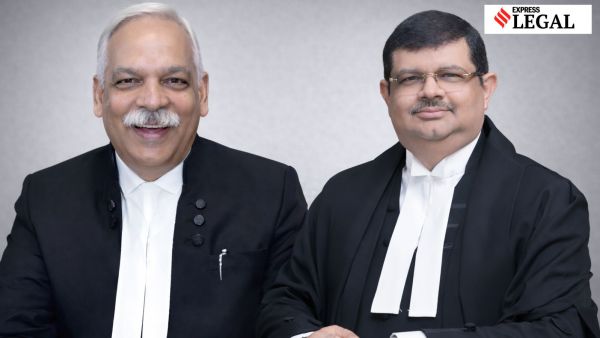 Chief Justice Devendra Kumar Upadhyaya and Justice Tejas Karia denied the petitioners seeking to appear in FMGE based on fragmented studies undergone by them at various foreign medical institutions.
The students (petitioners) appearing before the High Court were Indian citizens who studied medicine in foreign medical colleges and wanted to appear for the Foreign Medical Graduate Examination (FMGE) so that they could register and practise medicine in India. Their challenge was against the rule requiring foreign medical degrees to be attested/apostilled, and the rule that excluded foreign medical institutions not confirmed by the Indian Embassy.
They said they had initially studied at Micronesia Medical College and then gone to other foreign institutions, including Belize Medical University, due to unavoidable circumstances, including the “Covid-19 pandemic, the civil war, the Russia-Ukraine war” apart from other personal reasons. They eventually obtained a medical qualification from Micronesia Medical College.
When they applied for the FMGE in June 2023, they were not allowed to appear because the Indian Embassy had not attested their Micronesia qualification. They again submitted a qualification obtained from Belize Medical University while applying for FMGE in December 2023. According to the medical commission’s regulations, students can apply for the exam twice in year in the months of June and December.
Upon scrutiny, the authorities found that the petitioners had produced qualifications from two different institutions covering the same period of study and held them ineligible for the exam.
The matter was appealed by the students before the National Board of Examinations in Medical Sciences Examination Ethics Committee, which declared them ineligible via a May 14, 2025 communication.
Senior advocate Manish Singhvi and advocates Satish Pandey and Jay Jamini, argued that the Indian Medical Council (IMC) Act, 1956 does not prescribe that the foreign medical degree possessed by an Indian citizen, awarded by a foreign medical school, should be attested by the Embassy of India or should be apostilled by the appropriate authority of the foreign country concerned.
They also contended that the Belize Medical University had accepted the credits they had earned at Micronesia Medical College under an MoU and had issued a certificate validating their medical qualification. Therefore, the authorities should have allowed them to take the FMGE.
Appearing for the National Medical Commission, senior advocate Bishwabandhu and advocates Bipul Kumar and Nisha submitted that the Embassy-authentication requirement was necessary to ensure that foreign medical qualifications were genuine and came from institutions meeting acceptable standards.
The commission’s counsel claimed that Micronesia Medical College had a “grossly inadequate infrastructure”, including a namesake laboratory, absence of proper faculty and institutional set-up, and the institution was functioning from a floor in an old building; therefore, these facts fully justify the necessity of the confirmation of the primary medical qualifications (PMQ) by the Indian Embassy.
Such fragmented education, the commission said, produces half-baked professionals and, therefore, any Indian citizen having obtained such medical education in a foreign medical school or multiple foreign medical schools cannot be permitted to be treated as eligible for taking the screening test, as no such medical professional can be allowed to play with the health of the people.
After hearing both sides’ arguments, High Court found “no reason to interfere” with the decision of the medical commission, pointing out such a verification helps the examination authorities keep candidates with fake or false medical degrees from appearing in the FMGE and the dismissed the students’ case.